
Whywait Plumbing Services Logo

OFFICE HOURS

Mon to Fri 7.30am – 4pm
24-Hour EMERGENCY SERVICE

CALL 7 DAYS FOR SERVICE!

YOUR TRUSTED GOLD COAST PLUMBERS & GAS FITTERS

OFFICE HOURS
Mon – Sun 7.30am – 4pm
24 Hr Emergency Service

Burst Pipe in Your Apartment? Who’s Legally Responsible

Burst Pipe in Your Apartment? Who’s Legally Responsible

Water is coming through your ceiling, and you need two answers fast:

✅  How do I stop it?

✅  Who pays?

If you lived in a house, both answers would be simple. You’d turn off the main, call a plumber, and the bill would land on your kitchen bench.

In a Queensland apartment, it’s rarely that clean. We’ve attended jobs where a single burst pipe pulled in three owners, a body corporate committee, a building manager and two insurers. All before anyone had even found the leak.

Responsibility depends on where the pipe is located, who it serves, and what the building’s registered survey plan says. And the source of the leak is often nowhere near the damage. Water dripping into your bathroom might be coming from a failed flexi hose two floors up, a shared riser, or a body corporate pipe buried in the slab.

The Gold Coast is full of owners going through this for the first time. Plenty of people are moving out of standalone homes into apartments, and suddenly they’re dealing with common property, exclusive-use areas, bylaws, and access rules they’ve never heard of. Nobody explains any of it at the settlement. The first lesson usually arrives with the first leak.

Speed matters because water damage compounds by the hour. But access and repair approvals still have to follow Queensland body corporate law and the scheme’s registered documents. Even in a genuine emergency.

This blog walks through who pays, who gets access and what happens next, so you know the process before you’re standing in a wet hallway trying to work it out.

**Important:** This is general information, not legal or insurance advice. Every community title scheme is different. Check your community management statement, by-laws, survey plan and insurance arrangements.

Why apartment plumbing becomes complicated

Water doesn’t respect lot boundaries. A leak can show up in your bathroom after starting several floors above, and a blocked drain that affects one unit today can back up into three units by the weekend.

The damage you can see rarely tells you who’s responsible for fixing it. Depending on the building, a single leak can involve the apartment owner, a tenant, a property manager, the body corporate, the neighbours, the building manager, a licensed plumber, and one or more insurers. With that many parties in the mix, arguments about who pays can drag on while the water keeps moving.

That’s the trap. The smartest first move is almost always the same: 

✅ control the water, 

✅ document everything, 

✅ identify exactly which pipework failed. 

Sort out the money afterwards.

Is this a strata problem or a body corporate problem?

Most people say ‘strata’. It’s the term used in New South Wales and Victoria, and it’s stuck. In Queensland, the legal structure is actually called a “community titles scheme”, and a body corporate manages its shared affairs.

The building’s survey plan and community management statement define each lot and the common property. In many multi-storey buildings, the lot boundary runs through the centre of the floors, walls and ceilings that separate the units.

That boundary matters, but on its own, it won’t answer your plumbing question. You also need to know who the pipe serves and where it physically sits. Those two things trip people up constantly.

Who is responsible for apartment plumbing in Queensland?

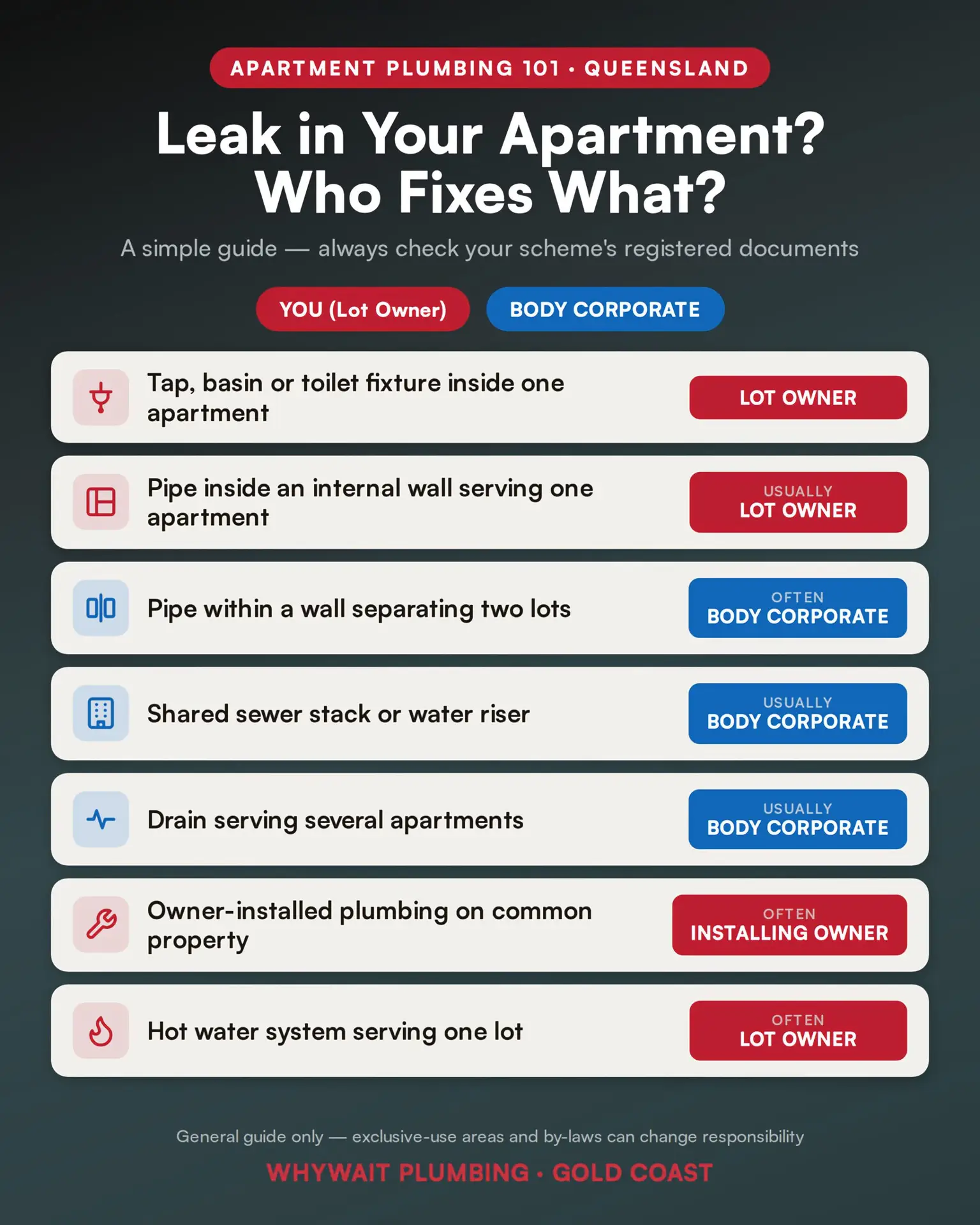
The body corporate is usually responsible for plumbing that forms part of the common property.

In practice, that tends to mean pipes, drains, or sewers that serve more than one apartment, sit within a boundary wall, floor, or ceiling, or form part of the building’s shared system.

A lot owner is generally responsible for the pipework that serves only their apartment, sits within their lot, and isn’t inside a boundary structure. A failed flexi hose under your vanity? That’s yours, and for what it’s worth, braided flexi hoses are one of the most common causes of flooding we see in apartments.

The shared sewer stack behind your bathroom wall? Almost certainly the body corporate’s.
burst pipe apartment, who is responsible

Treat these as starting points, not rulings. Queensland law contains exceptions:

✅ exclusive-use areas,

✅ owner-installed improvements,

✅ older building arrangements that can shift responsibility.

The scheme’s registered documents are what count.

The location of the water damage may mislead you

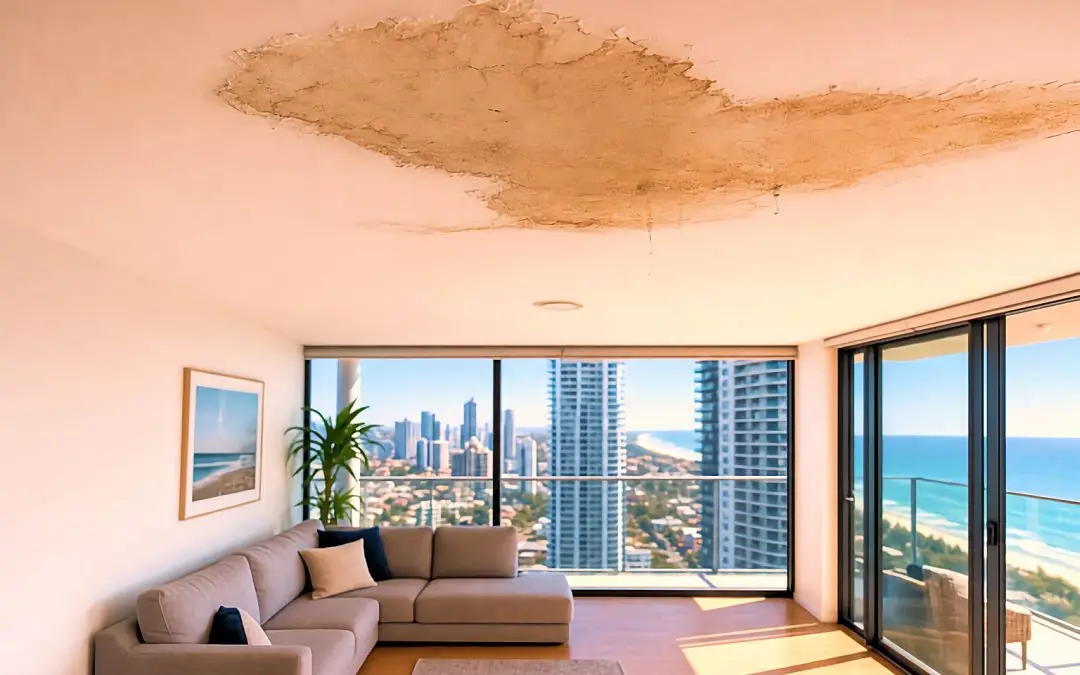
Picture water coming through the ceiling of a Broadbeach apartment. The wet ceiling belongs to one unit, but the leak could be coming from the apartment above, a shared water riser, a failed shower connection, a body corporate pipe inside the slab, or simply an overflowing bath caused by an occupant who got distracted.

Each of those causes creates distinct repair and insurance pathways. We’ve seen owners spend weeks blaming the wrong neighbour before anyone put a camera in the wall.

So resist the urge to argue about payment before you’ve found the source. A licensed plumber can isolate the likely cause and record what they find.

Photos, moisture readings and camera inspection footage feel like overkill on the day. They become the most valuable documents in the building once insurance claims begin.

Can a plumber enter another apartment?

Not just because a pipe crosses into it, no. But Queensland law does give the body corporate specific access powers.

The body corporate may authorise someone, including an external plumber, to enter a lot when it’s necessary to inspect or carry out work the body corporate is authorised or required to do. That authority can come through a committee resolution or an ordinary resolution.

For non-emergency access, the body corporate generally has to give the owner or occupier at least “seven days’ written notice”, and entry must happen at a reasonable time.

A decent notice spells out who needs access, the proposed date and time, how long the work should take, why entry is required, and who the resident can contact with questions.

In our experience, most access disputes never happen when that notice is clear, and someone actually picks up the phone beforehand.

What happens during a plumbing emergency?

Emergencies run under different rules. An authorised person may enter at any time during an emergency, with or without written notice. But the body corporate must still authorise that person. The authorisation requirement doesn’t disappear just because water is moving.

The legislation doesn’t define every emergency, so urgency depends on the facts. A burst shared pipe flooding several apartments obviously justifies rapid entry. A slowly dripping tap doesn’t, no matter how annoying it is.

Even in an emergency, the body corporate should contact the occupant immediately, where possible and explain the risk, the work required and who will be entering.

Emergency access is a legal power, not an excuse to skip basic courtesy.

Can an owner or tenant refuse access?

Owners are entitled to question whether an entry is lawful or genuinely necessary. But once the body corporate has properly authorised entry and given the required notice, the authorised person has a legal power to enter. The owner doesn’t need to be home, and they don’t need to consent again.

Obstructing an authorised person may be an offence, and the body corporate can pursue dispute resolution through the Commissioner for Body Corporate and Community Management in Queensland.

None of that means a plumber should force their way in. We won’t, and no reputable plumber will.

Access should be coordinated by the body corporate or its authorised representative, and any disagreement should be documented and handled through the proper process, not on the doorstep.

What should happen when water is actively leaking?

When water is spreading, forget about blame and focus on safety and damage control.

1. Reduce the immediate damage: Turn off the relevant isolation valve if it’s safe to reach. Don’t touch electrical fittings near water, and call emergency services if there’s immediate danger.

2. Notify the right people: Contact the building manager, body corporate representative, owner or property manager. Whoever applies to your situation. Tenants should report the problem to their property manager promptly and follow any building emergency procedure.

3. Engage a licensed plumber: Most plumbing and drainage work in Queensland is regulated, and an appropriately licensed plumber or drainer must perform it.

4. Identify the source: Finding the source matters more than blaming the nearest apartment. The plumber may need access above, below or beside the visible damage, so start those conversations early.

5. Record everything: Keep photographs and videos, access approvals, emails and text messages, the plumber’s findings, invoices and work orders, before-and-after photos, and records of any affected belongings.

Good records don’t create conflict. They shut it down.

Queensland plumbing compliance still applies

The pressure of an apartment emergency doesn’t exempt a plumber from their compliance obligations.

Queensland divides regulated plumbing into permit work, notifiable work and minor work, and each category carries its own approval or registration requirements. The National Construction Code and the associated Australian Standards sit beneath it all.

Where work is notifiable, the plumber must register it with the Queensland Building and Construction Commission (QBCC) generally within ten business days of issuing the invoice, and the client or occupier must receive the required documentation within the prescribed timeframe.

Before work starts, it’s worth asking your plumber whether the job requires City of Gold Coast approval, QBCC notifiable work registration, body corporate approval, access to another lot, water-shutdown coordination, or follow-up testing and inspection.

A small repair can affect an entire building. The paperwork is part of doing it properly, not an optional extra.

Who pays for water damage?

Here’s a distinction that catches nearly everyone out: repair responsibility and damage responsibility aren’t the same thing.

One party may pay to fix the failed pipe while a completely different policy covers the ruined flooring, paint or belongings. Payment can turn on:

🚨 whether the pipe is common property,

🚨 whether it serves one lot or several,

🚨 what caused the failure,

🚨 whether negligence or delay made things worse,

🚨 what the body corporate policy covers,

🚨 what the owner’s contents or landlord’s coverage picks up,

🚨 what excesses and exclusions apply.

Whatever you do, don’t assume the body corporate insurer will pay for everything. Notify the relevant insurers promptly and provide the plumber’s written findings and photographs.

Hold off on major reinstatement until responsibility is clearer, unless urgent work is needed to stop further damage.

Common mistakes that make apartment leaks worse

❌ Waiting for the next committee meeting: Active water damage rarely waits politely. The committee can approve necessary work without holding everything over to a general meeting.

❌ Sending a plumber without organising access: A plumbing technician standing outside a locked apartment cannot diagnose hidden pipework. We know, because we’ve been that plumbing technician. Confirm approvals, contact details, keys and resident availability first.

❌ Assuming the upstairs owner caused the leak: Water travels along slabs, pipes and building cavities in ways that surprise people. The apartment above may also be affected, and may not be responsible at all.

❌ Starting repairs before defining the scope: Opening walls without confirming authority can create a second dispute on top of the first. Work out whether the job involves common property or another lot before anyone picks up a saw.

❌ Relying only on verbal agreements: Memories become surprisingly foggy once ceilings, carpets and invoices are involved. Keep approvals in writing.

A practical checklist for Gold Coast apartment owners

Before the plumber arrives, gather:

1:  The exact location of visible water or blockage symptoms.

2:  Photographs and video of the affected area.

3:  Body corporate and building manager contact details.

4: The apartment owner or property manager’s details.

5:  Any available plans or previous repair reports.

6:  Written access authority where another lot is involved.

7:  Details of any water shutdown restrictions.

8:  Insurance claim numbers, when already issued.

Twenty minutes of preparation can save hours on site and prevent repeat visits and unnecessary holes in walls.

What Whywait Plumbing does differently

Apartment plumbing takes more than tools and fittings. Most of the hard part is communication:

who’s affected,

who decides,

who pays,

who needs to know what before anything gets opened up.

Whywait Plumbing Services helps Gold Coast owners, property managers and bodies corporate with leaking and burst pipes, blocked apartment drains, shared sewer problems, water leak investigation, hot water faults, CCTV drain inspections, and plumbing repairs and compliance work.

We explain what we find in plain English. And where responsibility is unclear, we separate the facts from the assumptions, so owners and committee members can make their next decision on solid ground rather than guesswork.

Frequently Asked Questions

No. Responsibility depends on the wall, the lot boundary and who the pipe serves. A pipe inside an internal wall serving one apartment may remain the owner’s responsibility.

In certain circumstances, yes. The body corporate must properly authorise the entry, and non-emergency entries generally require at least 7 days’ written notice. Different rules apply during emergencies.

Report the problem promptly to the property manager or owner. Where common property may be involved, the body corporate should also be notified. Emergency water damage may require all three parties to coordinate simultaneously.

Most regulated plumbing work in Queensland requires a QBCC-licensed plumber or drainer.

For active flooding, contact both immediately. For a non-urgent issue involving common property, notify the body corporate before arranging any invasive work.

Don't let a small leak become a building-wide problem

Apartment plumbing problems get expensive when responsibility, access and repairs aren’t coordinated, not because the plumbing itself is complicated.

Start with the facts. Control the water, notify the right people, and use a licensed plumber who documents their findings.

For burst pipes, apartment plumbing, blocked drains or hot water problems across the Gold Coast, contact Whywait Plumbing Services.

Early investigation usually creates more options and fewer ruined ceilings.

Why wait? Experienced Gold Coast Plumbers have expertise, skills and knowledge

Why wait? Experienced Gold Coast Plumbers have expertise, skills and knowledge

DIY plumbing is no match for real Gold Coast Plumbers with experience, skills, knowledge and expertise

Plumbing issues are never easy to deal with, but the temptation to handle them yourself and get all the materials you need from Bunnings can be intense. After all, why pay a professional when you can save money by fixing the problem on your own?

However, when it comes to plumbing, taking the DIY route can often lead to more significant issues and expenses in the long run.

That’s why hiring real Gold Coast plumbers with the necessary experience, skills, knowledge, and expertise is crucial to getting the job done right the first time.

An expert plumber’s experience and knowledge is the key to tackling plumbing problems

There’s no substitute for experience and knowledge when it comes to plumbing problems. Expert Gold Coast plumbers who are experienced plumbers bring a wealth of practical know-how to the job, with years of experience tackling multiple issues. Whether it’s a leaking tap, a blocked drain, no hot water or a burst pipe, an experienced plumber has the skills and expertise to assess the problem quickly and provide an effective and efficient solution.

Not only does an experienced plumber possess the technical know-how to solve plumbing problems, but they also bring a deep understanding of the broader issues at play. This can include everything from City of Gold Coast plumbing requirements and regulations to environmental concerns and best practices for maintaining plumbing systems over the long term.

By relying on an experienced plumber, clients can feel confident that their plumbing problems will be addressed in a way that solves the immediate issue and considers their long-term needs and goals.

Ask any real Gold Coast plumbers how incomplete or inaccurate DIY plumbing solutions from Bunnings or Google for plumbing problems can backfire

While the internet can provide a wealth of information on a range of topics, including DIY plumbing solutions, it is essential to exercise caution when relying on Google. Of course, the nice man at Bunnings may listen attentively and sell you various solutions. Still, they are a hardware supermarket, not a licenced plumber who visually inspects your problem.

Incomplete or inaccurate information can lead to costly mistakes and even potentially dangerous situations when it comes to plumbing problems. In addition, it’s important to remember that plumbing systems are complex, and what may seem like a simple fix can require a deeper level of understanding and experience to resolve correctly.

Don’t disrespect a plumber’s expertise and experience by haggling about their prices

It’s an unfortunate occupational hazard for plumbing businesses that a business you’ve worked for resorts to dishonesty to avoid paying its tax invoice for the work undertaken. Thankfully, a recent experience with a dental practice is generally the exception, not the rule. In this case, the dental practice in question attempted to spin a web of lies to justify their non-payment. It’s frustrating for everyone involved, but it’s important to remember that such behaviour is disrespectful and unprofessional.

Can you imagine the repercussions and reaction if you attempted to withhold payment from the dentist under the pretext of discrediting their expertise and accusing them of incompetence and grossly overcharging?

It’s common for some clients to attempt to negotiate a lower price for our services. Still, there’s a difference between negotiating in good faith and trying to manipulate the situation through dishonesty.

When a business such as a dental practice attempts to beat a plumber’s price down deceitfully, they disrespect the experience and expertise that the plumber brings to the job. It’s important to remember that a plumber’s price is not just for the service they provide but for the years of training and knowledge they bring to the table. Disrespecting their price is disrespecting their value as a professional plumber.

A Plumber's Perspective: A Conversation with a Client on Solving Plumbing Issues and The Ulimate Cost of The Work

G’day mate, now that you’ve looked at everything on my existing hottie, how much for replacing it with a new one?

Well, it’ll cost you $5230, mate.

What? That’s too much! That’s a bloody fortune! Can’t you do it cheaper?

I understand, but this is a big job. So we’re not just slapping a band-aid on it. We’re fixing it properly.

Fair enough, but I reckon it’s a simple job. I’ve Googled it, and all the experts consider $2000 up to $3000 as a fair price. So how about $2500?

I appreciate your opinion, mate, but unfortunately, I can’t do it for that little. I would be better off staying in bed than coming here to work at a loss. Unlike all your Google experts, I’ve eyeballed what is required to properly replace your hot water system and comply with the Plumbing and Drainage Act. But I have a proposition for you. For $1500, I can teach you how to do it yourself.

Teach me? I don’t even know where to start! I work with my brain, not my hands, I’m a financial planner, so I’m not exactly a tradie, mate.

No worries, mate. For $1500, I’ll teach you everything you need to know. It’ll be like a DIY Bunnings sausage sizzle. Plus, you’ll get the knowledge and experience to do it yourself next time.

Alright, I’m game. What do I need to do?

First, you’ll need tools like a pressing tool, battery drill, half-inch benders, screwdrivers and shifters, PPE, a trolley to move the gear around the house and a few other hand tools.

Crikey! I don’t have any of those.

No problem, mate. I can rent them to you for another $1300. So you’re still saving $2430 in the end.

Cool, I’m in, then. Sounds like a good deal. When can we start?

I’m available on Saturdays.

Saturday? But I have plans on Saturdays! It’s my weekend…my day off to spend with the family.

I’m sorry, mate. Saturdays are my teaching days for teaching Bunnings weekend warriors. And if you’re doing it yourself, you’ll need to get up early and get the gear we need for the job from Tradelink at 6.30, so we can start by 9.

That’s a bit rough, mate. Saturday is usually my sleep in morning. Can’t we get the gear from Bunnings?

Sorry mate, if we’re going to fix this correctly, you need suitable quality materials from an actual plumbers merchant.

I don’t have any free Saturdays coming up. Can’t we do it on a weekday?

No. As I said, Saturday is my only free day to teach you. Also, you’ll need a truck to transport the gear.

A truck? I don’t have a truck! I have a Tesla!

It looks like you’ll have to rent one. And the gear is pretty heavy to lift, so you will need some of your mates to come over to help you load and unload the truck.

I really don’t think I can ask my friends, they’re all professionals, not manual labourers, to do that. Can’t we do it on a weekday, and I’ll hire some guys off Airtasker?

I’m afraid not, mate. I’ve got other jobs during the week. However, I have good news for you! You can hire me to do it on a weekday if you’d like.

Really? That sounds like a better idea. But how much will that cost?

Well, it’ll cost you $5230, just like I said at the beginning.

C’mon mate, that’s too expensive! All the experts on Google agree.

I understand, mate. But you’re not just paying for a job. You’re paying for the knowledge, experience, equipment, tools, time, employees and family sacrifices I bring.

I guess you’re right. You know what? I’ve been thinking. It probably is better for you to do the job. It’s better to pay you to do the job right and not have to go through all that hassle.

Sensible decision, mate. Don’t worry, we’ve got you covered, mate. When you hire us, you’re not just paying for the job. You’re paying for our experience, expertise and everything we bring to the table with the tools in the back of the ute.


Some advice to plumbers reading this blog – “As a Gold Coast plumber, you know your worth. Don’t let anyone tell you otherwise – you’re worth every cent. After all, you’re the professional expert here – you know the costs to keep your business running smoothly. So value your services appropriately and do not undersell yourself as a professional licenced plumber.”


Mutual respect and professionalism are essential for every successful business relationship

As a Gold Coast plumber and business owner with 46 years of experience, I’ve seen first-hand how negative stereotypes can affect people in different professions, trades, and occupations. As a result, I believe in treating everyone as I expect to be treated and in giving people the benefit of the doubt until they give me a reason not to trust them.

Sadly, it’s all too common to hear someone say, “I’m just a…”, which sends a subliminal message that their work is of lesser value. But every occupation requires unique skills and expertise, and it’s essential to avoid making generalisations or assumptions about any profession based on these stereotypes.

One thing that bothers me is how certain professions are viewed as less prestigious or essential than others. This can lead to unfair judgments and undervaluation of people in those occupations. To build a positive business-to-client relationship and create a culture of mutual respect, we must actively listen to each other, communicate effectively, and find common ground to create a solution that is beneficial to everyone. By doing so, we can break down barriers and work together towards a more inclusive and collaborative business relationship.

We must also recognise how negative stereotypes can affect people in different professions, trades, and occupations. Therefore, it’s essential to treat everyone with respect and professionalism, regardless of their job title or position. Doing so can create a more supportive and inclusive environment for all.

A true Gold Coast plumber stands as a beacon of quality and trustworthiness

As we wrap up this exploration into the hallmarks of a genuine Gold Coast plumber, we cannot overemphasise the importance of expertise, skills, experience, and knowledge in this field.

As you navigate the often complex waters of plumbing issues and maintenance, remember that a true Gold Coast plumber stands as a beacon of quality and trustworthiness. They embody a rich blend of technical proficiency and a deep understanding of the local nuances, committed to delivering not just solutions but peace of mind.

In a realm where precision and reliability are non-negotiable, settling for anything less than experienced Gold Coast plumbers is not an option. Stay informed, choose wisely, and safeguard your home’s plumbing integrity with a professional who bears the genuine mark of excellence and reliability.

The Future of Flushable Products: A Comprehensive New Standard AS/NZS 5328:2022 Flushable Products

The Future of Flushable Products: A Comprehensive New Standard AS/NZS 5328:2022 Flushable Products

New Flushable Products Standard: A Win for Whywait Plumbing and Our Customers Introduction

Here at Whywait Plumbing, we have long advocated for clear guidelines around using and labelling flushable products. But unfortunately, we’ve seen far too many instances of blockages, overflowing drains, and the ensuing damage to properties and infrastructure due to the misuse of such products.

So from our perspective, sharing the recent news about releasing the new Flushable Products Standard is positive. After all, We’ve done media interviews on this, plus written countless blogs and newsletter articles:

The Water Services Association of Australia (WSAA) has released the new Flushable Products Standard (PAS 2845.1:2022), which provides manufacturers and consumers with clear guidance on the proper use and disposal of flushable products. In this blog post, we’ll explore the critical aspects of this new Standard and discuss how it aligns with Whywait Plumbing’s long-held beliefs on the issue.

The Importance of the Flushable Products Standard

Addressing the Drain Blockage Problem

Whywait Plumbing has been advocating for these changes mainly because of the immense problem of drain blockages caused by flushing inappropriate items down the toilet. According to the WSAA, approximately 75% of sewer blockages are caused by flushing non-flushable items, costing millions of dollars annually to rectify.

This has led to environmental issues and costly repairs for homeowners and local water authorities. The new Flushable Products Standard aims to reduce the incidence of blockages and save money for everyone involved, making it a welcome development for plumbers and homeowners alike.

Clear Guidelines for Manufacturers

One of the critical aspects of the new Standard is the provision of clear guidelines for manufacturers of flushable products. This includes stringent testing requirements to ensure that only genuinely flushable products can be marketed as such. The Standard also mandates clear labelling, helping consumers make informed choices about what they flush down their toilets.

This means that manufacturers will now have to adhere to these guidelines, ensuring that their products meet the criteria to be deemed flushable. This will help reduce the number of inappropriate items being flushed, leading to fewer blockages and plumbing problems.

How Will The Symbol Be Displayed

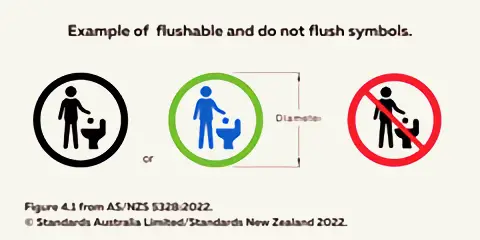
The symbols for packaging indicating that a product has passed the criteria in the Standard and is safe for flushing can vary. However, they are typically simple, easily recognisable icons that convey the message. For example, for products that are safe to flush, the symbol might consist of a toilet with a checkmark, signifying that the item can be flushed without causing harm to the plumbing system or the environment.

Conversely, if a product is unsuitable for flushing, the symbol might depict a toilet with a crossed-out circle, indicating that the item should not be flushed. This “do not flush” symbol is crucial for products with a high potential to be flushed, as it helps inform customers about the appropriate disposal method.

In both cases, the symbol should be prominently visible on the on-shelf package, unobscured by packaging seals or folds, ensuring that consumers can quickly identify whether the product is flushable. Again, the goal is to provide consumers with clear, easily understood information, helping them make responsible choices for their plumbing systems and the environment.

flushable products standard

How Does A Product Qualify to Be Flushable?

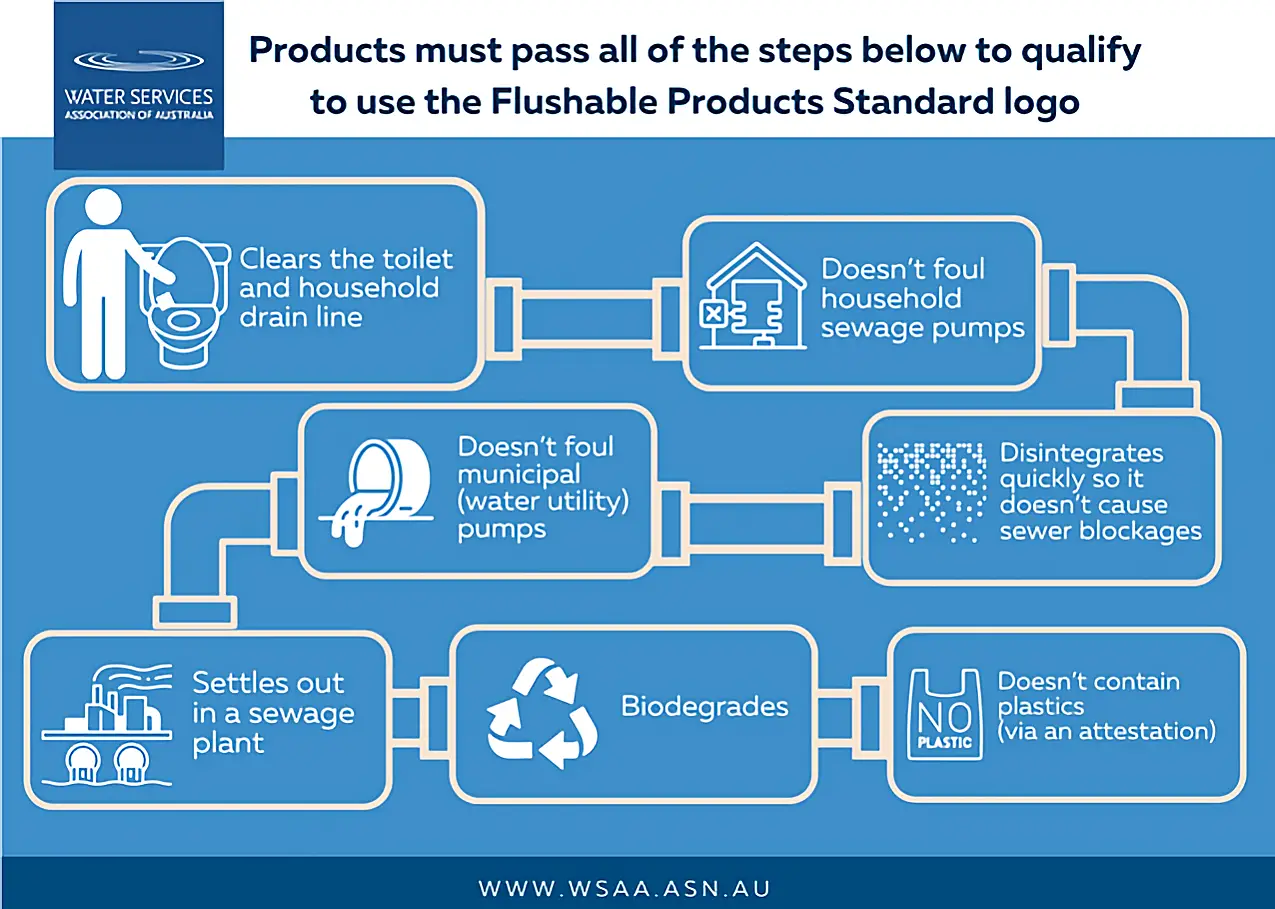
To qualify for the new Flushable Products Standard and display the flushable logo, products must undergo a series of tests and meet specific criteria outlined in the Standard. These tests ensure the product is safe for flushing and will not harm the plumbing system or the environment. Here are the seven steps a product must pass to qualify:

  1. Clears the toilet and household drain line: The product must pass through the toilet and the household drain line without causing blockages or damage to the plumbing system.
  2. Doesn’t foul household sewage pumps: The product must not clog or interfere with the proper functioning of household sewage pumps.
  3. Disintegrates quickly to prevent sewer blockages: The product must break down rapidly once it enters the sewer system to ensure that it does not cause blockages or damage to the sewer infrastructure.
  4. Doesn’t foul council sewer water utility pumps: The product must not cause any problems or blockages in municipal water utility pumps, ensuring that the more extensive sewage treatment system remains functional.
  5. Settles out in a sewage plant: The product must settle out in a sewage treatment plant, allowing it to be correctly processed and treated without causing issues in the sewage plant.
  6. Biodegrades: The product must be able to biodegrade naturally, ensuring that it does not contribute to environmental pollution or harm aquatic life.
  7. Doesn’t contain plastics (via an attestation): Manufacturers must attest that their product does not contain any plastics, helping to reduce the amount of plastic waste entering our waterways and sewer systems.

By meeting these requirements, a product can qualify for the Flushable Products Standard and display the flushable logo on its packaging. This provides consumers with clear information about the product’s suitability for flushing, helping them make responsible choices for their plumbing systems and the environment.

flushable products standard testing requirements

How the Flushable Products Standard Aligns with Whywait Plumbing’s Beliefs

Prioritising the Health of Our Waterways and Infrastructure

At Whywait Plumbing, we have always believed in maintaining the health of our waterways and infrastructure. The new Flushable Products Standard is a significant step in this direction. It will help prevent the clogging of our sewer systems and the pollution of our waterways with non-flushable waste.

By ensuring that only genuinely flushable products can be marketed as such, we can collectively reduce the strain on our water infrastructure and preserve the environment for future generations.

Empowering Consumers with Accurate Information

Another critical aspect of the Flushable Products Standard that aligns with our beliefs is the focus on providing consumers with accurate information about the products they use. With precise labelling requirements, consumers will be better informed about which items are safe to flush and which should be disposed of in other ways.

This empowers individuals to make better choices for their homes and the environment, helping to reduce the number of blockages and plumbing issues caused by flushing inappropriate items.

A Positive Step for the Plumbing Industry and the Environment

The release of the Flushable Products Standard (PAS 2845.1:2022) is a significant milestone in the fight against drain blockages and the associated environmental and financial costs. By providing clear guidelines for manufacturers and empowering consumers with accurate information, this Standard will help to reduce the number of blockages caused by non-flushable items.

As a long-time advocate for these changes, Whywait Plumbing is delighted to see this progress. It remains committed to promoting responsible flushing practices and educating our customers about the importance of these new guidelines. We believe this Standard will positively impact the plumbing industry, the environment, and the overall health of our water infrastructure.

Our Commitment to Client Education

At Whywait Plumbing, we understand that many of our customers may not be aware of the new Flushable Products Standard and the implications it has for their daily lives. As a result, we are dedicated to educating our customers about the importance of following these guidelines and how they can help prevent blockages and protect the environment.

We will update our website, social media channels, and other educational materials to reflect the latest information on flushable products and the new Standard. Additionally, our team of skilled plumbers will be available to advise and answer any questions our customers may have regarding the proper use and disposal of flushable products.

Future Developments and Ongoing Advocacy

While releasing the Flushable Products Standard is a significant achievement, we at Whywait Plumbing believe there is always room for improvement and further progress. Therefore, we will continue to advocate for stricter guidelines, increased public awareness, and ongoing research into developing truly flushable products that do not harm our waterways and infrastructure.

We will also remain vigilant in monitoring the implementation and enforcement of the new Standard, ensuring that manufacturers comply with the guidelines and that consumers have access to accurate and up-to-date information. We aim to be crucial in driving positive change within the plumbing industry and beyond by staying active in this space.

Tips for Preventing Drain Blockages

While the Flushable Products Standard is a significant step in the right direction, everyone needs to play their part in preventing drain blockages. Here are some practical tips for ensuring your plumbing system stays in top shape:

Only flush the “Three P’s”: Always remember that the only items that should be flushed down the toilet are pee, poo, and toilet paper. Everything else, including wet wipes, facial tissues, and sanitary products, should be disposed of in the trash.

Dispose of fats, oils, and grease (FOG) responsibly: FOG can solidify in your pipes and cause blockages. Instead of pouring them down the sink, collect them in a container and dispose of them in the trash once cooled.

Install drain screens: Placing a drain screen over your sink, shower, and bathtub drains can help catch hair, soap scum, and other debris, preventing them from entering your pipes and causing blockages.

Schedule regular plumbing maintenance: Having a professional plumber inspect and clean your plumbing system regularly can help identify and address potential issues before they become significant problems.

Whywait Plumbing: Your Partner in Responsible Plumbing Practices

As a company that has long advocated for responsible plumbing practices and the proper use of flushable products, Whywait Plumbing is proud to support the implementation of the new Flushable Products Standard. We believe this Standard will decrease drain blockages, benefiting homeowners and the environment.

If you have any questions about the new Standard or need assistance with your plumbing system, please don’t hesitate to contact us at Whywait Plumbing. Our experienced professionals are always here to help you with your plumbing needs, ensuring your home’s plumbing system remains in top condition.

Commendation of Exceptional Service from Whywait Plumbing

Commendation of Exceptional Service from Whywait Plumbing

Whywait Plumbing Receives High Praise for Exceptional Service

Below is an email I received from a client yesterday, which got me thinking once again about how critical we are as plumbers. Yes, electricians are sparkies. They’ve got a cute nickname. And carpenters are chippies, which is also cute. But us plumbers, we are they just called, well, plumbers? Could it be something to do with respect for plumbers stemming from our profession’s long history?

Take a look at the history books. You’ll find plumbum – that’s lead to you and me – being fashioned into pipes by the early Romans. Those pipes, courtesy of your everyday plumber, carried the lifeblood of Rome: clean water in, dirty water out. No plumber, no pipes. No pipes, no Rome. And without Rome, you and I’d be chattering in a different tongue and dancing to the beat of a different legal drum.

Our world today? Brought to you by plumbers with clean water in and dirty water out, still.

On the face of it, plumbing doesn’t look like a walk in the park, does it? Plumbers spend their days on their knees, elbow-deep in what is often a mystery. Plumbers are under sinks wrestling with rot and rats or shoulder-deep in drains tackling who knows what. And if they’re not there, they’re in your ceiling space, bent like a pretzel in the swelter, tools in hand, while the homeowners beneath send desperate prayers.

And yet, who do people dial when disaster strikes? Not the sparky. Not the chippy. It’s the plumber who’s the knight in shining fluro shirts. We’re the ones which stem the flood, who avert the ruin, the guardians of your water pipes and drains, the heroes of your home. We’re your round-the-clock rescuers, knights of the drip and Lancelots of the leak.

I’ve discovered that plumbers are more than just repairmen; you are everyday heroes…

Subject: Commendation of Exceptional Service from Whywait Plumbing

Dear Mr Mays,

I trust this message finds you well. I am writing this email to share my utmost satisfaction and appreciation for the excellent plumbing service I recently received from you and your team.

Before my interaction with you, I was, admittedly, one of those who underappreciated a skilled plumber’s invaluable role in maintaining life’s fundamental necessities. The day my home’s plumbing system suffered a significant malfunction with our sewer drain was a harsh wake-up call. This incident brought to light that the harmony of a home could be disrupted by a plumbing failure, affecting everything from morning rituals to essential domestic routines.

Then came Whywait Plumbing, embodying the knight in shining armour – armed not with a sword but an array of exciting plumbing tools, pipes, and an unparalleled understanding of the intricate plumbing networks. You arrived promptly after my distress call, ready to tackle the issues at hand, a testament to your swift response time.

Your team displayed a unique blend of skill, professionalism, and an intuitive understanding of my home’s plumbing infrastructure. The way your team identified and resolved the problem was almost poetic. It was like watching a maestro conducting a symphony, an artist creating a masterpiece, or a coder decoding complex algorithms. There was a beauty to the simplicity with which you made sense of the chaos and brought harmony back into my home.

Not only was the issue resolved efficiently, but you also took the time to explain the situation and preventative measures to avoid future issues. This commitment to customer education is something I greatly appreciate and is not something that every service provider offers. Your respect for my time, understanding of my concern, and dedication to ensuring a solution that was both quick and lasting is something worth acknowledging.

The experience made me reconsider my previous misconceptions about plumbers and their work. I’ve come to recognise your vital role in our society, upkeeping the comfort and functionality of our homes. I’ve discovered that plumbers are more than just repairmen; you are everyday heroes, quietly ensuring our lives go unhampered.

In conclusion, I want to express my deep gratitude to the entire Whywait Plumbing team. I am beyond satisfied with the service I received. The professionalism, knowledge, and human touch your team brought to the task were simply outstanding. You’ve earned a customer for life, and I wouldn’t hesitate to recommend Whywait Plumbing to anyone needing top-tier plumbing services.

Best Regards,

Tiffany Zang

Choose Whywait and Consider It Done

Upon receiving the email, I immediately contacted Tiffany to extend my gratitude. As we conversed, she shared her previous experiences with service providers on the Gold Coast, echoing the issues I’ve observed throughout many years in the industry. However, as I explained to her, it’s not my place to comment on other businesses. Each one operates distinctively, driven by its unique blend of training, equipment, experience, ethics, and cost structures.

Humbled by her praise, I asked Tiffany’s permission to share her words publicly. She gladly consented, her gratitude palpable for everything our dedicated team at Whywait accomplished to rectify her blocked drains.

In closing, I think Tiffany’s words encapsulate our mission perfectly: “I wouldn’t hesitate to recommend Whywait Plumbing to anyone needing top-tier plumbing services.” This is a testament to the dedication, expertise, and commitment to customer satisfaction that we strive to uphold in every task we undertake. As we’ve said for many years, choose Whywait and consider it done.

Water Damage Insurance Claims Are Still Increasing

Water Damage Insurance Claims Are Still Increasing

Water damage insurance claims are an issue we deal with every week. We are continually called upon to deal with insurance companies or assessors on behalf of clients when they have sustained water damage to their homes.

With COVID-19 lockdowns keeping a large proportion of Australians at home, research from QBE Insurance indicates water damage insurance claims remain at high levels.

New research from QBE Insurance revealed that 77% of people who experienced water damage were home at the time of the incident, unravelling misconceptions that flooding mainly occurs when the house is unoccupied.

The QBE Insurance research statistics reveal that:

  • 77% of claimants impacted by water damage were at home for the water damage incident.
  • Burst pipes, blocked pipes, damaged roofs and old plumbing are the main water damage culprits.

According to the research, internal water damage is typical, with 58% of survey respondents having experienced internal water damage themselves or know someone who has, or both.

This coincides with QBE claims data, which found water damage incidents account for almost a quarter (24%) of all home insurance claims. Water damage insurance claims are one of QBE’s most regular home insurance claims. An average claim is $5,000, and more severe water damage claims commonly reaching over half a million dollars.

“Preparedness and prevention are key to limiting the potential damage caused by internal water damage,” says Arron Mann, General Manager, Short Tail Claims at QBE.

“Water damage can happen whether a household member is at home or not being home more often, as many of us are right now, can increase the pressure on our plumbing and risk to our homes. However, this kind of damage can also be sudden and severe regardless of whether you’re home or not, which is why prevention and knowing what to do when something goes awry are so valuable.”

Despite 53% of research respondents saying their first response to water damage would be turning off the water main, 1 in 5 Australians (21%) don’t know where their water main is, and worryingly, 1 in 5 (18%) also don’t know how to turn it off.

The QBE research also revealed that almost 30% of Australians don’t know what home maintenance tasks can prevent water damage in their homes, with 16% not knowing that home maintenance can prevent it in the first place. Cost is also a factor, with 21% not undertaking any home maintenance because it’s too expensive, while 8% say they don’t have the time.

“Sometimes, the difference between no damage and severe damage can be in how quickly a householder responds. Yet concerningly, many people are unaware that much of this damage – and the stress and cost that comes with it – is often preventable,” says Arron Mann.

The best way to avoid water damage insurance claims is by regular maintenance from Whywait Plumbing. Now this will not prevent every possible water leak scenario from happening, but it will demonstrate to the insurance company that you have been undertaking regular maintenance if claim difficulties occur.

At Whywait Plumbing, we see instances every day of water damage that has occurred through the failure to maintain your home regularly. That is why we recommend all our clients to become a Service Partner and enjoy the VIP benefits of having a Service Partner Plan to maintain your most valuable asset, your home, proactively.

Your plumbing hates you! All homeowners find this out eventually

Your plumbing hates you! All homeowners find this out eventually

Your plumbing hates you! It’s a fact.

Your plumbing hates you because you show no respect for your plumbing systems. You routinely do hideously disgusting things to it, with it and into it.

You routinely ignore the needs of your plumbing systems to be given some tender loving care. You just assume your plumbing will always work for you as you desire.

Your plumbing literally sees you at your worst. As a consequence, it’s always plotting revenge on you. Those gurgling sounds you sometimes hear when you flush the toilet is your plumbing waiting for the right moment to strike back in revenge.

The favourite time for your plumbing to strike back with a lethal attack is at Christmas or Easter when plumbers are scarce and have to charge expensive call-out rates.

That gurgling sound you hear when you flush the toilet is liquid evil

The most mistreated plumbing fixtures in any home are the toilet and kitchen sink. The toilet is the most abused plumbing fixture as it’s considered a receptacle to dispose of anything and everything.

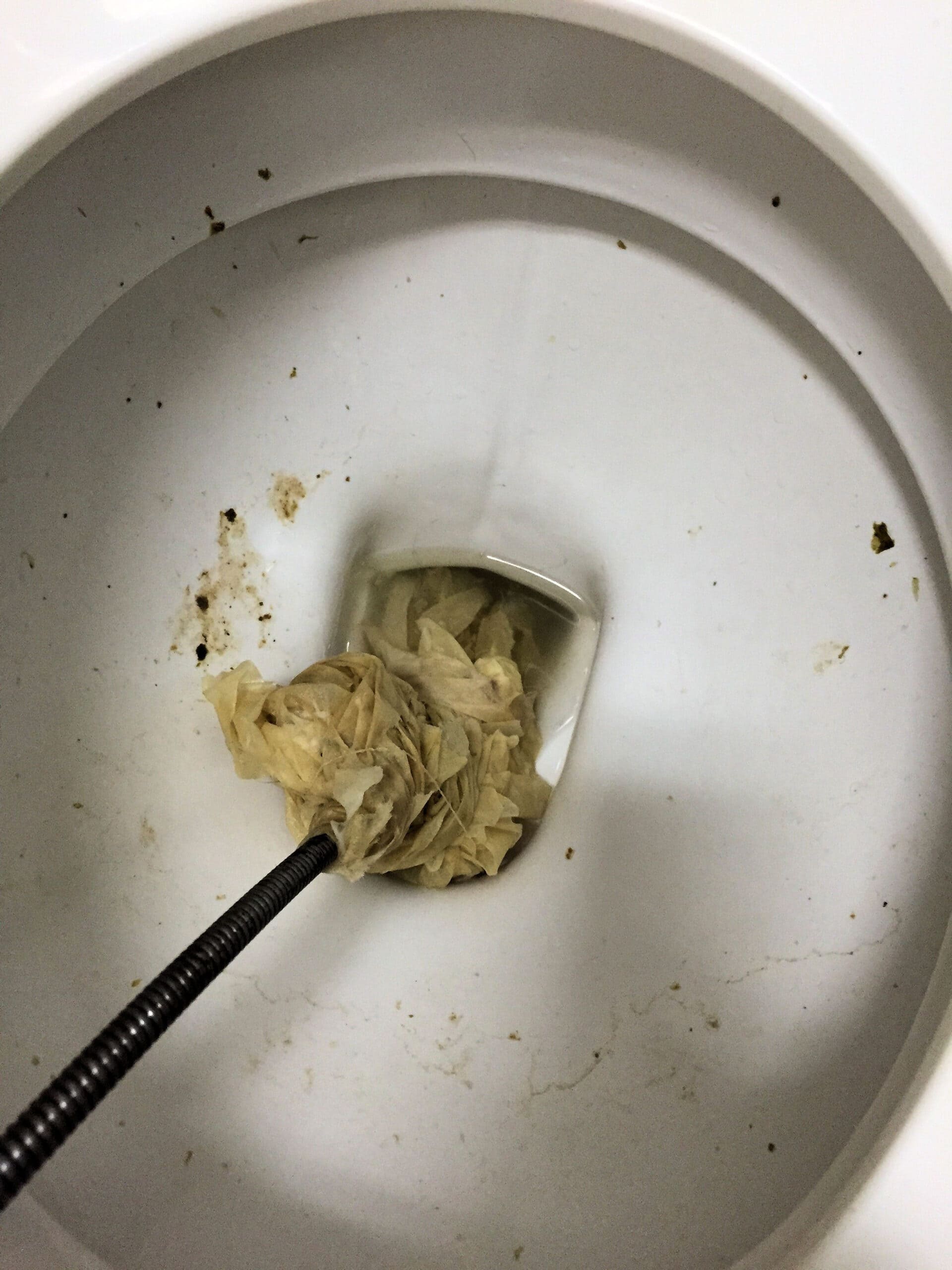
Describing gurgling sounds as liquid evil is a perfect description. The photo below illustrates perfectly why paper towels should not be thrown into the toilet.

Paper towels as you can see are not designed to be flushed down a toilet. Paper towels are not designed to enter your sewer drains. If you choose to flush paper towels into your toilet the photo below perfectly illustrates why your plumbing hates you.
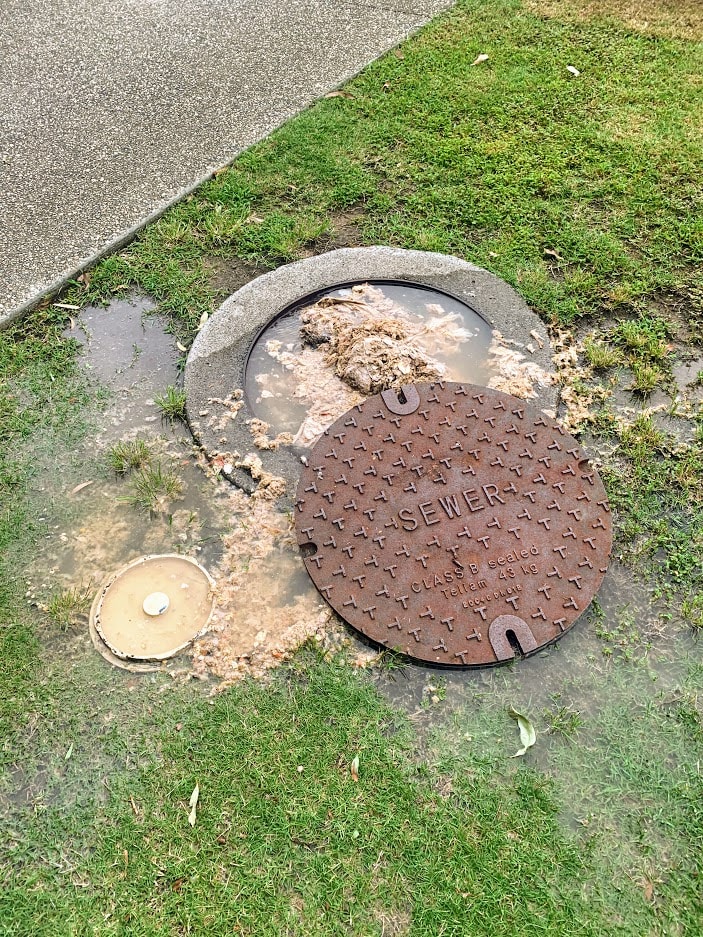
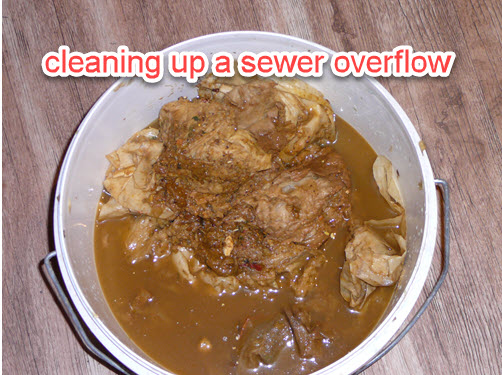
As you can see the plumbing systems had the ultimate revenge for the lack of respect. In this instant, the paper towels work their way through to the manhole and blocked the entire sewer drainage system.

The paper towels will frequently block your toilet pan but they can flush through into the sewer drain where they will slowly go down the drain until they jam against a junction or a point where flow is restricted such as in a manhole.

From there on the whole plumbing system will grind to a halt as the water from every drainage point in your house fills up the sewer drains.

Foreign objects that cause a blocked toilet are flushable wipes, paper towels, facial tissues, cotton tips, Q-tips, cotton buds, ear cleaners, hair removal wax strips, cotton balls, pantie liners, sanitary napkins and our old favourite of children’s toys.

Gurgling drains don’t clear themselves ever!

If your main sewer drains block, it doesn’t take long for your homes toilets and internal drains to begin to back up.

Hopefully, your overflow relief gully works correctly, and the sewage overflows into your garden rather than inside your house. Either way, it’s messy and yucky having to clean up sewage that has overflowed.

Blocked drains, whether backed up or overflowing, are not only inconvenient but can also pose a risk to your health.

Gurgling drains, smelly drains or slow draining sinks are all signs that your blocked drains need urgent attention.

Plumbing problems are confronting

Solving plumbing problems can be a challenge for us as plumbers and you as a client. The reality is solving plumbing problems takes time, patience and, above all, experience.

Google searches do not make you into an instant plumber. In our experience, a Google diagnosis is generally wrong.

Regretfully many people associate plumbers with unpleasant events that they have experienced with their plumbing, such as a burst pipe or overflowing sewage that flooded their house.

Due to the emergency type situations that most people call a plumber out for, there are numerous misconceptions about what a plumber can do and cannot do quickly. In too many circumstances, this is aligned to the cost rather than the outcome which seldom solves the problem.

Your plumbing hates you since you have a lot of plumbing infrastructure 

Bear in mind you have considerable plumbing infrastructure that is out of sight and consequently out of mind. That is until it stops functioning.

The reality is 90% of your plumbing infrastructure is concealed in walls, under your floor, in your roof space or underground outside.

Below the photo of sewer drains, we installed at Southport Sharks illustrates what we face as plumbers when diagnosing your plumbing problems.

The sewer drains inside your house under the floor once installed are inaccessible as they are covered by concrete. To repair the drains is a significant cost in just accessing them coupled with rectification and then replacing the concrete.

sewer drains at Southport Sharks installed by Whywait Plumbing illustrate why your plumbing hates you
Maintaining your plumbing infrastructure is an investment. In our experience, most unforeseen problems with your plumbing originate from when your home was originally constructed. As I’ve said many times these days, in reality, all buildings are constructed to a cost, not to the legal, regulatory standards of the National Construction Code (NCC) administered by the Australian Building Codes Board (ABCB).

The photo below illustrates how much work we have undertaken to repair broken sewer drains under your concrete floor. In this instance the work required was:

  • locate by CCTV drain camera the exact location of the broken pipes
  • cut the concrete slab with a quick-cut demolition saw
  • remove the slabs of concrete and dispose of off-site
  • excavate by hand to expose the sewer drain pipes
  • cut and remove the broken and crushed sections of the PVC sewer drain
  • install new PVC pipes with flexible joints
  • test the drain to ensure there were no leaks and it was fully functional
  • backfill and compact the excavation
  • drill into the concrete slab to install reinforcing steel to tie the replacement concrete to the existing slab
  • install a replacement concrete slab
your plumbing hates you until Whywait Plumbing repair the drain

Concealed plumbing infrastructure will always be expensive to repair

We understand how you can feel that your plumbing hates you when we have to undertake major work to repair plumbing infrastructure that is concealed in walls or under your concrete floor.

From our perspective, we know we are delivering bad news that you don’t want to hear. The frustrating thing is that you frequently don’t see all the work that goes into repairing a broken sewer drain as by the time we are finished there is literally nothing to see. The video below illustrates perfectly the repairs we undertook on a drain under a 50 year old stone wall and when completed you would never have known we had been there.

Proactive prevention is preferable to a reactive emergency

There will always be unplanned plumbing emergencies that you can never foresee. That is a simple fact of life.

But proactive preventative maintenance can eliminate the majority of potential plumbing emergencies.

This is why we recommend our Service Partner Plan© to all our clients. The annual audit is focused on locating potential problems before they occur.

Enquire today how you can simply be signed up to get extra benefits and service advantages in managing your properties plumbing, drainage, roofing and gas infrastructure.

service partner plan from Whywait Plumbing
Whywait Plumbing are Master Plumbers
CALL NOW
CALL NOW