by Gary Mays | Jun 28, 2018 | City of Gold Coast, Cold Water, Consumer Issues, Gold Coast Plumbing, Gold Coast Water, Leaking Pipes, Plumbers Gold Coast, Queensland Government, Rain Water Tanks, Sustainable Plumbing, Water, Water Filtration, Water Leaks, Whywait Plumbing
Gold Coast council water rates are about to increase again. For both homeowners and business owners, this could be a double whammy when you couple this with the increases in power bills in recent years.
The Increases are likely to continue in coming years even though the City of Gold Coast has not increased its portion of your water bill at all for three years. Bulk water charges for the City of Gold Coast are recommended to increase by the Queensland Competition Authority a further $12 a year for the next two years.
The City of Gold Coast has now finalised the 2018-19 budget. Your Gold Coast council water rates charges will not increase on the retail and distribution component of the water and sewerage charges from the last financial year.
However, the significant portion of your water cost which is Queensland Government’s bulk water price will increase in line with the recommendations by the Queensland Competition Authority. The bulk water price will increase by 2.5% from $2.74 per kilolitre to $2.91 per kilolitre.
Contrary to some urban myths City of Gold Coast no longer owns Hinze Dam and the desalination plant. Gold Coast Water buys the water that you use through your meter from Seqwater owned by the Queensland Government. The price paid for the bulk water is itemised in your water bill.
Essentially the bulk water charges levied by the Queensland Government makes up the bulk of your water bill.
These charges are still reflecting the poor planning from 20 years ago that resulted in the multi-billion dollar water grid construction in 2007-08 which resulted in supply pipes connecting all of South-East Queensland being built. To a large extent, the pipe grid was constructed without dams being built and to lesser extent dams constructed without pipes which also resulted in the construction of the seldom-used Tugun desalination plant.
For 2018-19 your Gold Coast council water rates will increase on 1 July for your water and sewerage which will comprise of the following charges:
- Queensland Government bulk water charge $2.91 per k/L
- City of Gold Coast distribution $1.09 per k/L
- Total water consumption charge $4.00 per k/L
The water and sewerage access charges will remain the same as in previous years being:
- water access charge of $212.08 per year
- sewerage access charge of $724.12 per year.
Currently, water charges are relatively stable, but significant problems are looming. Long term planning is required to address the issues of aging infrastructure and their maintenance costs which will impact Gold Coast council water rates.
Infrastructure Australia in a major report has predicted water bills will go the way of power bills increasing by at least $50 every year. They predict today’s average annual water bill of $1200 will increase to $2500 within 20 years.
The report correctly says we need to start planning now as our dams are relatively full which gives us the rare opportunity of “….clear thinking and long-term planning to meet our future needs.”
As we all know from the water management supply crisis of 2007-09 South East Queensland can be adversely effected quickly with a combination of natural disasters, poor planning and below average rainfall.
Very simply if we don’t start long-term planning now for planning our future water needs the drastic increases in water bills will cripple family and business budgets in the same way power bills are now.
by Gary Mays | Jun 13, 2018 | Bathrooms, Blocked drain, City of Gold Coast, Consumer Issues, DIY Plumbing, Gold Coast Plumbing, Health Issues, Hot Water, Hot Water Heat Pump, Hot Water Solar, Plumbers Gold Coast, Plumbing Maintenance, Plumbing Renovation, Sanden “Eco®” Plus Heat Pump hot water system, solar hot water, Sustainable Plumbing, Waterless Urinals, ZeroFlush waterless urinals
Plumbing innovations have always been the norm in the plumbing industry. Innovation is change and is always about better ways of doing the same thing.
When I started my apprenticeship the clearing of a blocked drain started using a plunger and was at least a two-man job using 1m long drainage rods. The rods were screwed together and manually pushed slowly down the drain until we hit the blockage. Clearing drains this way frequently took 3-4 hours.
Plumbing innovations mean that we now clear a blocked drain with state of the art high-pressure jetrodding technology that was unknown 20 years ago.
Innovation is always about change, but at Whywait Plumbing we have always been at the forefront of plumbing innovations. We have always lead change as Gold Coast plumbers from the purchase of our first high-pressure water jetting unit in 1992 or installing vehicle tracking systems or introducing guaranteed upfront pricing in 1999.
What we always considered was developing and improving our way of solving your plumbing problems is now referred to as disruptive innovation. I agree disruptive innovation is the new term in business in the 21st century. But it’s not new it’s just a new way of talking about improving our methods and practices using the latest technology.
Change is the norm, but it just appears to be frantic to an outside observer with online banking, online shopping, online flight bookings and so the list goes on. At least with plumbing, it can’t be done online except for those DIY enthusiasts who believe Google Plumbing has all the answers.
The level of disruption through plumbing innovations has impacted all plumbing installation and maintenance has been significant starting with:
- Increasing use of prefabrication of bathroom and kitchen modules off-site where the plumbing is all undertaken in a factory, transported to the site and connected up to a water and drainage connection.
- Continual advances in sustainability with the advent of low flow toilets, low flow taps, waterless urinals and recirculated hot water.
- Advances in energy efficient products with heat pump hot water units, solar hot water, instant hot water and underfloor heating.
- All of the different materials we now use in the pipework, relining of existing pipework, CCTV cameras to inspect pipes and pipe jointing methods where welding is now obsolete.
- Excavation methods with advanced technologies in hydro excavation and tracking and locating of underground services.
The ongoing changes in technology in the plumbing industry are disruptive if not embraced. I agree that plumbing innovations cause a significant difference in how we undertake to solve plumbing problems and how the plumbers at Whywait work now.
Ultimately plumbing continues to be about protecting the health and safety of the community for now and the future to ensure we have good quality water and sewer systems in our buildings.

by Gary Mays | Jun 8, 2018 | Consumer Issues, Gold Coast Plumbing, Hot Water, Hot Water Heat Pump, Hot Water Solar, Hot Water Temperature, Plumbers Gold Coast, Plumbing Maintenance, Sanden “Eco®” Plus Heat Pump hot water system, solar hot water
Replacing Your Hot Water Service – How Will You Know What’s Right For You?
When replacing your hot water service the most common question asked is what will it cost?
Whilst price is always an important consideration, at Whywait Plumbing believe that there are other equally important factors. This article will help you make an informed decision.
Should The Price of the Replacement Hot Water Service Be The First Consideration?
Besides renovating your home, replacing your hot water service is a major cost. It is often an expense that occurs with very little warning.
Unfortunately, unless you like cold showers, this gives you little time to carefully review available replacement options.
Hot water systems are not all created equal and the choice you make today will be one that lasts for the next ten to fifteen years. With ever-increasing energy costs impacting household budgets, having an efficient and well maintained hot water service has never been more important. A cheap hot water service may cost you a great deal more in ongoing expenses.
With So Many Hot Water Systems On the Market How Do You Know Which One To Choose?
With modern technological advances and the push for energy-efficient heating solutions, it’s no longer a matter of just replacing your hot water system with like for like. So how do you know which hot water service to buy?
Hot water services are available in electric, gas, solar and heat pump models, and all come in a huge range of sizes. Purchasing the right hot water service for your needs is something you should seek advice about from a qualified hot water specialist. With a little help from Whywait’s Hot Water Specialists you will be able to select the system that best suits your situation.
Hot Water Service FAQ’s
Before making any decisions about a hot water service replacement you will need to think about:
- What size is your current hot water service and have you ever run out of hot water with your current hot water system?
- Does your current hot water service operate on an off-peak electricity tariff?
- Are your hot water needs likely to increase, decrease or stay the same over the next five years?
- Do you intend to remain in your current property for at least the next five years?
- What is more important to you the initial up-front installation cost or the ongoing running costs?
- Is the quality of the product and length of warranty a consideration when comparing hot water services?
Once you have answered the above points it will be time to consider the available options.
by Gary Mays | May 5, 2018 | Consumer Issues, Emergency Plumber, Gold Coast Plumbing, Health Issues, Hot Water, Hot Water Heat Pump, Hot Water Solar, Hot Water Temperature, Hot water tempering valve, Plumbers Gold Coast, Plumbing Emergencies, solar hot water
A common question we get asked this time of year concerning hot water repairs is “Why is my hot water not hot enough?”
We find our clients tend to notice this problem predominately when showering and in most instances, the temperature of the water hasn’t suddenly changed. It’s more than when the weather is fresher, and we tend to increase the ratio of hot to cold water, and therefore, any fault that affects the hot water becomes more apparent.
Hot Water Not Hot Enough, Common Causes
When customers ask “why is my hot water not hot enough” we always provide as much information as possible.
In our 42 years of plumbing experience and as hot water specialists, we have found the most common causes of this problem are:
Let’s take a closer look at each of these possible problems.
Malfunctioning tempering valve
Tempering valves are designed to blend hot and cold water to deliver water at a constant temperature that does not exceed 50’C. If water entering the tempering valve contains small amounts of sand or other debris, this can become lodged in the filters of the tempering valve and affect the operation of the valve resulting in lukewarm rather than hot water. Read more about tempering valves.
Faulty hot water service
If your hot water service is older (usually 10-15 years) or you have overlooked regular maintenance, it could result in a problem with the heating system.
A hot water system fails most commonly at these points:
The element is the mechanism within the hot water service that heats the water with the thermostat being responsible for switching the element on and off. Any problem with either of these parts can result in disruption to your hot water.
The relief valve is responsible for releasing built-up pressure as the water heats. If this valve is continuously leaking, then you will lose hot water which in turn is replaced with cold water that cools the hot water stored in the tank.
Hot water demand exceeds the capacity
Typically if a tanks capacity is over 125L, then you would connect to one of the off-peak tariffs, which means that electricity used by the hot water system will be charged at a lower rate. While this makes for a cost-effective solution, it does come with some limitations as you do not have an unlimited supply and if for any reason your demand for hot water increases there is always the possibility that you could run out of hot water.
If you are finding the hot water in your household is consistently not hot enough, and repairs are not required, then seriously consider a more substantial capacity, new hot water system.
Help Is On Hand
Here at Whywait Plumbing, we don’t consider hot water a luxury, it is a necessity. So if you are experiencing a cold shower and asking yourself why is my hot water not hot enough, call us now for Same Day Service.

by Gary Mays | Apr 15, 2018 | Bathrooms, Blocked drain, City of Gold Coast, Consumer Issues, Drain Odours, Gold Coast Plumbing, Health Issues, Insurance, Plumbers, Plumbers Gold Coast, Plumbing Emergencies, Plumbing Maintenance, Septic Tanks, Sustainable Plumbing, Toilets
Back in September 2015 we here at Whywait Plumbing first alerted our clients in newsletters and blogs to the fact that flushable wipes were in fact not flushable. At the time we said flushable wipes are an environmental nightmare and we stand by that claim.
We have repeated over and over again that the only things that are flushable in your toilet are toilet paper, urine and faeces or if you like to adhere to the three P’s rule of pee, poo and paper.
But as we all know a multitude of products labelled as flushable wipes or wet wipes have been claimed by their manufacturers that they could be simply disposed of by flushing down the toilet.
 Last Thursday the first of the ACCC prosecutions against manufacturers Pental and Kimberly-Clark Australia had a positive result in the Federal Court of Australia.
The manufacturer of White Kings flushable toilet and bathroom cleaning wipes Pental Limited and Pental Products Pty Ltd was fined $700,000 for its continual false and misleading claims that their products disintegrated “just like toilet paper” in the sewage system. The ACCC has separate ongoing proceedings against Kimberly-Clark Australia.
White Kings products in labelling, packaging and promotional materials included the following misleading statements:
- flushable
- White King Toilet Wipes are made from a specially designed material, which will disintegrate in the sewage system when flushed, just like toilet paper
- Simply wipe over the hard surface of the toilet … and just flush away
The Federal Court ruled all these statements were, in fact, false with ACCC Commissioner, Sarah Court stating, “These White King wipes can’t be flushed down the toilet, and Australian wastewater authorities face significant problems if they are because they can cause blockages in household and municipal sewerage systems.”
This is a huge win for the sewers and house drains where blockages have been an ongoing issue creating $16000 plumbing repair bills for homeowners.
Here in Queensland Michelle Cull from Queensland Urban Utilities said it was a “real win” for sewers as “We remove around 160 tonnes of flushable wipes from our sewerage network every year. Laid end-to-end, that’s enough to stretch all the way from Brisbane to Bali. We spend around $1.5 million a year clearing blockages from our sewer pipes and flushable wipes are a big contributing factor.”
 The campaign by Choice against flushable wipes has been an outstanding success. In 2015 Kleenex flushable wipes were an outstanding winner in their 2015 “Shonky Awards” which we highlighted in Flushable Wipes Win “Shonky Award” from CHOICE at the time.
On Thursday after the Federal Court, decision Choice spokesman Tom Godfrey reiterated that the false claims about flushable wipes were a “grubby marketing tactic that left households, local councils and water services organisations having to struggle with the cost of removing these wipes from the sewage system”.
The $700,000 fine is a positive message to manufacturers and the water industry and plumbers are now hopeful the manufacturers of wipes products now prominently label DO NOT FLUSH on all their products.
The $700,000 fine also sends a positive international message as the water industry worldwide has collectively committed to a position statement where all wipes and personal hygiene products must be clearly marked DO NOT FLUSH and that they can only be disposed of in the rubbish bin.
Here at Whywait Plumbing, we hope this $700,000 fine reinforces to everyone that any wipe product is never flushed down the toilet. I can only repeat if you wish to continue flushing wipes in all their forms down your toilet then I recommend you become a Whywait Plumbing Service Partner.
by Gary Mays | Mar 24, 2018 | City of Gold Coast, Consumer Issues, Gold Coast Plumbing, Health Issues, Insurance, Leaking Pipes, Plumbers Gold Coast, Plumbing Emergencies, Plumbing Legislation, Water, Water Leaks
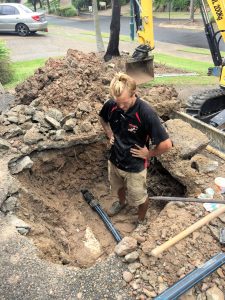
In August 2014 after a large number of issues where every other job we attended was a leaking water main, I concluded that all of them were caused by incorrect installation. In our monthly newsletter and in a blog I highlighted that negligence causes plumbing emergencies.
 Since 2014 nothing has changed with polypipe leaking water main repairs being a constant source of work. The number of defective installations in new homes reinforces that a City of Gold Coast plumbing inspection is not a guarantee.
It is positive to see that the Department of Housing and Public Works issued Building And Plumbing Newsflash 558 on 13 March highlighting issues on the correct selection and installation of polyethylene (PE) pipe which is commonly called polypipe or blue line poly, used as a material for water supply installations. The QBBC also raised the matter in a blog Health and safety concerns relating to PE pipes, or ‘blue line poly’.
The issues we see every day on almost every leaking water main has been highlighted in the Newsflash with the Department stating “…..has become aware of issues associated with PE pipe including pipe leakage resulting from material splitting and holes developing in the material. Although the direct cause of these failings has not been determined, it is timely that the department issue advice on the correct selection and installation of the product.”
When installing a polypipe water main a licenced plumber must ensure that it is done so in accordance with the Plumbing Code of Australia and the referenced standard which is AS/NZS 3500.1-2015. These are not options but are law as per the Plumbing and Drainage Act 2002.
The following clauses in AS/NZS 3500.1-2015 must be complied with in regard to installing any underground water main:
- Clause 2.3 Selection and Use of Materials and Products – this clause states that materials and products used in a water service shall be selected to ensure fitness for their intended purpose and goes on to list all those factors so that there is no doubt.
- Clause 5.2 Proximity to Other Services – this clause is very specific on hoe water service pipes are to be separated from any other underground services including gas or electrical and drainage pipes. The separation distances range between 100mm and 600mm depending on the size of the water service and the type of the neighbouring service. The specific requirements are laid out in clauses 5.2.1 through to 5.2.10.
- Clause 5.9 Depth of Cover – this clause once again is very specific in stating the depth at which underground pipes shall be with table 5.9 giving specific loading conditions and the minimum cover or depth which ensure the pipe is protected. In most cases the minimum depth is 300mm unless there are vehicle loading factors which then can require the pipe to be at 750mm depending on what the ground surface is.
- Clause 5.10 Bedding and Backfill – this clause is the one we see most commonly ignored on the Gold Coast and is what causes the entire leaking water main to require replacing. The clause is very specific in stating that the pipe must be surrounded entirely with a minimum of 75mm of compacted sand or fine grain soil with no hard edged object in contact with the pipe. Again very specifically it states the final backfill shall be free from rock, hard matter, organic matter and be broken up to ensure that there are no soil lumps larger than 75mm.
- Clause 5.11 Installation in Contaminated Areas – this clause states exactly what is a contaminated area and that a pipe laid in a contaminated area shall be installed in a water tight, corrosion resistant conduit.
The clauses above are quite specific on how your water main should be installed. They are specific requirements under the Plumbing and Drainage Act 2002. They are not options the plumber can choose to opt in and out of.
If you suffer a leaking water main and it is not installed as per the above clauses the licensed plumber installing it has done so knowing it is non-compliant and that it is reasonably foreseeable that failure and damage will occur over time. Very simply this is negligence.