


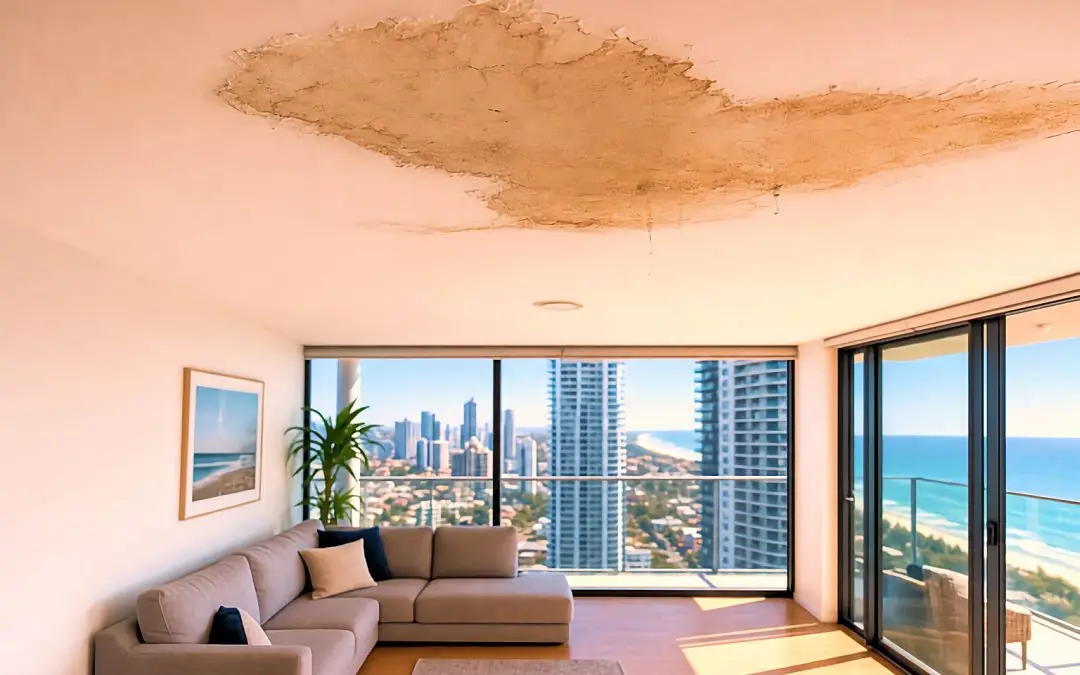
Water is coming through your ceiling, and you need two answers fast:
✅ How do I stop it?
✅ Who pays?
If you lived in a house, both answers would be simple. You’d turn off the main, call a plumber, and the bill would land on your kitchen bench.
In a Queensland apartment, it’s rarely that clean. We’ve attended jobs where a single burst pipe pulled in three owners, a body corporate committee, a building manager and two insurers. All before anyone had even found the leak.
Responsibility depends on where the pipe is located, who it serves, and what the building’s registered survey plan says. And the source of the leak is often nowhere near the damage. Water dripping into your bathroom might be coming from a failed flexi hose two floors up, a shared riser, or a body corporate pipe buried in the slab.
The Gold Coast is full of owners going through this for the first time. Plenty of people are moving out of standalone homes into apartments, and suddenly they’re dealing with common property, exclusive-use areas, bylaws, and access rules they’ve never heard of. Nobody explains any of it at the settlement. The first lesson usually arrives with the first leak.
Speed matters because water damage compounds by the hour. But access and repair approvals still have to follow Queensland body corporate law and the scheme’s registered documents. Even in a genuine emergency.
This blog walks through who pays, who gets access and what happens next, so you know the process before you’re standing in a wet hallway trying to work it out.
**Important:** This is general information, not legal or insurance advice. Every community title scheme is different. Check your community management statement, by-laws, survey plan and insurance arrangements.
Why apartment plumbing becomes complicated
Water doesn’t respect lot boundaries. A leak can show up in your bathroom after starting several floors above, and a blocked drain that affects one unit today can back up into three units by the weekend.
The damage you can see rarely tells you who’s responsible for fixing it. Depending on the building, a single leak can involve the apartment owner, a tenant, a property manager, the body corporate, the neighbours, the building manager, a licensed plumber, and one or more insurers. With that many parties in the mix, arguments about who pays can drag on while the water keeps moving.
That’s the trap. The smartest first move is almost always the same:
✅ control the water,
✅ document everything,
✅ identify exactly which pipework failed.
Sort out the money afterwards.
Is this a strata problem or a body corporate problem?
Most people say ‘strata’. It’s the term used in New South Wales and Victoria, and it’s stuck. In Queensland, the legal structure is actually called a “community titles scheme”, and a body corporate manages its shared affairs.
The building’s survey plan and community management statement define each lot and the common property. In many multi-storey buildings, the lot boundary runs through the centre of the floors, walls and ceilings that separate the units.
That boundary matters, but on its own, it won’t answer your plumbing question. You also need to know who the pipe serves and where it physically sits. Those two things trip people up constantly.
Who is responsible for apartment plumbing in Queensland?
The body corporate is usually responsible for plumbing that forms part of the common property.
In practice, that tends to mean pipes, drains, or sewers that serve more than one apartment, sit within a boundary wall, floor, or ceiling, or form part of the building’s shared system.
A lot owner is generally responsible for the pipework that serves only their apartment, sits within their lot, and isn’t inside a boundary structure. A failed flexi hose under your vanity? That’s yours, and for what it’s worth, braided flexi hoses are one of the most common causes of flooding we see in apartments.
The shared sewer stack behind your bathroom wall? Almost certainly the body corporate’s.
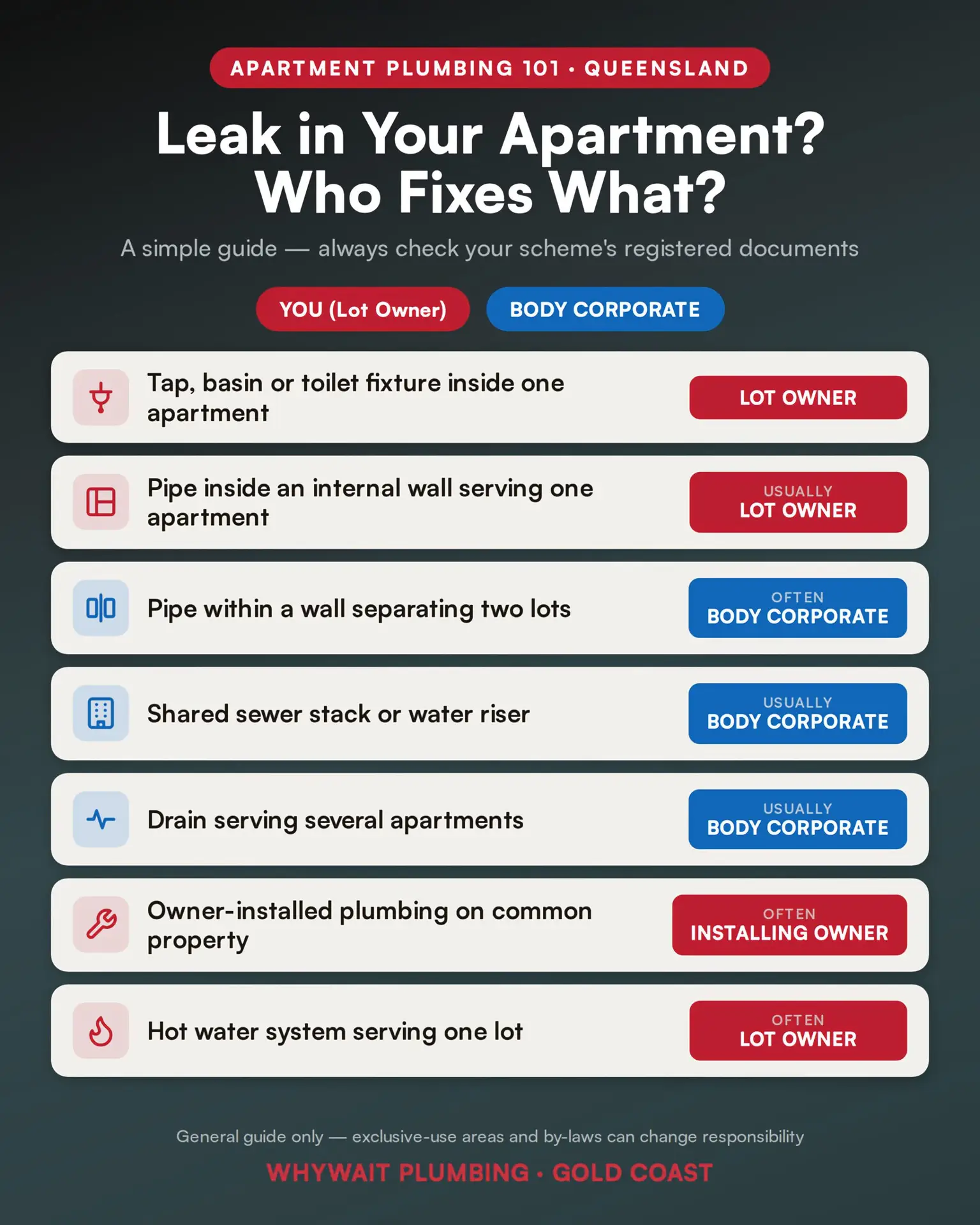
Treat these as starting points, not rulings. Queensland law contains exceptions:
✅ exclusive-use areas,
✅ owner-installed improvements,
✅ older building arrangements that can shift responsibility.
The scheme’s registered documents are what count.
The location of the water damage may mislead you
Picture water coming through the ceiling of a Broadbeach apartment. The wet ceiling belongs to one unit, but the leak could be coming from the apartment above, a shared water riser, a failed shower connection, a body corporate pipe inside the slab, or simply an overflowing bath caused by an occupant who got distracted.
Each of those causes creates distinct repair and insurance pathways. We’ve seen owners spend weeks blaming the wrong neighbour before anyone put a camera in the wall.
So resist the urge to argue about payment before you’ve found the source. A licensed plumber can isolate the likely cause and record what they find.
Photos, moisture readings and camera inspection footage feel like overkill on the day. They become the most valuable documents in the building once insurance claims begin.
Can a plumber enter another apartment?
Not just because a pipe crosses into it, no. But Queensland law does give the body corporate specific access powers.
The body corporate may authorise someone, including an external plumber, to enter a lot when it’s necessary to inspect or carry out work the body corporate is authorised or required to do. That authority can come through a committee resolution or an ordinary resolution.
For non-emergency access, the body corporate generally has to give the owner or occupier at least “seven days’ written notice”, and entry must happen at a reasonable time.
A decent notice spells out who needs access, the proposed date and time, how long the work should take, why entry is required, and who the resident can contact with questions.
In our experience, most access disputes never happen when that notice is clear, and someone actually picks up the phone beforehand.
What happens during a plumbing emergency?
Emergencies run under different rules. An authorised person may enter at any time during an emergency, with or without written notice. But the body corporate must still authorise that person. The authorisation requirement doesn’t disappear just because water is moving.
The legislation doesn’t define every emergency, so urgency depends on the facts. A burst shared pipe flooding several apartments obviously justifies rapid entry. A slowly dripping tap doesn’t, no matter how annoying it is.
Even in an emergency, the body corporate should contact the occupant immediately, where possible and explain the risk, the work required and who will be entering.
Emergency access is a legal power, not an excuse to skip basic courtesy.
Can an owner or tenant refuse access?
Owners are entitled to question whether an entry is lawful or genuinely necessary. But once the body corporate has properly authorised entry and given the required notice, the authorised person has a legal power to enter. The owner doesn’t need to be home, and they don’t need to consent again.
Obstructing an authorised person may be an offence, and the body corporate can pursue dispute resolution through the Commissioner for Body Corporate and Community Management in Queensland.
None of that means a plumber should force their way in. We won’t, and no reputable plumber will.
Access should be coordinated by the body corporate or its authorised representative, and any disagreement should be documented and handled through the proper process, not on the doorstep.
What should happen when water is actively leaking?
When water is spreading, forget about blame and focus on safety and damage control.
1. Reduce the immediate damage: Turn off the relevant isolation valve if it’s safe to reach. Don’t touch electrical fittings near water, and call emergency services if there’s immediate danger.
2. Notify the right people: Contact the building manager, body corporate representative, owner or property manager. Whoever applies to your situation. Tenants should report the problem to their property manager promptly and follow any building emergency procedure.
3. Engage a licensed plumber: Most plumbing and drainage work in Queensland is regulated, and an appropriately licensed plumber or drainer must perform it.
4. Identify the source: Finding the source matters more than blaming the nearest apartment. The plumber may need access above, below or beside the visible damage, so start those conversations early.
5. Record everything: Keep photographs and videos, access approvals, emails and text messages, the plumber’s findings, invoices and work orders, before-and-after photos, and records of any affected belongings.
Good records don’t create conflict. They shut it down.
Queensland plumbing compliance still applies
The pressure of an apartment emergency doesn’t exempt a plumber from their compliance obligations.
Queensland divides regulated plumbing into permit work, notifiable work and minor work, and each category carries its own approval or registration requirements. The National Construction Code and the associated Australian Standards sit beneath it all.
Where work is notifiable, the plumber must register it with the Queensland Building and Construction Commission (QBCC) generally within ten business days of issuing the invoice, and the client or occupier must receive the required documentation within the prescribed timeframe.
Before work starts, it’s worth asking your plumber whether the job requires City of Gold Coast approval, QBCC notifiable work registration, body corporate approval, access to another lot, water-shutdown coordination, or follow-up testing and inspection.
A small repair can affect an entire building. The paperwork is part of doing it properly, not an optional extra.
Who pays for water damage?
Here’s a distinction that catches nearly everyone out: repair responsibility and damage responsibility aren’t the same thing.
One party may pay to fix the failed pipe while a completely different policy covers the ruined flooring, paint or belongings. Payment can turn on:
🚨 whether the pipe is common property,
🚨 whether it serves one lot or several,
🚨 what caused the failure,
🚨 whether negligence or delay made things worse,
🚨 what the body corporate policy covers,
🚨 what the owner’s contents or landlord’s coverage picks up,
🚨 what excesses and exclusions apply.
Whatever you do, don’t assume the body corporate insurer will pay for everything. Notify the relevant insurers promptly and provide the plumber’s written findings and photographs.
Hold off on major reinstatement until responsibility is clearer, unless urgent work is needed to stop further damage.
Common mistakes that make apartment leaks worse
❌ Waiting for the next committee meeting: Active water damage rarely waits politely. The committee can approve necessary work without holding everything over to a general meeting.
❌ Sending a plumber without organising access: A plumbing technician standing outside a locked apartment cannot diagnose hidden pipework. We know, because we’ve been that plumbing technician. Confirm approvals, contact details, keys and resident availability first.
❌ Assuming the upstairs owner caused the leak: Water travels along slabs, pipes and building cavities in ways that surprise people. The apartment above may also be affected, and may not be responsible at all.
❌ Starting repairs before defining the scope: Opening walls without confirming authority can create a second dispute on top of the first. Work out whether the job involves common property or another lot before anyone picks up a saw.
❌ Relying only on verbal agreements: Memories become surprisingly foggy once ceilings, carpets and invoices are involved. Keep approvals in writing.
A practical checklist for Gold Coast apartment owners
Before the plumber arrives, gather:
1: The exact location of visible water or blockage symptoms.
2: Photographs and video of the affected area.
3: Body corporate and building manager contact details.
4: The apartment owner or property manager’s details.
5: Any available plans or previous repair reports.
6: Written access authority where another lot is involved.
7: Details of any water shutdown restrictions.
8: Insurance claim numbers, when already issued.
Twenty minutes of preparation can save hours on site and prevent repeat visits and unnecessary holes in walls.
What Whywait Plumbing does differently
Apartment plumbing takes more than tools and fittings. Most of the hard part is communication:
✅ who’s affected,
✅ who decides,
✅ who pays,
✅ who needs to know what before anything gets opened up.
Whywait Plumbing Services helps Gold Coast owners, property managers and bodies corporate with leaking and burst pipes, blocked apartment drains, shared sewer problems, water leak investigation, hot water faults, CCTV drain inspections, and plumbing repairs and compliance work.
We explain what we find in plain English. And where responsibility is unclear, we separate the facts from the assumptions, so owners and committee members can make their next decision on solid ground rather than guesswork.
Frequently Asked Questions
No. Responsibility depends on the wall, the lot boundary and who the pipe serves. A pipe inside an internal wall serving one apartment may remain the owner’s responsibility.
In certain circumstances, yes. The body corporate must properly authorise the entry, and non-emergency entries generally require at least 7 days’ written notice. Different rules apply during emergencies.
Report the problem promptly to the property manager or owner. Where common property may be involved, the body corporate should also be notified. Emergency water damage may require all three parties to coordinate simultaneously.
Most regulated plumbing work in Queensland requires a QBCC-licensed plumber or drainer.
For active flooding, contact both immediately. For a non-urgent issue involving common property, notify the body corporate before arranging any invasive work.
Don't let a small leak become a building-wide problem
Apartment plumbing problems get expensive when responsibility, access and repairs aren’t coordinated, not because the plumbing itself is complicated.
Start with the facts. Control the water, notify the right people, and use a licensed plumber who documents their findings.
For burst pipes, apartment plumbing, blocked drains or hot water problems across the Gold Coast, contact Whywait Plumbing Services.
Early investigation usually creates more options and fewer ruined ceilings.

