by Gary Mays | Sep 25, 2013 | City of Gold Coast, Cold Water, Consumer Issues, DIY Plumbing, Emergency Plumber, Gold Coast Plumbing, Gold Coast Water, Leaking Pipes, Plumbers, Plumbers Gold Coast, Plumbing Emergencies, Plumbing Maintenance, Toilets, Water, Water Leaks, Water Meters
How to check if you have a water pipe leak
With a water pipe leak, it’s commonly said that prevention is the key. Positive preventive maintenance saves you thousands of dollars in hassles and water damage.
That’s why you want to follow the simple step by step check for a water pipe leak. This will prevent the hassles before they hit you where it hurts most – in your pocket!
Step by Step Instructions
Below we run through:
- Check your taps
- Check your toilets
- Turn the taps off
- Check your water meter
- Wait 15 minutes
- Compare water meter readings
- Turn the taps back on
- When to call a plumber
- When your good to go
At Whywait Plumbing, we have always preached that preventative maintenance policies and procedures will prevent many of the significant cost blowouts in plumbing maintenance.
As always, prevention on checking for a water leak is the best solution. An underground concealed water pipe leak is often impossible to see or hear. More so if your home is on sandy soil or has lots of garden vegetation.
The simplest way to check if you have a concealed water pipe leak is to follow the how-to steps below:
Step 1 – Check your taps
Check all taps both inside the house and outside the house are not dripping.
Step 2 – Check your toilets
Check the toilet cisterns are not overflowing or running into the toilet bowl by tipping a few drops of food dye into the cistern and if there is no colouring of the water in the toilet bowl you know there is no leak.
Step 3 – Turn the taps off
 Turn off all the taps that you normally leave turned on, such as the washing machine, dishwasher and the toilet cisterns.
Step 4 – Check your water meter
At the council water meter check the meter is not turning and write down the figures on the meter dial.
Step 5 – Wait 15 minutes
After 15 minutes recheck the water meter and write down the figures on the meter dial again.
Step 6 – Compare water meter readings
Compare the figures you have written down, and if the numbers have not changed at all, then you have no water pipe leak. If the numbers have changed very slightly repeat the test but do it for at least 1 hour.
Step 7 – Turn the taps back on
If you are satisfied there are no leaks remember to turn back on the taps you turned off at the washing machine, dishwasher and toilet cisterns.
Step 8 – When to call a plumber
 If the meter dial reading on the water meter has changed after 1 hour then in all likelihood you have an underground concealed water pipe leak, and you need to give Whywait a call to organise leak detection.
Step 9 – When your good to go
If the meter dial reading has not changed, that means your underground water reticulation piping is in good condition.
Prevention is the key
No matter what your results in the above step by step preventative maintenance suggestions, we recommend you repeat it monthly. We also recommend you record your water meter readings every month as any change in water use patterns will quickly indicate a possible leak.
As a rule of thumb, YOU ARE RESPONSIBLE for any water leak after the council water meter that is on your property. Therefore we recommend that you at least check your water meter reading every month and seriously consider the installation of an AquaTrip water pipe leak detection and control system.
by Gary Mays | Sep 5, 2013 | bathroom mould, Bathrooms, Consumer Issues, Drain Odours, Gold Coast Plumbing, Health Issues, Leaking Pipes, Plumbers, Plumbers Gold Coast, Sustainable Plumbing
Do you have mould around the tiles or on the walls in your bathroom or kitchen? If you do then you are not alone as it is a common problem particularly in bathrooms but also in kitchens in South East Queensland due to our sub-tropical climate. Like most problems prevention is vital and often very simple.
Because your bathroom and especially the shower area are the wettest areas in your home it is not uncommon to see mould growing in the grouting and silicon sealants. Bathroom Mould loves the perfect atmosphere to create the ideal conditions for mould growth in the cracks and gaps in the tiling. Consequently mould grows in behind and through the grout joints on the tiles. As can be seen on the photo on the right mould loves getting in behind the silicon seal on the internal corners whether it be the wall or the floor.
The most common area to find mould is in your shower where it is nourished by your body oils, shampoo and soap residue that are left behind every time the shower is used.
Poor air circulation actively assists mould growth as the warmth and moisture created in the enclosed area of a shower offer further ideal conditions for mould growth in the dark areas of the shower around the internal corners and the shower floor drain. Poor air circulation is easily resolved by ensuring you install a good quality bathroom extraction fan above the shower that turns on automatically to remove all of the steam and water particles while you are using the shower.
If you are suffering from mould growth in your bathroom and or kitchen then Whywait Plumbing recommend that you act now to remove it before permanent stains are created. To not only prevent but also treat mould you need to use what nature uses and that is enzymes rather than corrosive chemicals. Enzymes are a natural part of our world and play an important role in everyday life. They are found in every living organism and life is not possible without enzymes. Enzymes are catalysts – not living organisms.
The success Whywait Plumbing have enjoyed with utilising Enzyme Wizard products is incredible with every problem we have utilised it on exceeding not only our expectations but those of our clients. Enzyme Wizard products are a guaranteed supply of plant based enzymes and enzyme products that by their very nature eliminate odours and organic matter, from blood stains, to cleaning carpets and counter tops, removing wallpaper, and even used as a high quality cleaner/degreaser.
For preventing and treating bathroom mould in the bathroom or the kitchen you need to utilise Kitchen & Bathroom Mould & Mildew spray which is a spray and wipe product which is suitable for all surfaces in a bathroom or kitchen whether they are formica or stone bench tops, tiles, glass, timber or stainless steel as it will not only attack existing mould but prevent mould developing.
If you have surface mould in areas such as tiles grout simply spray the effected area with Mould & Mildew spray whilst cleaning the area with a stiff brush. Once you have finished brushing the area leave it 5 minutes then rinse it with clean water. If you have heavy infiltration of mould it maybe necessary to apply a couple of extra times to completely remove the mould.
Frequently you will find mould behind the silicon sealant on the internal corners in tile areas which will require more thorough work. You will need to use a utility knife such as a Stanley knife to scrape off all of the silicon plus ensure you use use a blade to scrape the remnants of silicon clear off the tiles. Once all of the silicon has been removed spray the mould with Mould & Mildew spray as above until it has all disappeared. Once the mould has gone rinse the area clean and dry it thoroughly with a hot air dryer to ensure there is no moisture trapped in the open joint. Finally you will need yo apply a good quality mould resistant silicon to the joint which is specifically designed for high moisture areas.
Once you have removed the kitchen or bathroom mould you need to ensure that you remove the chemical cleaners and bleaches from your cleaning regime and use Enzyme Wizard products in your bathroom and kitchen to prevent mould reoccurring and ensure you have a positive prevention program in place in your home that contain no harmful phosphates or caustic chemicals.
If you observe mould reappearing after a few days of removing then you may have problems with leaking pipes or fittings that require a thorough investigation by Whywait Plumbing to ensure you are not damaging internal frames and wall linings. If you have leaking pipes or fittings behind the wall then mould is only a sympton of a bigger problem and ignoring will not make it disappear. If in any doubt contact Whywait Plumbing for advice on how to deal with mould in your bathroom and or kitchen.
by Gary Mays | Aug 30, 2013 | City of Gold Coast, Cold Water, Consumer Issues, Water, Water Filtration, Water Leaks
Imagine opening your mail to find a water bill for $27154.83.
We all know water is the basis of all life and an absolute necessity of life, but I’m sure we all agree a $27154.83 water bill is not what anyone would want.
This property is a commercial property where the normal water bill for 6 months is around $4000 and as the exasperated owner said, “why has water got so bloody expensive?” The very simple answer to that question is that water costs are a direct reflection of appalling state government planning between 1990 and 2007.
Many of us remember when water was essentially free and the only time you got charged for it was if you used excess water over and above the very generous allowance that was paid for as part of your council rates.
However, cheap water is the past. The reality of today is that water is expensive if you use vast quantities for irrigation or have a concealed water leak as in the situation above. We all have to be vigilant in ensuring that the integrity of our household water pipes is maintained at all times. The only guarantee anyone can give you on the cost of water is that it will continually increase every year.
If you live on the Gold Coast or in Logan then water costs are comparable. Have a look at annual costs below:
| Water Service Charge |
$205.74 |
| Sewerage Service Charge |
$703.34 |
| Water Consumption Charge |
$3.5167 per k/L |
|
|
| Annual Cost to use 250 k/L of water |
$879.18 |
| Annual Service Charges |
$909.08 |
| Total Annual Cost |
$1788.26 |
| Water Service Charge |
$279.00 |
| Sewerage Service Charge |
$661.60 |
| Water Consumption Charge |
$3.5813 per k/L |
|
|
| Annual Cost to use 250 k/L of water |
$895.33 |
| Annual Service Charges |
$940.60 |
| Total Annual Cost |
$1835.93 |
As you can see Logan is marginally more expensive and if you used 250 kilolitres of water then you would pay $47.67 more for living in Logan.
However where a concealed leak has occurred and eligibility criteria have been met Logan is definitely more understanding and generous in their relief on payment over a 3 year period.
Logan City Council allows:
- a claim once every year
- provide a reduction of 50% of the difference between the consumption for the billing period and the average of the previous consumption history as recorded by council over the preceding four billing periods
City of Gold Coast allows:
- a claim once every three years
- provide a reduction of 60% of the estimated water loss attributed to the concealed leak
- the water loss through a concealed leak must be in excess of 50 kilolitres
- relief increases to 85% if you receive a pensioner water subsidy.
So for example if you normally used 250 kilolitres but had two concealed leaks resulting in an increase to 900 kilolitres in a 3 year period, which is not an unusual occurrence then you would receive relief from payment of $2327.84 at Logan but only$1377.51 on the Gold Coast.
As a rule of thumb YOU ARE RESPONSIBLE for any water leak after the council meter that is on your property. Therefore I recommend that you at least check your water meter reading every month and seriously consider the installation of an AquaTrip water leak detection and control system.
In reality the convenience of reliable, good quality drinking water from your tap is still inexpensive if you compare it to:
| Product |
Litre Cost |
Kilolitre Cost |
| Coca Cola |
$2.33 |
$2330.00 |
| Just Juice |
$1.17 |
$1170.00 |
| Nudie Juice |
$2.50 |
$2500.00 |
| Wolf Blass Yellow Label Shiraz |
$24.00 |
$24000.00 |
| Johnie Walker Black Label |
$71.43 |
$71430.00 |
| XXXX Gold |
$7.35 |
$7350.00 |
| Woolworths Milk |
$1.00 |
$1000.00 |
| Standard Petrol |
$1.52 |
$1520.00 |
| Mount Franklin Spring Water |
$4.65 |
$4650.00 |
| Logan Water |
$0.0036 |
$3.58 |
| Gold Coast Water |
$0.0035 |
$3.52 |
When you look at the real cost of water compared to other products you purchase to drink it not only puts it in perspective but makes you appreciate how fortunate we are to be able to turn on a tap and receive drinking water that is free of bacteria and virus’s so we are not forced to purchase bottled water at $4650.00 per kilolitre to drink.
Yours sincerely,
Gary Mays

by Gary Mays | Aug 23, 2013 | City of Gold Coast, cloudy hot water, Consumer Issues, Gold Coast Plumbing, Health Issues, Hot Water, Hot Water Heat Pump, Hot Water Temperature, licensed plumber, Plumbers Gold Coast, Plumbing Maintenance, Taqua built in filtration sink mixer tap, Water Filtration
Why does my hot water look yuck?
Why is my hot water cloudy is one of those perennial questions that arise for the plumbing technicians at Whywait Plumbing.
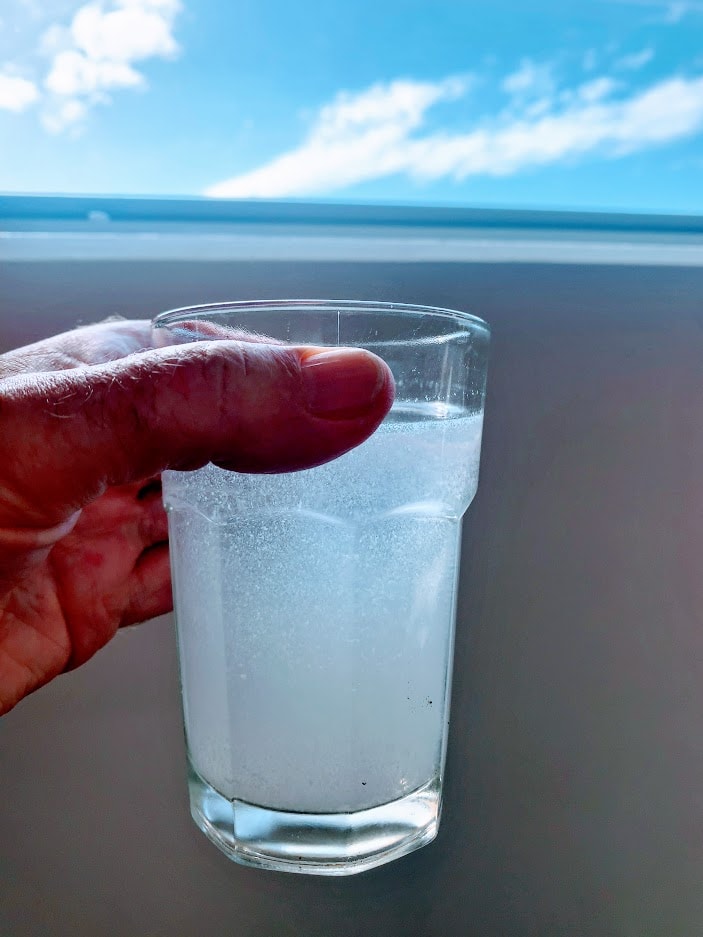
Generally, the problem is based around reoccurring issues of “what do you think causes cloudy (white, not dirty) water that comes out of the kitchen tap when on hot? It doesn’t do it in the cold; you don’t get the same residue if you boil cold. The photo below is the residue after 30 seconds when the water settles.”
Very simply, in most cases, cloudy, hot water is caused by dissolved gases in the water. We assure you it is safe to use.
To get cloudy water from your hot tap, you must create the right set of circumstances for everything to come together simultaneously.
So why is my hot water not clear but looks milky?
Turning on the hot water tap and having milky or cloudy water for a few seconds is not unusual. This is a common occurrence that a fundamental principle of physics can explain.
To understand why hot water can appear cloudy, you first need to know that all the water in your home is stored in your pipes under pressure. When water is under pressure, it has a higher capacity to hold dissolved gases. However, when you heat water, the ability to hold those dissolved gases is reduced. This creates supersaturation, which is when there are more dissolved gases in the water than they can carry.
When you turn on the hot water tap, the release of pressure causes those dissolved gases to be released in the form of tiny gas bubbles, which give the water a cloudy or milky appearance. Think of it like popping the cork off a bottle of champagne – all that pressure has to go somewhere!
What causes hot water to look milky or cloudy when you first turn on your tap?
If you’ve ever turned on your hot water tap and found that the water is milky or cloudy, don’t worry, you’re not alone. This common occurrence can happen when turning on the tap releases the pressure, often in an initial highly pressurised burst. The dissolved gas in the water comes out of the solution in the form of tiny gas bubbles, which fill the water and give it a cloudy or milky appearance.
But the good news is that this is a normal and healthy condition for your water. In fact, reasonable quantities of dissolved gas or air in water are not uncommon. And as the gas bubbles dissolve, the water will clear from the bottom up, like a disappearing act. You can easily observe the water rapidly clearing from the bottom up in a glass.
So, if you’re concerned that your hot water service is defective or your water is contaminated, don’t be. We guarantee that cloudy water does not mean anything wrong with your hot water service or water quality. In fact, gas bubbles in your hot water supply will increase with the increase in temperature of your water because the hotter your water, the lower the number of gas bubbles that can be held. So, give it a few seconds, and your hot water will be clear and ready to use.
What should I do if my hot water is always cloudy?
If your water is continually cloudy after the initial burst of hot water, it needs further investigation. Gas bubbles do not cause cloudiness that does not dissolve in hot water.
Seldom is it a fault with your hot water service? If the water does not lose the cloudiness within thirty seconds, you likely have a water filtration problem or a sediment buildup in the hot water tank.
Investigating cloudy, hot water needs to be undertaken by a licensed plumber, so if you are continuously asking yourself why is my hot water cloudy, you need to call us at Whywait Plumbing on (07) 5580 4311 and book a site visit.
by Gary Mays | Jul 4, 2013 | Health Issues, Insurance, Leaking Pipes, Plumbing Emergencies
Imagine you’re at home in the kitchen, cooking dinner and water suddenly starts to pour through the light fitting in the ceiling above your head.
Do you know how to shut off the main water supply into your home?
If you answered yes that’s great. But do your children know?
And yes just in case you were wondering a light fitting is the most common place for water to leak from in the ceiling. The first thing to do is turn off the water and not the electricity supply.
Considering the amount of panicking phone calls we receive every week at Whywait Plumbing from people who have water pouring out of the ceiling or out of a burst tap or from under their sink or from their hot water service I can assure you there is an awful lot of people who don’t know how to turn off their main water supply.
In any Australian home the water supply is one of the most important things that you always expect to be working. After all, a house would not be worth much without a working kitchen sink or toilet or shower. So familiarising yourself, and your family with your water supply system can save you stress, time, money and most of all avoid what can be costly repairs from water damage.
The most critical thing every person who lives in the house should know is where and how to turn off the main water supply.
Finding where is the first step. If your home is on the city water supply which is the greatest majority of homes then there will be a meter that controls the water supply. This is usually located at the front boundary line of your property on either the far left or far right side. In all likelihood it will be in the grass area in the meter box similar to the photo on the right.
Once you locate the meter box you will need to lift the lid to access the meter and the control valve. However do be cautious, as there are almost always spiders and often cane toads living inside.
In all likelihood when you lift the meter box lid you will be confronted by a build-up of sand or silt inside the box which frequently means digging it out to locate the control valve and the meter.
Once you have uncovered the fittings inside the meter box you will see there is only a control valve to turn off the water supply to your home and the actual water meter. Neither of these can be confused for the other.
The control valve is always located away from your house closest to the road or kerb side. Unfortunately it is not a standard valve and will come in a wide variety of configurations. Most common is a lever action ball valve which is simply a quarter turn to isolate the water.
Hopefully there are no problems with the water supply system in your home, but if the situation does arise it is best to be prepared. We therefore recommend you do the following:
- locate where your meter box is on your property and ensure you work out how to operate the control valve
- open the lid every month and remove and sand and silt build-up
- at least every 6 months check that the control valve is turning the water supply off to the whole house
- make sure every person living in the house knows where and how to turn off the main water supply control valve
If you have any questions about isolating your homes main water supply call Whywait Plumbing or next time you have a plumber from Whywait at your home or business ensure you get all your questions answered on turning off your water.
Finally always remember to turn off your water supply when going away on holiday because nothing will ruin your return home like driving up your driveway to see water pouring out of the garage or front door.
By Gary Mays