

Can my gas BBQ explode is a question we get asked every summer as we all love a barbecue its part of our lifestyle. But every year far too many people suffer severe burns and injuries.
Most barbecues have been lying around, unused over the winter months and as soon as the warm weather returns we all fire up the barbecue without a second thought as to whether its safe to use.
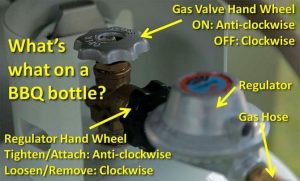
Gas bottles with their regulator and hose connections are the most common potential for leaking LPG gas to literally explode when you are using it.
Before using your barbecue this summer we recommend that you spend 5 minutes to carry out the following:
check all your connections are tight
check the gas hose from the bottle to the barbecue to make sure it has not perished
a soapy water spray leak test on the gas bottle, gas regulator, rubber hose and hose connections
Above is a short video that will run you through seven simple checks before using your barbecue that shows all of the tests listed above including a soapy water test.
Once you have checked your connections are tight and checked the rubber gas hose for any signs of being perished please ensure you carry out a soapy water leak of all the connections.
You can create soapy water in a bowl with soap and brush it on, or preferably use a spray bottle where you put some gel soap into a spray bottle with water and spray all of the connections.
If a leak is present, the soapy water will produce bubbles indicating the location of the leak. If a leak is detected, you may need to disconnect the joint and clean the mating surfaces. Then re-connect and re-check for leaks again. If you continue to see leaks then it is likely that fitting needs replacing before using the barbecue.
A gas leak on a barbecue can spread very quickly as you can see in the photo above which is why you should follow these basic rules:
never use a gas barbecue indoors or in a confined space
do not connect or disconnect a LPG cylinder in the vicinity of a naked flame and always shut off the cylinder valve before disconnecting from the barbecue
do not use a gas barbecue in windy conditions as if the flames are blown out the LPG can accumulate and create a potential explosion
LPG gas cylinders seldom explode because they all come with a pressure relief valve so if there is a problem with heating up, the relief valve automatically allows the LPG to vent. Consequently rather than exploding the venting LPG in the worst possible scenario can ignite if there is an ignition source and you have a spectacular plume of flame going upwards. The cylinder will in a short time run out of gas and the flame will extinguish and this is why you always use a barbecue outside and away from the house in a well-ventilated area separated from ignition sources.
Remember if you smell gas always turn off the valve at the gas bottle. All gas installation work must be undertaken by a licensed gasfitter so if you have any questions contact Whywait Plumbing Services now.
A plumbing inspection by the council is not a guarantee and never has been. They are a compliance audit – nothing more, nothing less.
Recently Kelly from Hope Island sent me an email that began with the comment, “builders are liars, plumbers are incompetent, and the Gold Coast plumbing inspectors are frauds who take no responsibility…..”
I can only repeat to Kelly what many of us know and see every day in new or recently renovated buildings – “everyone who worked on your home did so because they were the cheapest, not because they were the best qualified and skilled to undertake the work.” Sadly that has become a reality in the construction industry.
The pressure by builders on plumbers to reduce prices and take “SHORTCUTS” increases daily, as I have stated previously, and in fairness, is frequently driven by the client demanding a “LOWER PRICE” and looking for the “BEST DEAL”.
In respect to Kelly’s comment about the Gold Coast plumbing inspectors, I understand the remark as there is a common urban myth that once your home or building has had a final inspection that it has been certified by the council and that the plumbing is perfect and that they are guaranteeing it.
This is incorrect as the plumbing inspector’s functions are set out in the Plumbing and Drainage Act 2002. A plumbing inspector’s functions are to conduct investigations and inspections for monitoring and enforcing compliance with-
the Plumbing and Drainage Act 2002; or
the Sustainable Planning Act 2009; or
the Local Government Act 2009.
The critical word in the legislation is COMPLIANCE. When the council inspector signs off the plumbing and drainage work on your home after being requested to undertake a final inspection by the licensed plumber responsible, you will only get a letter that says it is a PLUMBING AND DRAINAGE COMPLIANCE CERTIFICATE. It will state clearly, “This Compliance Certificate approves the regulated work or on-site sewerage work for the above property in respect of Compliance Permit number…..”
A compliance certificate from the plumbing inspectors is not a guarantee in any way, shape or form and should not be construed as such.
Unfortunately and sadly but these days, it is ultimately up to you to ensure that you are getting high-standard, quality work by dealing with reputable, experienced licensed contractors who perform work to the standards set out in the Plumbing Code of Australia.
Always ask to see the plumber’s contractor’s license, and always ensure for insurance purposes, you get a copy of either the council compliance certificate or the QBCC Form 4 compliance certificate, depending upon the work you have had undertaken.
Gas compliance plate must be installed for all properties verifying the work on all gas is safe & legally compliant.
Not all plumbers are gasfitters with many people thinking that regular plumbers can work on gas appliances and troubleshoot any problems that they are having with their gas system.
To the casual observer it appears that gas and water seem to flow through the same type of pipe systems but the reality is that the way in which they work is totally different.
Gas systems both natural gas and LPG are a lot more dangerous and the slightest mistake can create a gas leak leading to a potential explosion or a fire. For this reason alone if you are having a problem with your gas pipes or appliances you must use a plumbing company that is a licensed contractor to work on gas and employs licensed gasfitters.
You should be aware of the following when undertaking service or installation work on your gas system:
The company must be licensed: In Queensland all companies or individuals undertaking gas work are required to have a contractors licence from Queensland Building and Construction Commission, (QBCC) plus every person working on gas must have a a gas work licence issued by the Chief Gas Examiner from the Department of Natural Resources and Mines. Without these licenses they cannot legally touch your gas appliances or piping system.
Ensure you get all legal certification: A gasfitter doing any servicing or installation work on any part of gas system must affix a “Gas System Compliance Plate” as illustrated above on all new installations. The gasfitter is also legally obliged to give you a “Gas System Compliance Certificate” immediately after the installation is complete which you must keep as it is a legal document indicating the work is legally compliant.
Legally your obligations if you use gas in your home or business are that you must take all reasonable steps to ensure that your gas system complies with safety requirements. This is complied with simply by:
regularly having gas appliances serviced
ensure all gas servicing and installation is carried out by a licensed gasfitter
ensuring you have compliance plates affixed and you retain copies of all gas certificates on site
Ultimately you as the property owner will be liable for the cost of rectification of non-compliant gas installations if the gasfitter who undertook the work cannot be identified plus it potentially makes your insurance coverage null and void.
DIY plumbing is not an option, nor is DIY electrical, but some people still believe the law does not apply to them. Frequently the reason to attempt DIY is that some people want to avoid hiring a professional plumberdue to the cost of plumbing services.
At Whywait Plumbing we understand a perceived simple plumbing job might cost many people more than what they can afford which is why we custom price every job up front so you always know in advance the answer to your question, “how much is this going to cost?”
Always when we are repairing the work after people have tried the DIY approach to plumbing repairs themselves they pinpoint cost them as the main reason. The reality is though that the mistakes they make undertaking DIY plumbing frequently creates a much bigger problem which incurs more expenses and stress.
Apart from the fact that DIY plumbing is illegal there are a few other reasons why you should not try DIY plumbing:
Warranty & Insurance – this is one of the most critical issues as DIY plumbing will leave you without the security of a manufacturers warranty on any product or fixture not installed by a licensed plumber. Even worse if a tap for example blows apart and floods your home the likelihood is your insurance policy will not cover the damage if the tap was not installed by a licensed plumber.
Safety – plumbing involves dealing with a number of hazards especially in drains that can create health issues for your family if not undertaken legally and compliantly. Misuse of specialised plumbing tools and equipment can result in you sustaining minor or even major injuries. Safety is always a concern if you attempt DIY plumbing when you do not have the proper knowledge or training. It always looks easy when you watch a professional with the correct equipment do the job.
Value for Money – DIY plumbing is more costly in the long term because the jobs invariably are never repaired correctly and continue to give problems repeatedly. Getting a licensed plumber to do the job right the first time is always the cheapest option in the end.
There is no better plumbing, drainage or gas repair than that undertaken by a licensed, professional plumbing company where the plumbers are experienced, trained, insured and knowledgeable.
Negligence causes plumbing emergencies as a fact I am becoming acutely aware of with over half of the plumbing emergencies we attend having been caused due to a plumbers negligence in the initial installation.
A large part of this negligence is driven by plumbing work being undertaken to a cost and not to the legislative requirements or standards that plumbers are legally obliged to comply with.
As I constantly have to remind clients who are victims of this negligence in near new or recently renovated buildings – everyone who worked on your home did so because they were the cheapest not because they were the best qualified and skilled to undertake the work. Sadly that is the reality in the construction industry.
The most common plumbing emergencies we see that are in most cases attributable to deliberate negligence by the plumber who did the initial work are:
leaking water-mains laid in rock and backfilled with rock with no compliant bedding or backfill material
broken house sewer drains once again laid in rock and backfilled with rock
mixer taps installed without isolation valves
Negligence by a plumber in installing the examples above are just the tip of the iceberg that we see daily but all cause a great deal of damage and are frequently expensive to repair.
The pressure by builders on plumbers to reduce prices and take “shortcuts” increases daily but is not an excuse to ignore undertaking the work in as set out in AS3500 and called into law through the Plumbing and Drainage Act 2002.
Under common law, the term “negligence” generally describes damage causing conduct that arises because of the defendant’s carelessness or failure to take reasonable care.
As an example, a plumber who installs a plastic polypipe water main straight onto the rocky ground and then backfills it with the same spoil he dug out has breached his duty of care. As a professional licensed plumber, he is fully aware that the job is not in accordance with clause 5.12 of AS3500 Part 1 for Water Services which states:
The water services shall be surrounded with not less than 75mm of compacted sand, or fine-grained soil, with no hard edged object permitted to come into contact with or resting against any pipe or fitting.
Material used for final backfill shall be free from rock, hard matter or organic material and be broken up to contain no soil larger than 75mm.
As you can see the wording and diagram in Australian Standards are quite specific on how your water main should be installed. They are specific requirements under law not options the plumber can choose to obey.
Very simply if your water main is not installed as above the licensed plumber installing it has done so knowing it is noncompliant and that it is reasonably foreseeable that failure and damage will occur.
In conclusion, I reiterate that most plumbing emergencies are caused by negligence and we are prepared to assist you if you have the willpower to legally seek compensation. It’s your choice but the industry will only be cleaned up when plumbers who continually break the law are hit in their hip pocket.