This Christmas I can guarantee that burst plastic water reticulation pipes or burst flexi hoses will create more emotional stress and insurance claims than fires and burglaries combined.
How to avoid house flooding is becoming more challenging as we continually add more and more water connections inside our homes. Insurance companies are experiencing year on year increases in ever-increasing water damage insurance claims. The average insurance claim from internal water damage flooding has increased from $17627 in 2014 to $30361 in 2018.
A collapsed ceiling from a water deluge above caused by a burst pipe
If you are going away on holiday this Christmas and New Year holiday season and leaving your home empty then I only have one recommendation. And that is before you drive off walk over to your water meter box and turn off the water supply.
How to avoid house flooding is simple if you turn your water off at the council water meter. By undertaking this simple task I can 100% guarantee you will not arrive home to a flooded house caused by a burst water pipe.
I’ve written frequently over the last 10 years about the issues we see every week with homes getting flooded. We’ve witnessed an ever-increasing amount of homes having plastic water pipes and flexi hoses being installed. In turn, we have seen an ever-increasing number of burst flexi hoses and split plastic pipes flooding homes.
In all likelihood even if you have copper water pipes you will still have multiple flexi hoses in your home. They will exist commonly in both residential and commercial buildings under the kitchen sink, under the bathroom vanity basins, under the toilet cistern and under the laundry tub.
Every flexi hose is potentially a ticking time bomb. It has become so common that we attend to burst flexi hoses every day. In 1 hour a burst flexi hose can discharge 1500 litres of water so in 1 day that could be 36000 litres of water. We’ve all experienced how far a spilt glass of water runs on a floor so imagine how far 108000 glasses of water will run.
We have multiple solutions available to prevent flooding in your home ranging from AquaTrip valves at the boundary that turns the water off automatically to individual auto shut off valves for flexi hoses.
If you have any concerns about your water pipes, flexi hoses, fridge connections or valves in your home and don’t want to have one of our plumbers spending part of Christmas Day with you then call us today.
In 2019 as we have done so for the last 43 years we will continue to provide full plumbing, drainage and gasfitting services every day up to and right through the upcoming Christmas holiday and 2020 New Year holiday period.
Public holiday diagnostic fees will apply to all call outs on those days except for Whywait Service Partners.
I’m always mindful that Christmas greetings can become superficial but even so everyone here at Whywait Plumbing Services wishes you and your family a Merry Christmas and a prosperous 2020. Remember the best of gifts around your Christmas tree on 25 December in the presence of a happy family with a toilet that flushes and a tap that turns off.
Here at Whywait Plumbing, we frequently get a phone call asking does insurance cover water leaks? Every week we are called upon to deal with insurance companies or assessors on behalf of clients when they have sustained water damage to their home.
With water leaks just like everything else to do with insurance, there seem to be multiple grey areas with numerous interpretations. It is our experience we find every time we deal with an insurance company where the circumstances of the water leak are similar to previous we meet with a different response.
The product disclosure statement issued with your policy is where we find all the confusion starts. This is where the insurance company hopefully discloses what is covered by your policy. If you find the product disclosure statement confusing then call the insurance company to clarify what the coverage is that you are paying for. The more questions you ask, the more you will understand. Remember there is no such thing as a stupid question. Also, remember insurance companies record all calls, so keep diary notes of when you called and who you spoke to. Better still send them an email confirming your phone call and what your understanding was of the answers you received. This creates an electronic paper trail that can be utilised at a later date.
Important Definitions & Clauses
There are three important definitions and clauses which appear to apply to the question does insurance cover water leaks:
the “Water Damage Clauses” in the actual policy
the definition of what is water damage
the definition of what is gradual water damage
The Water Damage Clauses
The water damage clauses you should always read carefully and ensure you understand. Generally, it will have a section with several clauses and subclauses in the policy which will cover water damage and what you can claim for if you make a water damage claim on your home.
As a rule, it will state precisely what water damage your insurance policy covers and what is excluded. The exclusions are what you need to be aware of as often they will include an all-encompassing negligence clause coupled with a failure to maintain your home in good repair. If you have these general all-encompassing clauses, ask your insurance company what they precisely mean as we’ve seen these clauses used to deny coverage where it was in a very grey area and open to interpretation in their favour.
The Definition of Water Damage
Water damage can occur in so many ways that it’s generally not well defined in your insurance policy. In our experience, insurance companies specify water damage in two ways:
accidental or sudden water damage
gradual water damage
We’ve found that instances such as burst pipes, burst taps, burst valves, overflowing sewerage, overflowing stormwater and storm damage are covered by most insurance policies. This is because it was a sudden event that you could not have prevented.
In contrast, the damage caused by slow plumbing leaks in pipes, showers, toilets, gutters and roofs not damaged by a storm is not covered as they are classified as gradual water damage.
The Definition of Gradual Water Damage
Essentially gradual water damage is the insurance policy get out of jail free card. It is water damage they assess has occurred gradually over time. Frequently the water damage was visible to the trained eye but invisible to you as it covers the rotting of timber under the paint or mould in the walls, floor or ceiling. Essentially the insurance company will conclude you were negligent in not maintaining your home.
Examples of gradual water damage we frequently see are:
seepage from leaking taps into cupboards
leaking shower trays
leaking shower taps
leaking toilet cisterns
leaking drain pipes
rusted-out sections in gutters and roof
The water damage from many of these occurrences is often not covered by your insurance policy as it will be concluded you failed to keep your home in good repair through regular and reasonable maintenance.
Water Leak Prevention
The best way to avoid an unsuccessful water leak claim is regular maintenance by Whywait Plumbing. Now this will not prevent every possible water leak scenario happening, but it will demonstrate to the insurance company that you have been undertaking regular maintenance.
At Whywait Plumbing, we see instances every day of water damage that has occurred through the failure to maintain your home regularly. That is why we recommend all our clients to become a Service Partner and enjoy the VIP benefits of having a Service Partner Plan to maintain your most valuable asset, your home, proactively.
Most property owners on the Gold Coast have just received their City of Gold Coast Water and Sewerage Rate Notice for January. Under Queensland law, you must receive a quarterly water bill. The City of Gold Coast issues their water bills in January, April, July and October.
Whenever water bills arrive, we get clients asking us why their Gold Coast water bill is always out of date. From experience, we can guarantee the average Gold Coast Water bill is still out of date. For example, most water bills issued in January were for water that was used between July and October. This is due to the contractors who read each water meter having set routes and timelines to read your meter so yes your usage charges are always at least two months out of date. This is why we suggest you monitor your water meter weekly and read how to do it on our page “How To Read Your Water Meter”.
For most homeowners who use around the average daily water usage of 451 litres, the highest costs in the quarterly water bill are their sewerage and water services charges. If you look closely at your water bill you can see that you have the following charges:
Sewerage service charges – sewerage access $181.03 per quarter
Water service charges – water access $53.02 per quarter
Gold Coast Water – water usage per kilolitre $1.09
Queensland Government – water usage per kilolitre $2.91
In reality, even if you used no water, you would still pay for service charges of $234.05 every quarter or $936.20 every year.
Average water use of 451 litres or 0.451kL per property is not an accurate guide to your water use. In our experience, most homes with more than one occupant will use 1-2 kL every day. Remember your water usage will vary every day based on the number of occupants at home each day and their water use behaviours. That is why we recommend you read your water meter weekly as that will give you a better guide about your average consumption but will also alert you to a potential water leak.
If you suspect a water leak, call Whywait Plumbing and ask for our leak detection service.
With the Gold Coast City Council recently posting out the quarterly Water and Sewerage Rate Noticeswe have noticed a spike in the number of calls for leaking water pipes.
A common theme is that the owners have been completely unaware that they have had a hidden water leak and only discovered the problem when they opened their bill, which unfortunately for some, contained a nasty shock.
Pipes Can Leak Without Any Outward Signs
The pure nature of plumbing, with pipes hidden underground or in walls, it often means that pipes can leak with no outward signs, especially in areas with sandy soil. Couple this with the fact that the bills issued in early July are for water consumed between January and April, it is easy to see how charges can accumulate as a pipe could potentially leak undetected for a period of three months between billing cycles.
A pipe could potentially leak undetected for 3 months or more, between water rate billing cycles
How Well Was Your House Constructed
Unfortunately, as a home owner, there is little you can do to prevent leaks from the water meter to the house. Basically it gets down to how well it was installed when the house was built.
In our forty plus years of experience we have found that if a pipe is well protected in a bed of sand there are few problems. However if there are items such as pieces of tiles, small rocks or other building debris then the chances are you will have problems over time and in some instances repeated leaks.
Interesting Fact
An interesting fact is the incidents of water leaks increase when we have cycles of rain followed by dry spells and is likely caused by ground movement allowing any sharp or rough objects adjacent to the pipes to rub against its side with the potential to create a split or hole in the pipe.
Monitor Your Water Usage
As a home owner the most effective way of detecting a concealed leak is to monitor your water usage, this is especially important if you have experienced a previous leak.
Your bill will have a daily average usage calculated for you so by reading the meter you should be able to pick up any increase.
At Whywait Plumbingwe recommendreading your water meter monthly.
Set a reminder for the first of each month, however if you have had previous leaks you may wish to do this more frequently.
If you suspect you may have a leak then doing an overnight meter check is a good way to confirm, however it is best to turn the water off to the cisterns in case someone gets up during the night and flushes the toilet and remember not to turn the dishwasher on before going to bed. Not sure how to read your water meter? We tell you exactly what to do! Click here for instructions.
Consider A Leak Detection System
If you would prefer not to have the hassle of monitoring your households water usage then it is worth considering purchasing one of the Leak DetectionSystems available on the market. We recommend Aquatripa programmable Leak Detection System with an automatic shutoff valve.
Aquatrip is easily fitted on your main incoming water pipe, and acts as a Water Safety Trip Switch. It is designed to detect the difference between your normal water use and a leak and will shut off the water if a leak is detected or a tap, hose or appliance is left running.
If you suspect you have a leak or to find out more about the Aquatrip give our office a call to speak with one of our friendly staff.
Gold Coast council water rates are about to increase again. For both homeowners and business owners, this could be a double whammy when you couple this with the increases in power bills in recent years.
The Increases are likely to continue in coming years even though the City of Gold Coast has not increased its portion of your water bill at all for three years. Bulk water charges for the City of Gold Coast are recommended to increase by the Queensland Competition Authority a further $12 a year for the next two years.
The City of Gold Coast has now finalised the 2018-19 budget. Your Gold Coast council water rates charges will not increase on the retail and distribution component of the water and sewerage charges from the last financial year.
However, the significant portion of your water cost which is Queensland Government’s bulk water price will increase in line with the recommendations by the Queensland Competition Authority. The bulk water price will increase by 2.5% from $2.74 per kilolitre to $2.91 per kilolitre.
Contrary to some urban myths City of Gold Coast no longer owns Hinze Dam and the desalination plant. Gold Coast Water buys the water that you use through your meter from Seqwater owned by the Queensland Government. The price paid for the bulk water is itemised in your water bill.
Essentially the bulk water charges levied by the Queensland Government makes up the bulk of your water bill.
These charges are still reflecting the poor planning from 20 years ago that resulted in the multi-billion dollar water grid construction in 2007-08 which resulted in supply pipes connecting all of South-East Queensland being built. To a large extent, the pipe grid was constructed without dams being built and to lesser extent dams constructed without pipes which also resulted in the construction of the seldom-used Tugun desalination plant.
For 2018-19 your Gold Coast council water rates will increase on 1 July for your water and sewerage which will comprise of the following charges:
Queensland Government bulk water charge $2.91 per k/L
City of Gold Coast distribution $1.09 per k/L
Total water consumption charge $4.00 per k/L
The water and sewerage access charges will remain the same as in previous years being:
water access charge of $212.08 per year
sewerage access charge of $724.12 per year.
Currently, water charges are relatively stable, but significant problems are looming. Long term planning is required to address the issues of aging infrastructure and their maintenance costs which will impact Gold Coast council water rates.
Infrastructure Australia in a major report has predicted water bills will go the way of power bills increasing by at least $50 every year. They predict today’s average annual water bill of $1200 will increase to $2500 within 20 years.
The report correctly says we need to start planning now as our dams are relatively full which gives us the rare opportunity of “….clear thinking and long-term planning to meet our future needs.”
As we all know from the water management supply crisis of 2007-09 South East Queensland can be adversely effected quickly with a combination of natural disasters, poor planning and below average rainfall.
Very simply if we don’t start long-term planning now for planning our future water needs the drastic increases in water bills will cripple family and business budgets in the same way power bills are now.
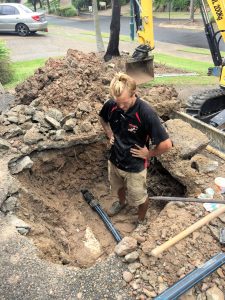
In August 2014 after a large number of issues where every other job we attended was a leaking water main, I concluded that all of them were caused by incorrect installation. In our monthly newsletter and in a blog I highlighted that negligence causes plumbing emergencies.
Since 2014 nothing has changed with polypipe leaking water main repairs being a constant source of work. The number of defective installations in new homes reinforces that a City of Gold Coast plumbing inspection is not a guarantee.
It is positive to see that the Department of Housing and Public Works issuedBuilding And Plumbing Newsflash 558on 13 March highlighting issues on the correct selection and installation of polyethylene (PE) pipe which is commonly called polypipe or blue line poly, used as a material for water supply installations. The QBBC also raised the matter in a blog Health and safety concerns relating to PE pipes, or ‘blue line poly’.
The issues we see every day on almost every leaking water main has been highlighted in the Newsflash with the Department stating “…..has become aware of issues associated with PE pipe including pipe leakage resulting from material splitting and holes developing in the material. Although the direct cause of these failings has not been determined, it is timely that the department issue advice on the correct selection and installation of the product.”
When installing a polypipe water main a licenced plumber must ensure that it is done so in accordance with the Plumbing Code of Australia and the referenced standard which is AS/NZS 3500.1-2015. These are not options but are law as per the Plumbing and Drainage Act 2002.
The following clauses in AS/NZS 3500.1-2015 must be complied with in regard to installing any underground water main:
Clause 2.3 Selection and Use of Materials and Products – this clause states that materials and products used in a water service shall be selected to ensure fitness for their intended purpose and goes on to list all those factors so that there is no doubt.
Clause 5.2 Proximity to Other Services – this clause is very specific on hoe water service pipes are to be separated from any other underground services including gas or electrical and drainage pipes. The separation distances range between 100mm and 600mm depending on the size of the water service and the type of the neighbouring service. The specific requirements are laid out in clauses 5.2.1 through to 5.2.10.
Clause 5.9 Depth of Cover – this clause once again is very specific in stating the depth at which underground pipes shall be with table 5.9 giving specific loading conditions and the minimum cover or depth which ensure the pipe is protected. In most cases the minimum depth is 300mm unless there are vehicle loading factors which then can require the pipe to be at 750mm depending on what the ground surface is.
Clause 5.10 Bedding and Backfill – this clause is the one we see most commonly ignored on the Gold Coast and is what causes the entire leaking water main to require replacing. The clause is very specific in stating that the pipe must be surrounded entirely with a minimum of 75mm of compacted sand or fine grain soil with no hard edged object in contact with the pipe. Again very specifically it states the final backfill shall be free from rock, hard matter, organic matter and be broken up to ensure that there are no soil lumps larger than 75mm.
Clause 5.11 Installation in Contaminated Areas – this clause states exactly what is a contaminated area and that a pipe laid in a contaminated area shall be installed in a water tight, corrosion resistant conduit.
The clauses above are quite specific on how your water main should be installed. They are specific requirements under the Plumbing and Drainage Act 2002. They are not options the plumber can choose to opt in and out of.
If you suffer a leaking water main and it is not installed as per the above clauses the licensed plumber installing it has done so knowing it is non-compliant and that it is reasonably foreseeable that failure and damage will occur over time. Very simply this is negligence.





 With
With  Water damage can occur in so many ways that it’s generally not well defined in your insurance policy. In our experience, insurance companies specify water damage in two ways:
 Whenever water bills arrive, we get clients asking us why their Gold Coast water bill is always out of date. From experience, we can guarantee the average Gold Coast Water bill is still out of date. For example, most water bills issued in January were for water that was used between July and October. This is due to the contractors who read each water meter having set routes and timelines to read your meter so yes your usage charges are always at least two months out of date. This is why we suggest you monitor your water meter weekly and read how to do it on our page

 Since 2014 nothing has changed with polypipe leaking water main repairs being a constant source of work. The number of defective installations in new homes reinforces that a
