by Gary Mays | Feb 24, 2018 | Consumer Issues, Insurance, Plumbers, Plumbers Gold Coast, plumbing rip offs, QBCC
I’m well aware everyone loves a bargain, especially with tradies giving cash discounts. We all understand household budgets are being stretched to the limit by ever-increasing state government charges on electricity, car registration and water charges.
In the 41 years I’ve been in business, nothing has changed in one area, and that is so many people expect substantial cash discounts if they pay tradies in cash.
The Australian economy’s trade services sector is notorious for undercutting and giving cash discounts to clients who pay in cash.
Tradies who offer substantial cash discounts are tax cheats
Generally, tradies who offer substantial cash discounts are solo operators who pocket the cash and not pay for critical business expenses to protect clients such as public liability insurance. As a rule, they are also tax cheats which cost us all more in tax ultimately.
Cash discounts rip everyone off, including yourself when you have no invoice to prove who did the work, which means no guarantees if anything goes wrong.
Paying cash frequently means you have no guarantee
I have lost count of the number of times I have been out to defective and non-compliant plumbing jobs where the client cannot get hold of the original plumber who did the work. Frequently this is because they have no record of who did the work as they paid in cash for the work to be done cheaply. This results in the client paying twice to have the same job undertaken and often costs much more to rectify and make legally compliant.
The ATO and the Tax Commissioner, Chris Jordon are 100% correct in saying cash discounts were ripping “billions of dollars” out of the economy that would otherwise be going to services such as schools and hospitals.
Like most other business owners I am 100% supportive of Chris Jordon when he recently issued a passionate plea to Australians to stop paying tradies in cash as the ATO confronts a host of black-economy rorts that include the fraudulent misuse of ABN’s.
Stop paying cash for a discount
“Stop paying cash for a discount,” he has told taxpayers.“Because you are effectively cheating the system or helping someone else to. This is not a victimless crime. If you pay cash for a discount, in many cases you are effectively ripping off yourself as an Australian taxpayer, because this type of behaviour is what sees billions flow out of the tax system and into the cash economy.”
The Australian Government’s Black Economy Taskforce has estimated that the cash economy is now in excess of $25 billion a year. Simply this is $25 billion of cash transactions where no tax is paid in GST or PAYG or superannuation or company tax.
Always demand a legitimate tax invoice
I’m well aware some people like to pay in cash but don’t rip yourself off by not getting an invoice from the tradie who has done your work if you pay him in cash. As a precaution, you should always ensure that you are getting a legitimate ‘Tax Invoice’ with all the tradies details on it, including a legitimate ABN and their QBCC contractor licence number.
It’s effortless to check an ABN to ensure it’s not a fictitious ABN. All you need to do is go the ABN Lookup and type in the ABN. It is quick and easy to do but gives you the assurance that you are dealing with a legitimate business that is paying their fair share of tax.
Every tradie must have a QBCC contractors licence, and once again it’s very easy to check at the QBCC Online Licence Search. Remember if they don’t have a contractor licence, then you do not have to pay them.
The old cliche that you get what you pay for will always be true
Scarily the Black Economic Taskforce found 40% of ABN’s quoted where cash was paid to tradies, were false and were the Bunnings ABN. There is no suggestion Bunnings has done anything wrong.
The old cliche that you get what you pay for will always be true. There is no need to ever pay cash despite what some tradies will try and force you to do. It would help if you never let a tradie take you to an ATM where they sit with you, watching you take out cash.
In today’s world of instant payments, it pays to protect yourself and create a digital trail.
At Whywait Plumbing we will happily take payment in cash or cheque or credit card. But we will not give you a discount for paying in cash ever as every job is invoiced correctly and paid into our bank account.
Remember at Whywait we ensure you always know the cost of your job before we start the job.
by Gary Mays | Oct 25, 2017 | apprentice plumber, Gold Coast Plumbing, Plumber Brisbane, Plumbers, Plumbers Gold Coast, Plumbing Legislation, Queensland Government, the going rate for plumbers
Sadly employing an apprentice plumber has become an expensive luxury for many small plumbing companies throughout Australia. This is due to the complexities of the Fair Work Act, to their high wages and the length of time away from work on holidays and at TAFE training.
This has been further exasperated by the explosion in sub-contracting with 65% of all plumbing businesses being a one-person operation who employ no staff at all.
As an industry, if we don’t train for the future, then we have no future. This is why we at Whywait Plumbing have always made it a policy to employ and train at least three apprentices at any given time. Even throughout the GFC in 2008-10, we maintained employment and training for four apprentices.
If you go to university, you don’t get paid and incur a hex debt that you eventually payback for your study. However, if you become an apprentice plumber, your employer pays you for the entire four years of your training, every week, with annual increases.
Currently, the archaic document that purports to be a ‘Modern Award’, the Plumbers and Fire Sprinklers Award 2010 requires a first-year apprentice plumber who has completed year 12 to be paid $13.18 per hour. If the apprentice plumber is aged over 20, he starts on $19.07 an hour. Compare this with how much you will get paid to attend university in the first and subsequent years.
 Apprenticeship numbers have been declining for the last 20 years. Much of the reason for this is due to decisions 20 years ago to focus everyone at high school on obtaining a university education. This has lead to many young people graduating with degrees and then being unable to gain employment in their chosen field of study.
The importance of well-trained plumbers to society as a whole cannot be underestimated. Plumbing as a trade will continue to exist and ensures young people taking up apprenticeships will always have a good job and a good future.
Interestingly apprenticeship completions at 64% is almost on par with university graduations of 67%. In plumbing, 80% of those who never finish their apprenticeship drop out in the first two years.
This decline in numbers of plumbers as a whole available to be employed has been brought home to us in recent months. We have been advertising for two licensed plumbers at that time, and these are fulltime jobs, not casual or sub-contract. It’s been alarming at how few plumbers applied for the job. Interviewing potential employees has been an intriguing and challenging exercise.

Dillon Lowes installing new sewer pipes at Niecon Plaza
We have employed two new employees in the last month as an apprentice plumber and welcome to Whywait Plumbing, Scott Moir and Dillon Lowes.
Unlike many of our competitors, we don’t employ sub-contractors, so everyone who works at Whywait Plumbing is a full-time employee. That means everyone working here is paid for six weeks of annual and personal leave plus two weeks of statutory holidays. Sub-contractors don’t receive those benefits plus they have to pay their own superannuation and work cover.
The combination of a reduction in plumbing businesses employing an apprentice plumber and the numbers of plumbers retiring means there is a shortfall of 13% between the number of plumbers available and the demand for plumbers.
All of these issues are increasing the cost of employing plumbers. This, in turn, increases the cost for plumbing businesses to undertake work across the board in both construction and maintenance. Ultimately it’s always a balancing act between supply and demand.
by Gary Mays | Sep 14, 2016 | Bathrooms, Blocked drain, City of Gold Coast, Consumer Issues, Drain Odours, Gold Coast Plumbing, Health Issues, Insurance, Plumbers, Plumbers Gold Coast, Plumbing Emergencies, Plumbing Maintenance, Septic Tanks, Sustainable Plumbing, Toilets
Flushable wipes are an environmental nightmare which is what I termed them in September 2015 when we here at Whywait Plumbing were seeing a horrendous increase in blocked drains.
 At the same time, consumer advocacy group CHOICE published the results of their dirty testing of “flushable” wipes and cleaning cloths in their testing labs. CHOICE came to the same conclusions that plumbers had long learnt and that was that “flushable” wipes were in most cases NOT FLUSHABLE.
Last year we promoted to Whywait Plumbing clients to join the CHOICE campaign to get rid of “flushable” claims on products that aren’t safe to flush.
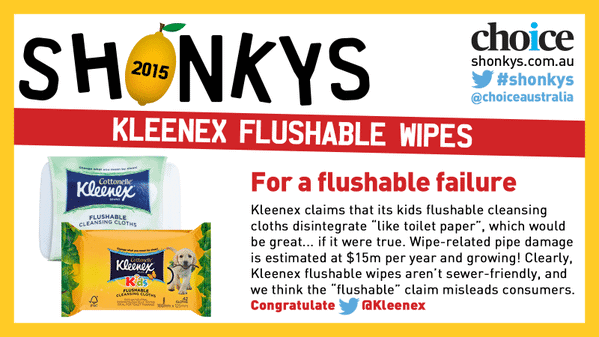
The worst offender in everyone’s eyes was the Kleenex brand. In fact, the website for Kleenex Cottonelle Flushable Cleansing Cloths For Kids claimed that the cloths break up in the sewerage system like toilet paper. As a result of this claim, CHOICE put it to the test and found that while toilet paper dissolves in a few minutes but the Kleenex wipes held together for over 21 hours.
Kleenex has responded to the CHOICE campaign by releasing an allegedly new and improved “flushable” wipes product. As a result, CHOICE has tested this new product and found nothing has changed. Kleenex new flushable wipes will still block your drains because they do not disintegrate like toilet paper.
CHOICE is now advocating that you don’t let your friends and family get caught by Kleenex and here’s what you can do:
1. Share on Facebook
2. Share on Twitter
When the CHOICE lab tests were widely published in all media last year, and the false Kleenex claims were exposed it sent a strong message to Kleenex. In fact, the message was so strong they apparently felt they needed to reinvent their “flushable” wipes.
But as CHOICE testing has found the “NEW” wipes are nowhere good enough to be considered safe to flush down your toilet. They are NOT FLUSHABLE, and they certainly do not disintegrate like toilet paper. As CHOICE states companies such as Kleenex need to deliver on their promises and should be prohibited from selling products that mislead consumers.
These Not-so-flushable Kleenex wipes put your homes sewer drains at risk of blockage still. As a community, we can and need to get these falsely marketed products off the supermarket shelves. That is why I urge you to tell your friends and family about the dangers of these dodgy Kleenex products to help keep your house drains, and the City of Gold Coast sewer drains flowing.

by Gary Mays | Sep 14, 2016 | Bathrooms, Blocked drain, City of Gold Coast, Consumer Issues, Drain Odours, Gold Coast Plumbing, Health Issues, Insurance, Plumbers, Plumbers Gold Coast, Plumbing Emergencies, Plumbing Maintenance, Septic Tanks, Sustainable Plumbing, Toilets
Like every other Gold Coast plumber, we here at Whywait Plumbing are seeing a horrendous increase in blocked drains due to the skyrocketing popularity of so-called “flushable” wipes. The term “flushable” is a catchy phrase and a favourite sales pitch presenting an image of convenience and hygiene.
But the reality of what happens to flushable wipes once they are flushed down a toilet pan is that they do not dissolve like toilet paper.
In fact, they remain intact, and these pieces of non-woven fabric when regularly used are blocking toilets, blocking house drains and blocking the City of Gold Coast sewer system.
It is gratifying to see local media taking the lead and highlighting the absolute disaster that flushable wipes are to our local Gold Coast environment. In a recent interview with Robyn Wuth that I did for the story “Gold Coast Sewerage Treatment Plant Wiped Out Once A Week” which was published in the weekly Gold Coast Sun and online at the Gold Coast Bulletin I was accurately quoted as saying wipes are an “environmental nightmare”.
Frustratingly for many businesses such as restaurants the increase in customers using their toilets and flushing wipes down the toilet has seen an increase in the number of blocked drains they are experiencing. For many businesses, the repeated flushing of wipes has resulted in costly and inconvenient consequences.
 The photo on the left clearly illustrates the problem where the toilets were all blocked at a Gold Coast McDonalds restaurant. Retrieving them in this instant was critical as they had created an interwoven tail of toilet paper held together with flushable wipes from the blocked toilet all the way into the sewer drains.
Wet wipes or disposable wet wipes are a new phenonium having only gained popularity in the last ten years. The early versions of these wipes were slow to gain widespread acceptance until manufacturers re-introduced them for a broader range of applications other than being just baby wipes.
Now they are available for multiple cleaning and hygiene tasks in the home and in workplaces with them being packaged in convenient carry cases that fit into handbags, glove boxes etc. and as a result, their popularity has skyrocketed.
 Frustratingly for ourselves and many Gold Coast plumbers, the durability of new generation wipes has seen blockages increase as the disposable wet wipes now come with confusing names. As you can in the photo on the right, they collect together in a drain very quickly and are a nightmare for us to remove in commercial high rise buildings.
Sadly flushable is assumed to mean biodegradable to consumers who love their convenience. As a result, when wipes are flushed down the toilet, there is a misleading assumption that the wipe will be the same as toilet paper and dissolve.
For many of our clients flushable means just that, until the problems begin from repeated flushing of wipes. If they are lucky they only experience a toilet blockage but often it is a complete blocked drain that would never have occurred but for those appallingly named flushable wipes which are in reality non-flushable.
Trust me the only things that are flushable in your toilet are toilet paper, urine and faeces. If you wish to continue flushing wet wipes or flushable wipes in all their forms down your toilet, then I recommend you become a Whywait Plumbing Service Partner.

by Gary Mays | Oct 14, 2015 | Bathrooms, Blocked drain, City of Gold Coast, Consumer Issues, Gold Coast Plumbing, Health Issues, Plumbers, Plumbers Gold Coast, Plumbing Emergencies, Septic Tanks, Sustainable Plumbing, Toilets
We were happy and astounded that we received so much positive feedback about our September newsletter and blog on flushable wipes being an environmental disaster.
A few people felt the photos were a bit too graphic. But let me assure you there is no other way of illustrating what a flushable wipe looks like that is blocking up a drain or toilet.
It was gratifying to see that a week after I wrote the newsletter about the disasters being caused by flushable wipes that Choice announced their 2015 “Shonky Awards” with Kleenex flushable wipes being one of the 8 “winners”.
Like every other plumber worldwide we at Whywait Plumbing are continuing to see a horrendous increase in blocked drains due to the sky-rocketing popularity of these so-called “flushable” wet wipes.
Unfortunately, the term “flushable” is a catchy phrase and a favourite sales pitch presenting an image of convenience and hygiene with the wipes being flushed down the toilet.
But the reality remains that the flushable wipes, once they are flushed down a toilet pan, do not dissolve like toilet paper. They stay intact, and these pieces of non-woven fabric when regularly used are blocking toilets, blocking house drains and blocking the City of Gold Coast sewer system.
It is positive that Choice has continued with their action to stop the sale of ipes labelled “flushable” by producing a very informative and graphic video titled “Flushable wipes – Are they flushable?”
But the facts are that flushable is assumed to mean biodegradable by consumers who love their convenience. As a result, when wipes are flushed down the toilet, there is a misleading assumption that the wipe will be the same as toilet paper and dissolve.
In fact, Choice surveyed 1679 Australians in July and asked: “If a pack of disposable wet wipes is labelled as ‘flushable’, would you expect the wipes to not cause any blocking or clogging of the toilet?”
As we would expect 73% of those surveyed answered yes with 67% saying that they would expect flushable wet wipes to disintegrate “like toilet paper”.
Choice, as you can see in the video, put the flushable product claims to the test. They used an agitation device designed to provide an environment similar to your sewer drain system.
Choice put 12 brands of wet wipes made up of 11 which were labelled as “flushable” and one that was labelled “do not flush” into the agitator along with standard 4-ply toilet paper. The agitator then ran for six hours.
The brands Choice tested that were labelled as ‘flushable’:
- Sorbent Clean and Fresh Wipes
- Sorbent Flushable Wipes – Kids
- Kleenex Cottonelle Cleansing Cloths
- Kleenex Cottonelle Flushable Cleansing Cloths for Kids
- Confidence Adult Wipes
- Woolworths Select Flushable Toilet Wipes
- Coles Bathroom and Toilet Wipes
- White King Flushable Bathroom Wipes
- Vagisil Feminine Flushable Wipes
- Harpic White and Shine Flushable Toilet Wipes
- Naty by Nature Babycare Flushable Wipes
 As expected the toilet paper started to break up within 90 seconds, then disintegrated entirely as required. All that was left was milky opaque water.
But all the wipes remained completely intact with no sign of them breaking up or losing any strength.
Choice is now running a campaign asking you to be a flush buster and wipe misleading claims off supermarket shelves. Click on the link below to register your support.
Trust me the only things that are flushable in your toilet are toilet paper, urine and faeces.
I can only repeat if you wish to continue flushing wet wipes in all their forms down your toilet then I recommend you become a Whywait Plumbing Service Partner.

by Gary Mays | Mar 28, 2015 | City of Gold Coast, Consumer Issues, Gold Coast Plumbing, Insurance, Leaking Pipes, Plumbers, Plumbers Gold Coast, Plumbing Emergencies, Plumbing Maintenance, Sustainable Plumbing, Tree roots in drains
Tree roots in a stormwater drain causing localised flooding is an issue confronted by many homeowners, particularly during our summer storms on the Gold Coast.
So imagine the issues faced when the tallest commercial office building on the Gold Coast at 118m tall and with 27 floors above ground and five levels of basement parking gets roots in their drains.
 Well, this scenario is precisely what has occurred at the Gold Coast’s premier office building, GDI Property Group’s refurbished “50 Cavill Avenue” in the heart of Surfers Paradise on the corner of Cavill Avenue and Beach Road. High profile tenants at 50 Cavill Avenue include Channel 9, Mantra, CBRE and Regus.
As you can see in the photo on the right, 50 Cavill Avenue is indeed a prestigious office building with a great street appearance. Part of that appearance is a magnificent fig tree in a grassed area on the very corner of the property at the Beach Road entrance. The tree can be seen on the bottom right of the photo.
 Unfortunately, over the years since being transplanted onto the site, the tree roots of this beautiful tree had slowly but surely gained access to 50 Cavill Avenues primary stormwater drainage system.
Stormwater drains are a critical part of any building and are designed to comply with AS 3500.3:2015 to ensure that the materials used, the design, installation and testing of roof drainage systems, surface drainage systems and subsoil drainage systems will always work.
Unfortunately, as we frequently witness, the stormwater drains are installed not in accordance with the designs causing flooding.
This is in the main due to the fact that stormwater drains are inspected and certified by private building certifiers, rather than council plumbing inspectors which in our experience frequently means they are never inspected to ensure they are compliant.
Every summer after storms and massive rainfall events, we see the consequences of poorly designed, poorly installed and poorly maintained stormwater drains all over the Gold Coast. Stormwater drains like most plumbing are hidden underground so are easily overlooked until the summer storms arrive.
As you can see from the photos above and below on the left the tree roots infiltration at 50 Cavill Avenue is extensive inside these 100mm stormwater drains. The tree roots in these photos are more than 30m away from the fig tree and are perfectly formed plus being incredibly strong, requiring power saws to cut through them.
The process to rectify these drains at 50 Cavill Avenue is hugely complex. We have had to hydro excavate extensive areas of grass and soil to locate where the tree roots are entering the stormwater drainage system whilst at the same time protecting the Moreton Bay fig tree.
 The photo on the right shows a 6m length of tree roots lying on the concrete floor that we removed that were utterly encompassing the entire interior of a 100mm pipe.
We are all aware we have had plenty of rain this summer, and that stormwater drains have been tested to the limit.
But you should never be complacent where your stormwater drains are concerned primarily if you have trees on your property or neighbouring properties. Infiltration by tree roots similar to what has happened at 50 Cavill Avenue can slowly sneak up on you if you are not vigilant.
Overflowing, slow draining or gurgling drains are your warning signs whenever you experience a rainfall event. They should never be ignored as they seldom go away and should be investigated immediately.
If you suspect your stormwater drains are not working effectively contact Whywait Plumbing now on (07) 5580 4311 to organise a site inspection to ensure, you have fully functioning stormwater drains.