Whywait Plumbing Services Logo

OFFICE HOURS

Mon to Fri 7.30am – 4pm
24-Hour EMERGENCY SERVICE

CALL 7 DAYS FOR SERVICE!

YOUR TRUSTED GOLD COAST PLUMBERS & GAS FITTERS

OFFICE HOURS
Mon – Sun 7.30am – 4pm
24 Hr Emergency Service

Are these tiny flies coming out of my bathroom drains drain flies?

Are these tiny flies coming out of my bathroom drains drain flies?

Yes the tiny flies in your bathroom are drain flies

As a Service Partner client, Lynette recently sent me a photo of her bathroom floor covered in tiny flies. It didn’t take me long to identify them as drain flies, which thrive in warm temperatures above 20°C, especially in spring and summer. Unfortunately, Lynette’s attempts to kill them were futile, as the flies kept coming back.

She was baffled and frustrated that they only appeared in one bathroom, accumulating on the walls and floor while absent in the rest of the house. The photo above shows the astounding number of flies that can exist in a small area.

Cleaning your bathroom won’t eliminate these pesky flies

Despite her rigorous cleaning routine, Lynette was fed up with the drain flies persistence.

She tried using a strong bleach cleaner, but the flies returned the next day, as she’d heard from others in a similar predicament.

Finally, a friend suggested pouring a 2.5-litre container of bleach down the drains to eliminate the flies within 24 hours, but the flies remained even after Lynette followed this advice.

Identifying drain flies in your home

Drain flies can be unsightly and frustrating, but they pose no health or property damage risks. They don’t bite or transmit diseases, nor do they ruin clothes, towels, or linen.

The problem lies in their ability to breed quickly, causing frustration for homeowners like Lynette. Unfortunately, the more she killed, the more seemed to emerge.

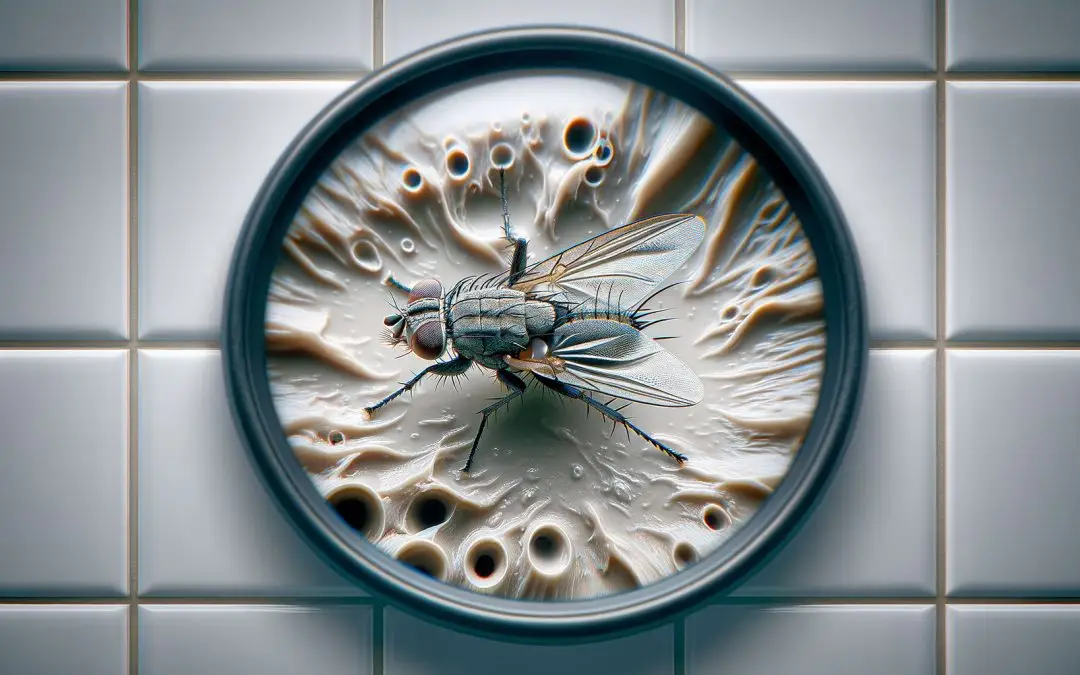
The flies are small, at only 3-4mm in length, with dark grey bodies and hairy moth-like wings that dominate their body size, as shown in the photo below.

Solving the mystery of why drain flies only appear in bathrooms?

If you’re not on an acreage with a septic tank or sewer treatment plant, your only encounter with these annoying flies is probably in your bathroom. These flies are prolific breeders in septic tanks and treatment plants but tend to stay near their food source.

During the day, bathroom flies often sit on walls or under the vanity basin or ceiling. However, they are more active at night, so you may not see them flying or emerging from your floor waste drain.

Despite being poor fliers, drain flies can travel long distances of 3-5km, carried by the wind away from septic tanks or treatment plants. They can enter your home through your insect screens since they are small enough to fit through the holes in the mesh. Ultimately, they will seek out your bathroom floor waste drains as a food and breeding source.

The drain fly dilemma where do they live and breed?

Drain flies are weak fliers, never straying far from the bathroom floor waste drain, causing them to be exclusively found in bathrooms.

Infestations occur when temperatures exceed 20°C in spring. Drain flies multiply rapidly as their life cycle is 1-3 weeks from egg to adult. Eggs hatch within 48 hours, becoming larvae that mature within 12 days, feeding on decaying organic matter in the bathroom floor waste drain. The adult flies emerge from the drain at night, living no more than two weeks.

Tiny insects, big headache: Tips for eliminating drain flies from your​ bathroom?

Removing breeding sites in bathroom drains is the best way to control and eliminate drain flies. Bleach can help with minor infestations but not major ones, which require sealing and cleaning of the floor waste trap.

Our experience has shown that cleaning the area around the floor waste, and inside the drain, with Enzyme Wizard All Purpose Surface Spray will sanitise and disinfect the breeding ground and food source of drain flies.

If you’re struggling with persistent drain fly infestations, call us at Whywait Plumbing on (07) 5580 4311 to book a service call. We’ll eliminate them for good.


WaterMark Certification Guaranteeing Community Health and Safety

WaterMark Certification Guaranteeing Community Health and Safety

The WaterMark Certification Scheme Is Ultimately About Your Health

The WaterMark Certification Scheme is not voluntary. It is a mandatory and legally enforcible certification scheme covering Australia for all plumbing and drainage products. Ultimately it is about guaranteeing community health and safety.  

Bear in mind the water you drink, cook with and wash in can conceivably transmit waterborne diseases if the water becomes contaminated. This is a major reason why all products such as taps you drink from must be WaterMark approved.

Every product that is intended for use in all plumbing and drainage installations must undergo a risk assessment to identify any potential risk of manufacturing faults and installation failures.

Looking for the WaterMark 

When purchasing any new plumbing products for your home such as taps or toilets you must check that the products you are buying or installing are certified for use in Australia?

Certified products are easy to identify by the WaterMark certification trademark logo, as illustrated below. The WaterMark logo must appear on a product or its packaging, in addition to its WaterMark licence number and the applicable product specification.

Regrettably, many people go online to buy “cheap” plumbing products especially taps. Few of these taps have WaterMark Certification and potentially can be manufactured with large amounts of lead in the metal.

Deplorably there are many companies in Australia who think they can ignore their responsibilities to obey the law where WaterMark Certification is required in the pursuit of profits. Online sales of what are technically illegal plumbing products are rampant. There are advertisements all over social media promoting the purchase and DIY installations of non WaterMark approved products such as My Bidet Australia.

WaterMark Awareness

The WaterMark Certification Scheme is administered by the Australian Building Codes Board or ABCB as part of the Plumbing Code of Australia or PCA.

With all of the issues surrounding COVID-19 earlier this year, the ABCB along with the QBCC and Queensland Health became very concerned about online purchasing of bidet seats, tap, shower, toilet and urinal products on eBay and other online stores.

This resulted in the ABCB rolling out the LOOK for the WaterMark campaign. The campaign aims to improve compliance with the PCA, by promoting the WaterMark Certification Scheme to increase the understanding of why products must have WaterMark.

The LOOK for the WaterMark campaign will be implemented as a succession of WaterMark promotions with three key messages:

  • WaterMark certified products are all marked with the WaterMark trademark logo, WaterMark licence number and applicable specification.
  • Plumbing work must be undertaken by licensed plumbers who are legally required to install only WaterMark certified products.
  • How to search the WaterMark product database to locate and verify all WaterMark certified products.

What is WaterMark?

The video below explains exactly what the WaterMark Certification Scheme is and why we have it to protect your health.

What Plumbing Products Require WaterMark?

The video below explains exactly which plumbing products are required to have WaterMark Certification and how you will know if the product has been certified.

How to Use The WaterMark Product Database

The video below explains how to search for plumbing products WaterMark Certification on the WaterMark Product Database so that you can verify if the product has been certified.

Responsibility for Supply & Installation of WaterMark Approved Products

Enforcement of most laws concerning plumbing and plumbing products lays with the Queensland Building and Construction Commission or QBCC.

As Licensed Plumbers, it has always been illegal for us here at Whywait Plumbing to install non WaterMark approved products and non-conforming plumbing products. Since 2017 it has been illegal for anyone to supply a non-conforming plumbing product.

At Whywait Plumbing we have always complied with the laws that pertain to plumbing products. We will notify the QBCC immediately whenever we discover non-conforming, non-compliant illegal plumbing products installed anywhere.

Ultimately all of these laws are for your protection, safety and the security of community health.

Don’t Fall For The Sacrificial Anode Replacement Rip-Off

Don’t Fall For The Sacrificial Anode Replacement Rip-Off

The Sacrificial Anode Replacement Rip-Off 

The great sacrificial anode replacement rip-off resurfaces every few years.

The routine invariably starts in the middle of the day with a knock on the door by a friendly “salesman”. After warm greetings, they state they are in your neighbourhood doing some work and that a neighbour had suggested they do the same “free check” on your hot water service.

This unsolicited pitch or a variation of it is the signature pitch of conmen who prey on unsuspecting homeowners, especially the elderly creating fear about their hot water tank. Commonly they display a great deal of empathy and concern and are only doing the “free check” of your hot water service as one of your neighbours had already had theirs repaired and were concerned for you.

The “free check” invariably concludes with you urgently needing a sacrificial anode replacement. If you have water stains on your hot water tank similar to the photo below then you have a leak in the tank.

What Is A Leaking Sacrificial Anode

As you can see below this tank needed replacement as it was leaking around the sacrificial anode. Installing a new sacrificial anode will achieve nothing.

A leaking hot water tank cannot be repaired.

Even if your hot water tank is not leaking the friendly salesman will assure you it is about to start leaking if you don’t replace the sacrificial anode now.

To back it up he will have information from the manufacturers about replacing the sacrificial anode backed up by horror photos.

Does A Sacrificial Anode Need Replacing?

Yes, your sacrificial anode on your hot water service should be checked at least every 5 years.

But if it has never been checked or replaced and your hot water service is over 10 years old you are wasting your time replacing it as the damage has already been done to your steel storage tank.

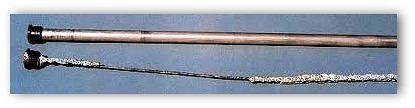
The photo above illustrates perfectly a brand new sacrificial anode at the top of the photo. The sacrificial anode in the bottom of the photo was removed after nine years inside a hot water tank.

 Basically your hot water tank is prevented from rusting away by the sacrificial anode. The anode corrodes instead of the steel tank which is the cathode. This principle of electrolytic corrosion control is described as cathodic protection. Hence the term sacrificial anode. As a cathodic surface cannot rust, the steel hot water tank is protected as long as the anode is whole and working.

These days the majority of hot water tanks last around 12 to 15 years. The sacrificial anode prolongs the life of your hot water tank. But once the anode becomes ineffective the steel tank is no longer a cathode and begins to rust from the inside. Once the rusting process begins, it takes about 3 to 5 years for it to eat away through the steel tank wall. 

Who Can Replace A Sacrificial Anode?

As with any plumbing fixture, only a licenced plumber working for a QBCC licensed plumbing contractor can replace a sacrificial anode.

Take it from me knocking on your door and cold-calling is not a professional or viable way to market or operate a plumbing business.

In all likelihood, the person knocking on your door is not a licensed plumber or a licensed plumbing contractor. Simply ask them to produce their licenses. In our experience, they are not a plumber but ordinary old con artists who have no experience or knowledge in servicing a hot water service.

InSinkErator Safety

InSinkErator Safety

InSinkErator Questions

In November it will be 48 years since I finished high school and began my plumbing apprenticeship. Over the years, I have either asked myself every dumb question or have been asked some interesting questions by other people concerning plumbing.

But last week I got asked a question by Steve, a long-standing client that I cannot recollect ever being asked before. The question being, “What happens if I stick my hand into the kitchen sink InSinkErator waste disposal unit when it’s going?

My first response was to wonder why you would contemplate even doing such a thing. That was until Steve explained it was a question posed by his 5-year-old grandson.

Steve was genuinely worried it was something his grandson may try to attempt. Now the question did not seem so dumb at all. Steve was correct to be worried that his grandson would try to see what would happen if he put his hand down the InSinkErator unit when it was turned on because as we all know a 5-year old has little fear.

Steve was seriously contemplating getting us to remove the food waste disposal unit out of the sink permanently. This was despite him being concerned about the loss of conveniently and hygienically disposing of food scraps which could also increase the risk of a blocked sink.

An InSinkErator Has NO BLADES

Like most people, Steve was convinced that an InSinkErator waste disposal unit is a mass of sharp blades spinning around chopping and shredding everything that enters its chamber. Contrary to popular believe an InSinkErator sink waste disposal unit is not like a kitchen blender and it has NO BLADES at all.

Steve was much happier once I explained how an InSinkErator unit works. If his grandson put his hand into the unit when it was turned on then he would at the worse end up with a bruised and maybe cut hand. Although in all likelihood he would pull his hand out as soon as it came into contact with the spinning plate and or its impellers which have absolutely no cutting function.

Very simply instead of spinning blades chopping, cutting and breaking down the food scraps InSinkErator waste disposal works by:

  • Instead of blades, impellers (or lugs) mounted on a spinning plate use centrifugal force to continuously force food waste particles against a stationary grind ring
  • The grind ring breaks down the food scraps into very fine particles – virtually liquefying them
  • After they are ground, the running water flushes the particles through the grind ring and out of the disposer and into your waste-water pipe and into the sewer house drains

How Does An InSinkErator Work? 

If you want to see exactly how an InSinkErator waste disposal unit works have a look at this 90-second video below which gives you a graphic inside view of how a unit works.
After watching the above video Steve was happy to keep using his InSinkErator waste disposal unit because like most people who have an InSinkErator he knew it was the most convenient, environmentally friendly and hygienic method to dispose of food waste and scraps. Generally, waste disposal units create a safer and cleaner kitchen using minimal water and electricity.

Tips on Using An InSinkErator

If you already have an InSinkErator sink waste disposal unit installed here are a few tips to using it which assist in prolonging its working life:

  • InSinkErator waste disposal units can become stuck or seized, and this can be caused by non-food items such as spoons being placed or falling into the unit
  • overfilling the InSinkErator can cause the unit to jam
  • grease or fatty liquids should not be poured into the InSinkErator
  • InSinkErator units should never be run dry, always use with the cold water running whilst the unit is spinning plus always turn the cold water off after turning off the unit
  • cleaning your InSinkErator waste disposal unit once every week by inserting and grinding a handful of ice in your unit. This will remove any buildup that may have been left when grinding food materials, and often gets rid of any smell coming from your kitchen sink drain. If an odour persists after carrying out this cleaning try cutting up and grinding a lemon or grapefruit will give a fresh citrus smell
  • the InSinkErator unit should be equipped with a reset button either at the side of the unit (older models) or underneath the unit.  If your unit fails to start after pressing the reset, then it is probably more than just jammed disposal, and you should call Whywait Plumbing and have one of our plumbers solve the problem.
Tree Roots in Sewer Drains

Tree Roots in Sewer Drains

Tree roots in sewer drains have legal rights

Tree roots in sewer drains are an issue we are confronted with every week. They can be confronting for plumbers as we are frequently faced with situations where clients want us to give quasi-legal rulings on non-compliance of tree roots in the sewer drains where there is, in reality, no black-or-white answer. The truth is there are multiple opinions in multiple shades of grey.

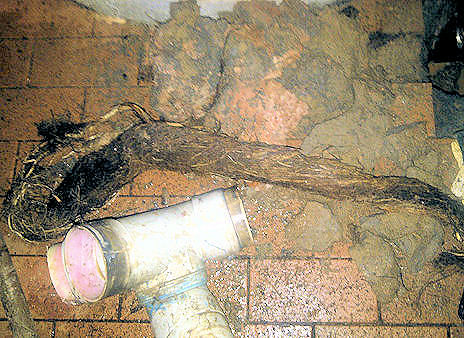
A perennial issue for all plumbers as long as I can remember is the issues created by trees and tree roots. Trees can significantly damage plumbing infrastructure, mainly underground water pipes and drains. Often the damage has been slowly occurring over many years before you are affected.

A common issue we are confronted with, numerous times every month, is tree roots in sewer drains and stormwater drains.

A fact that some people fail to grasp is that tree roots don’t respect or understand property boundaries. Trees grow, and their tree roots search for water and nutrients from the soil. Regrettably, your sewer drains are a great source of water and nutrients for tree roots. So your broken drains are the ultimate party time for trees.

tree roots in sewer drains

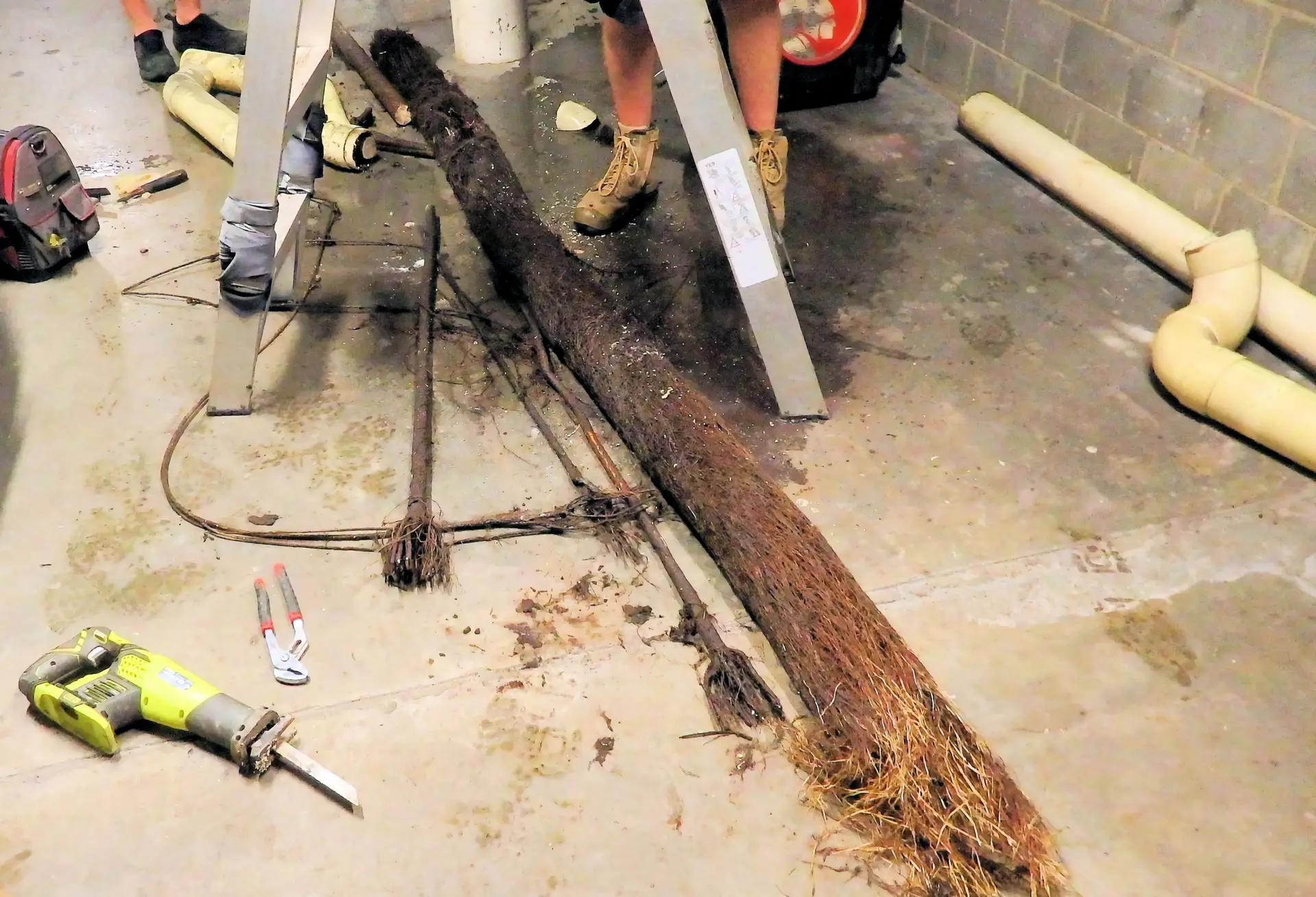
The photo above perfectly shows how far tree roots will infiltrate a drain. These tree roots we removed from a stormwater drain had infiltrated 42 meters down the drain and were causing flooding to the property every time there was a rainfall event.

These tree roots came from multiple trees situated in multiple surrounding properties. The roots infiltrated the drain in multiple locations where the pipe was cracked and broken. Broken pipes are how tree roots infiltrate a drain. Tree roots by themselves cannot break a pipe open.

Large trees are a source of neighbourhood disputes

Recently, the Gold Coast has allowed urban blocks to become smaller and smaller.  Over the years, as the trees in landscaped urban blocks mature, problems begin to occur. Any large tree can become a natural source of angst and stress. This results in trees becoming a source of disagreements between otherwise friendly neighbours, with the most common disputes being:

  • Branches overhanging the boundary fence and pushing over dividing fences
  • Branches, fruit and leaf litter dropping into the neighbouring property
  • Roots causing damage to underground drains, water mains, electrical conduits and telecommunications conduits
  • Roots damaging fences, walls, house foundations and concrete paths and driveways
  • Branches blocking sunlight for solar PV panels, solar hot water panels, windows, Foxtel microwave dishes and TV aerials

Issues with branches are visible to everyone, so they are generally much easier to resolve. In most instants, an amicable discussion with your neighbour can resolve most branch issues as there is a common interest.

Roots in sewer drains or stormwater drains are vastly different. These underground root infiltrations are neither visible nor easily traceable to their source. 

Tree roots in sewer drains & stormwater drains

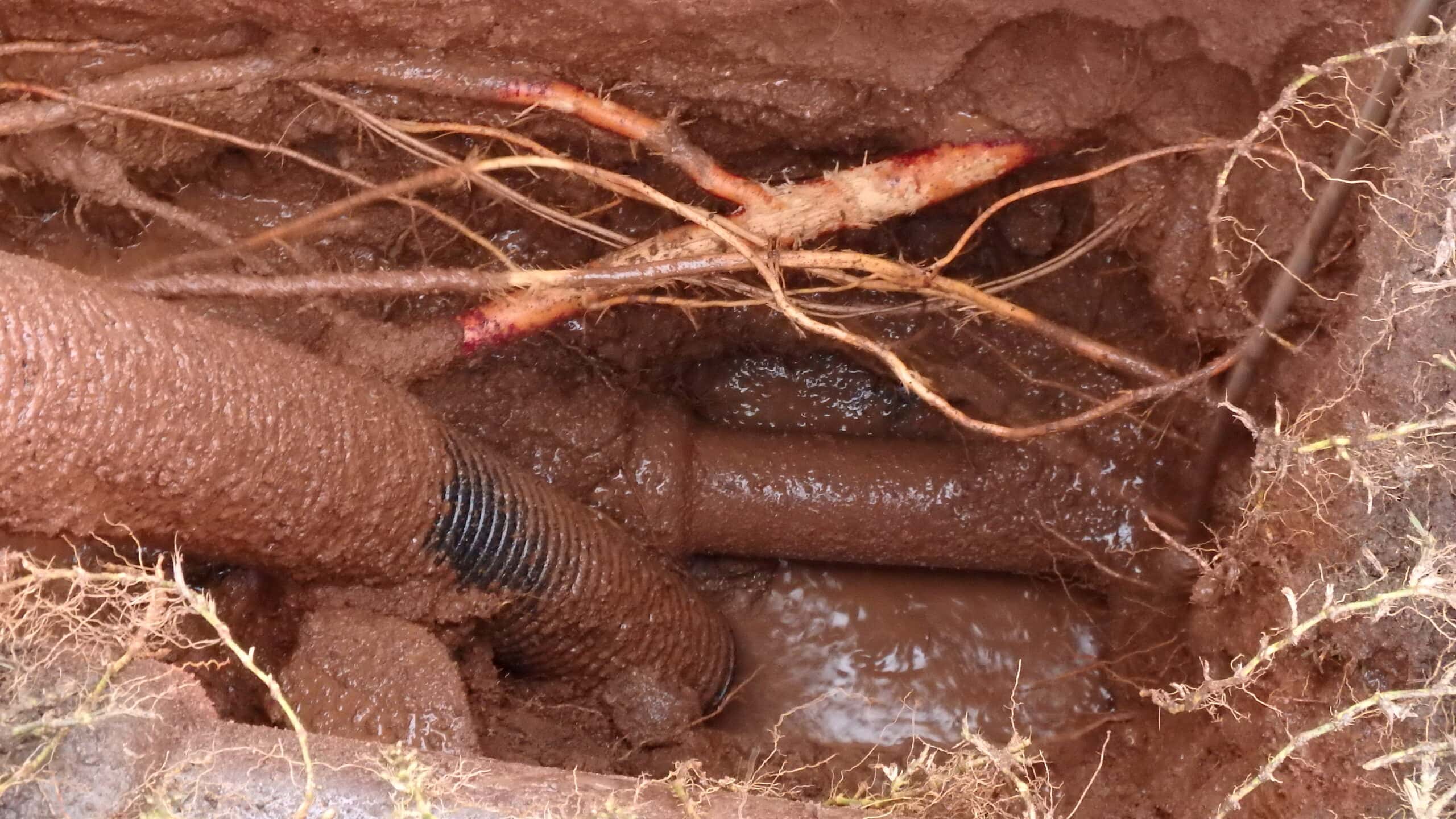
When we find your drain blocked with tree roots, multiple roots are often inside the drain causing the blockage. Without an extensive horticultural investigation to determine the type of tree the roots are from, no one can ascertain which tree’s roots have infiltrated your drain and where the tree roots originate from.

As you can see in the photo above, where we have undertaken vacuum excavation of a drain, the roots are everywhere around the sewer pipe. In addition, it is visible that there are multiple roots of varying sizes and tree types.

Contrary to multiple urban myths, tree roots do not break drains whether the drain is installed in PVC pipe or earthenware pipe.

Yes, in old earthenware, tree roots will infiltrate the drain around the rubber ring joints over time, but that is because of movement in the ground that enable the roots to infiltrate slowly over a number of years.

With PVC drains, tree roots can’t break open pipes or fittings. In every instant I have seen, the drain was broken, usually on a bend or junction that allowed the roots to infiltrate the drain. In just about every instant we come across broken PVC drains, it is our opinion the drain was damaged during the initial installation of the drain at the time of construction.

It is almost impossible to prevent tree roots from entering a broken drain without repairing the drain. This is where we commonly see the problems originating with neighbour disputes. It is not unusual to have clients misinterpret what we inform them and attempt to put words in our mouths as to whom is responsible for clearing the blocked drain and repairing the damaged drain.

The law concerning tree roots in sewer drains

If you have no trees on your property and your neighbour has a fully landscaped garden full of trees, then yes, it’s likely the neighbour is responsible.

Having been drawn into these arguments between neighbours on several occasions over the years, I highly recommend that you try to resolve the issue tactfully with your neighbour before things get out of hand. I can assure you this is always quicker, cheaper and much less stressful than taking legal action, which will ultimately end up in mediation after spending a small fortune with a solicitor.

From the legal perspective, the Neighbourhood Disputes (Dividing Fences and Trees) Act 2011 is legislation relating to trees. The legislation requires that you determine who has the responsibility for the tree. However, if the tree is on the boundary, both parties will have responsibility equivalent to the number of trees on each property.

Trees have legal rights

You must know that you cannot take the law into your own hands where trees are concerned. You cannot remove a tree outside your property that you believe is damaging your property. Legally all you can do is remove overhanging branches up to the boundary.

If you back onto a City of Gold Coast public park or reserve, you must contact the council about the problems as many trees in public parks are protected.

Before planting any large trees on your property, you should consider the height they will grow to when they mature and where their roots can spread. Similarly, assessing neighbouring trees with your neighbour now may prevent property damage and large bills in the future.

Ultimately your house is your primary asset, and it is in your interests to protect your investment but remember trees have rights to, and just cannot be chopped down for no reason if they are not on your property.

CALL NOW
CALL NOW