Non-Conforming & Non-Compliant, Plumbing & Building Products Are Illegal To Supply, Specify & Install
Non-conforming plumbing products that do not have the appropriate WaterMark certification have always been illegal for licensed plumbers to install.
The WaterMark Certification Scheme is not voluntary. It is a mandatory and legally enforceable certification scheme for plumbing and drainage products. This is to ensure they are fit for purpose plus appropriately tested and authorised for use in all plumbing and drainage installations.
It has been illegal since 2017 for anyone to supply, specify, or instruct others to install or for anyone to install non-conforming plumbing and building products in Queensland. Unfortunately, many companies think they can ignore their responsibilities to obey the law. Online sales of non-conforming plumbing products are rampant. There are advertisements all over social media promoting DIY installations of non-conforming plumbing products, such as My Bidet Australia.
On 30 August 2017, the Building and Construction Legislation (Non-conforming Building Products-Chain of Responsibility and Other Matters) Amendment Act 2017, regarding the use and sale of non-conforming building products, became law.
These laws further strengthened how compliance must be achieved with amendments to the Queensland Building and Construction Act 1991, the Plumbing and Drainage Act 2018, and the Building Act 1975 concerning non-conforming building and plumbing products.
These laws create a chain of responsibility so that designers, manufacturers, importers, and suppliers of plumbing and building products have as much responsibility as licensed plumbers to ensure a product is compliant and fit for its intended purpose.
These laws give the Queensland Building and Construction Commission (QBCC) new powers to investigate the manufacture, sale and use of non-conforming building products.
Building and plumbing products are regarded as illegal, non-conforming or non-compliant for an intended use if;
the product is not, or will not be, safe; or
does not, or will not, comply with the relevant regulatory provisions or
the product does not perform or is not capable of performing, for the use of the standard it is represented to conform by, such as Watermark certification.
Definitions of Non-Conforming Plumbing Products
There are 1000’s of plumbing products manufactured both in Australia and overseas. Consequently, it can be challenging to know whether or not a plumbing product is genuine and will perform as required, plus it will comply and conform with the WaterMark Certification Scheme.
You can check the WaterMark Product Database, which lists all plumbing products that have been certified and marked in accordance with the requirements of the WaterMark Certification Scheme.
In general, everyone should be aware of the following terms regarding compliant plumbing products:
Non-compliant plumbing and building products and materials are used when they do not comply with the National Construction Code (NCC) requirements, which encompasses the WaterMark Certification Scheme. You must be aware any plumbing product can be both non-conforming and non-compliant.
Fraudulent documentation refers to a recorded claim that a plumbing product’s performance meets specified Australian plumbing standards when used or tested, but it does not meet that performance claim. This frequently will include falsified documentation, fraudulent certification or test results.
Product substitution is commonplace and can occur when a product is submitted for third-party certification testing. After the WaterMark certification is granted, the manufacturer/supplier alters it and does not retest or recertify the product. Product substitution is also a widespread problem where a seemingly identical but non-conforming replacement plumbing product is offered to replace the WaterMark-certified product.
Counterfeit plumbing products are also widespread and are unauthorised copies of plumbing products created to deceive. They are illegally sold to suppliers, plumbers, building owners and consumers as genuine.
Responsibility
These laws have created a legal chain of responsibility for everyone for reporting non-conforming building or plumbing products to the QBCC. This duty applies to every person in the chain of responsibility who becomes aware or reasonably suspects that the building or plumbing product installed is non-conforming or non-compliant for the intended use.
As Licensed Plumbers, it has always been illegal for us here at Whywait Plumbing to install non-conforming plumbing products. However, it is now illegal to supply a non-conforming plumbing product.
At Whywait Plumbing, we have always complied with these laws. We will notify the QBCC immediately whenever we discover non-conforming, non-compliant, illegal plumbing products installed anywhere.
Ultimately, these laws are for everyone’s protection, safety, and security.
As good as Google can be for searching everything and anything, I guarantee no one at Google ever completed a plumbing apprenticeship, a medical degree, or an electrical apprenticeship.
One of the main reasons Google Plumbing should not be trusted as the ultimate authority on plumbing is that it is easy for anyone to post information online, regardless of their qualifications or expertise. This means that the information you find may not be accurate or reliable. Additionally, many online sources of information are not specifically tailored to your individual situation, which means that the advice you receive may not apply to your plumbing problem.
Another issue with relying on Google Plumbing for plumbing advice is that it can be difficult to distinguish between credible and non-credible sources. For example, a quick Google search for plumbing tips may yield mixed results, including blog posts, forums, and videos. However, not all of these sources will be equally reliable. For example, a blog post written by a professional plumber will likely be more credible than a forum thread started by a non-expert.
Google frustrates service delivery
I was chatting with my GP recently, and she voiced her frustrations with patients that Google their symptoms and then make an appointment to see her. Almost invariably, Dr Google is wrong. Usually, the patient has typed-in symptoms that frequently give an utterly incorrect diagnosis of multiple possible ailments. She said even more frustrating is that she then spends most of the appointment convincing them Dr Google was wrong.
She was so happy when I told her as plumbers, we go through the same issues daily. Everyone I know in a service industry with a consumer focus has the same problems and frustrations of being an instant expert thanks to Dr Google or Google Plumbing or Google Electrical.
We all agree Google is excellent, especially for product searches. But when you are in business, it can also be incredibly frustrating when clients tell you they have Googled the problem and you are wrong. Ultimately, for doctors, plumbers, or electricians, all we can do is diagnose the issues based on the information presented and eliminate possible causes.
Online symptom checkers are almost always wrong
The headline above compares Dr Google to a drunk friend I just had to adapt and use it after I saw it in a column by Tony Shepherd of The Adelaide Advertiser just after discussing Dr Google with my GP. It amused me as the description is perfect – dramatic and unreliable. You can read the entire column by clicking here; it is a great read. The first lines are “Cyberchondriacs, step away from the search engine. Online symptom checkers are almost always wrong and should never replace a real medical professional, writes Tory Shepherd.”
This advice equally applies to plumbing because it can be difficult enough to diagnose plumbing problems when on site, alone on a computer or over the phone. As I continually reiterate, no professional plumber can diagnose issues over the phone or give you an accurate price. There is only one way to diagnose plumbing problems: having a real plumber on-site to investigate. Even then, complex issues become a process of elimination.
From the plumbing and, ultimately, health perspective, the most frightening issue we’ve seen with COVID-19 is all of the online suggestions on DIY installations of bidet seats and douche sprays. For example, Google searches during the “toilet paper crisis” increased tenfold for bidet seats due to multiple social media posts and newspaper articles on alternate toileting devices. But, unfortunately, Google will only give you generalised answers tailored to you as Google tracks you online with artificial intelligence.
Tony Shepherd correctly points out – “Maybe it’s best to think of Google not as a medical professional but as Librarian Google, who holds plenty of information and might be able to help you find it, but might also be miffed at the amount of noise you make so just points you in the general direction of some stuff.”
My favourite lines after that are – “Or Friend Google who, after three champagnes, will tell you everything’s going to be great, but at 2 am starts crying into their whisky about how you’re going to die.”
The lines above describe the daily frustrations many consumer-focused service businesses experience. The old saying about computers of rubbish in, rubbish out is correct. The flawed Google searches of an inexperienced person create multiple issues, as nonsense input into a Google search will guarantee nonsense results.
Google Plumbing is not yet reality
The lines above describe the daily frustrations many consumer-focused service businesses experience. The old saying about computers of rubbish in, rubbish out is correct. The flawed Google searches of an inexperienced person create multiple issues, as nonsense input into a Google search will guarantee nonsense results.
Ultimately, Google is a tool or research assistant that can help you put things together logically or throw a real spanner in the works. But unfortunately, a Google search cannot replace a doctor, electrician, or plumber, no matter how good Google’s artificial intelligence is.
In conclusion, while the internet can be a valuable tool for gathering information about plumbing, it should not be relied upon as the sole source of knowledge. Instead, always seek the advice of a qualified and experienced plumber, like the team at Whywait Plumbing, for accurate and reliable information about your plumbing needs. We’re here to provide you with professional and efficient service, so don’t hesitate to contact us if you have any plumbing issues.
With all the uncertainly during this ongoing COVID-19 crisis, it is critical Gold Coast homeowners and businesses don’t fall into the trap of using so-called handymen or unlicensed plumbers. In reality, there is no such occupation categorised as unlicensed plumbers. Every person classified as a plumber is licensed by the Queensland Building and Construction Commission or QBCC.
All individuals and companies must hold a QBCC licence for any building works that involve any work that is:
Plumbing
Drainage
Gas Fitting
Your plumbing is not a simplistic plaything and worldwide is classified as critical public health infrastructure. All work undertaken on any aspect of your plumbing, drainage or gas infrastructure is legally required to be undertaken by appropriately licensed individuals and companies.
All plumbers frequently experience fixing up after a handyman who makes out that unlicensed plumbers exist and convinces homeowners he can undertake plumbing works as long as it’s under $3300 of value. This is a complete lie by opportunistic unlicensed scammers who put your families health at risk. The benchmark value for undertaking plumbing, drainage or gas work is $0 and always has been.
Any plumbing, drainage and gasfitting work is essential to ensuring the health and safety of the entire community. This is critically important with the COVIC-19 health pandemic we are currently facing.
Every aspect of the plumbing, drainage and gas trades are administered by a strict licensing and legislative regime. This ensures every person in these trades holds the relative QBCC licences that are legally required. This, in turn, ensures the safety and protection of the entire community through the provision of clean, safe drinking water, sanitary drains and sewers to dispose of wastewater, and gas pipes and appliances that are fit for purpose.
We all agree that using a licensed plumber or gas fitter can appear expensive, but it is an investment that protects your families health. Using an unlicensed plumber can null and void your insurance coverage plus leave you with possible legal and financial implications.
Especially now demand to sight the QBCC licences visually. A QBCC occupational licence enables the person to carry out the work physically. A QBCC contractor licence allows the person to engage in contracting for the work.
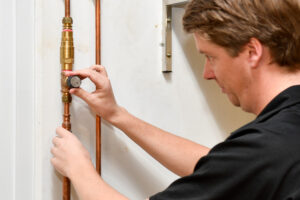
Can plumbing work be undertaken by unlicensed plumbers or handymen?
Repairing or replacing a drop valve washer, float valve washer or suction cup rubber in a toilet cistern
Replacing caps or covers to ground-level inspection openings on a sanitary drain
Cleaning or maintaining a ground-level grate for a trap on a sanitary drain
Installing or maintaining an irrigation or lawn watering system downstream from a tap, isolating valve or backflow prevention device on the supply pipe for the watering system
Repairing or maintaining an irrigation system for the disposal of effluent from a greywater use facility or on-site sewage facility
Fire protection work for testing plumbing carried out by a holder of a fire protection occupational licence or another QBCC licence
Incidental unskilled tasks such as excavating or backfilling a trench
Many of these tasks are much more complicated than they appear. Mixer taps, for example, can be extremely complicated just to dismantle and technically they have no washer so must always be worked on by a licensed plumber.
Despite social media saying yes you can we can guarantee it is entirely illegal for anyone other than a licensed plumber to install a bidet seat or a douche spray to a toilet.
Checking a plumbers licence
Prior to letting anyone commence work on your plumbing, drainage or gas ask them for their plumbers’ licence as they are legally obliged to produce it for you if requested.
For extra assurance go the QBCC website to find out more about a licensee you can use their online licensee search, or search their occupational licence.
Just remember there is no such occupational listing called unlicensed plumbers in Australia in any state or territory.
Like for Like Hot Water Service Replacement Online Pricing Scams
In Queensland, if you see online website prices or are quoted over the phone a price for like for like hot water service replacement for an electric or gas storage tank¹system, don’t believe one word of it. The prices are a sham designed to scam you into calling them to book in the job.
The Reality is Like For Like Replacements Seldom Exist
The prices quoted above are about right for a like for like installation. The problem is probably only one person in a hundred would qualify for this pricing.
I can 99% guarantee²you will not receive that price for a legally compliant hot water service replacement issued with aQBCC Form 4 compliance certificate.
The pricing and terminology are deliberately deceptive and are a scam. I will categorically state the prices are absolutely bullshit and lies, for most installations.
Going back over ten years ago yes all plumbers undertook like for like hot water service replacement when replacing electric or gas storage hot water tanks. Simply this was legally compliant at the time and accepted industry practice.
What is Like for Like Hot Water Service Replacement?
“Like for like” installation is frequently seen as the basis of website pricing as a starting point for replacing your hot water system. They usually use confusing terminology, stating that the pricing starts from what is a low price for a like for like installation. They then vaguely define like for like as being for replacing the hot water system where it is:
the same type of hot water system as the old hot water system
that the hot water system is being installed in precisely the same location as the old hot water system
that the new hot water system is the same size as the old hot water system
that the new hot water system has the same electrical requirements as the old hot water system
Of course, it’s not explained clearly like I have using sixty-seven words. Instead, they tell all that in one compressed, thirty-four-word sentence.
Naturally, there will be getting out of gaol clauses that are again vague and confusing. These clauses will state that other costs may be incurred because:
you have individual site installation requirements to ensure your like for like hot water service replacement is compliant with all regulations
if you require any additional valves installed that were not in the like for like scope of works
if you request the removal and disposal of the old hot water service
if you require a new concrete slab or support base
if you need any additional piping to be installed
if you require any additional electrical wiring or any electrical work other than disconnecting and reconnecting
any work whatsoever that is required to the existing plumbing, electrical or gas infrastructure to ensure your like for like hot water service replacement is compliant with the council, state or commonwealth regulations
any additional labour or equipment required due to site access conditions
Like for Like is at Best An Estimate of the Installation Cost Only
All of the above are standard requirements on any hot water system replacement to meet the legal requirements of the Plumbing and Drainage Act 2018 and thePlumbing and Drainage Regulation 2019.
The whole reason all of the above and many more possibilities are excluded from a like for like hot water service replacement offer is to fool you.
Ultimately every existing hot water service installation has individual requirements when installing a replacement hot water service. That is why a website price or a quote over the phone is meaningless.
You can only ever get a correct price for replacing your old, leaking hot water service after a comprehensive site inspection. In the small print on all websites that quote like for like replacements, they almost always state somewhere that pricing may change once their plumber undertakes a site inspection
Why Is A Like for Like Hot Water Service Replacement Non-Compliant?
The photo below is a Dux 50litre electric hot water servicethat has been replaced like for like.Except it is utterly non-compliant because:
the hot water pipes are not insulated
the relief valve is not insulated
there is no pressure reduction valve
there is no cold-water expansion valve
there is no tempering valve
as it is an internal installation, there is no hot water tray to contain water leaking from the tank, pipes or valves
there is no automatic shutoff valve to cut off the water should there be a leak
there was no QBCC form 4 given to the property owner
There is no such thing as a like for like installation. There is definitely no such thing as an exemption for a QBCC Form 4 compliance certificate if you are only undertaking a like for like installation.
What is Required to Replace a Leaking Hot Water Service?
If your hot water service is leaking and requires a replacement then in all likelihood it will be at least eight years old and probably much more. I can guarantee the infrastructure regarding valves and overflow drains will not be compliant with the legal requirements that we must now adhere to.
We recently replaced the nine-year-oldSiddons heat pumpunit in the photo below that was no longer functioning with a CO2 Smart Heat Pump hot water unit. Even though it was only installed nine years ago, it was utterly non-compliant with the current requirements.
Every Hot Water System Replacement Must Be Upgraded to be Compliant With AS/NZS 3500.4:2018
This standard, along with several other standards, is called into law via the Plumbing and Drainage Act 2018 and the Plumbing and Drainage Regulation 2019.
The installation of a new or replacement hot water service must comply absolutely with the standard and in particular Section 5 Installation of Water Heaters – General Requirements. The scope of this section states explicitly:This Section sets out general requirements for the installation of water heaters, their location, support, cold water service valves, the vent or drain lines, and the first 2 m of heated water supply piping.
This section sets out exactly how all hot water service installations must be undertaken. Nowhere does it refer to a like for like hot water service replacement.
Noprofessional, reputable plumberwill quote you on a like for like installation as they know it does not exist. Companies who market on this basis are engaging in deceptive and misleading marketing to get their foot in your door, so they can then upsell you.
Any plumber who starts telling you that you can get a lower price with a like for like replacement is simply a liar.
Every hot water service replacement must have a Form 4 compliance certificate lodged with the QBCC and the appropriate fee paid. Ultimately this is for your protection as compliantly installed plumbing, and drainage installation is about protecting your health.
Replacing a hot water service does not involve guesswork it’s about merely obeying the law and being compliant with the Plumbing and Drainage Act 2018. If you have had your hot water service replaced as a like for like replacement you need to report it now to theQBCC as an offence complaint. The plumber who undertook the installation will be required to return and complete the installation in compliance with the Plumbing and Drainage Act 2018 at his cost.
If you are uncertain about your hot water service replacement or need assistance contact us on(07) 5580 4311and we will give you our opinion on how to proceed.
Footnotes
¹ :Replacing an instantaneous gas hot water unit is frequently like for like as it is a straight disconnection and reconnection to the gas connection and to the water pipes. In most instantaneous units, there is no need to install or replace valves as all management of temperature is undertaken inside the unit.
² :The only time I have seen a compliant like for like replacement is when a faulty hot water service has had to be replaced within the first 12 months after installation and was already fully compliant. This is a genuine like for like replacement under the manufacturers guarantee where the client pays nothing and where everything concerning the plumbing and electrical infrastructure was already compliant.
Water is a finite resource, and as environmental consciousness grows, so does our responsibility to preserve it. With traditional urinals squandering copious amounts of water, an alternative is not just an option but an urgent necessity.
Ditching the Old Ways: How Traditional Urinals Fail Us
It might startle you, but conventional urinals can waste up to 25 litres of water with each flush. That’s the same volume as filling a typical kitchen sink to dispose of a small amount of urine.
But, ZeroFlush waterless urinals turn the tables using gravity’s power.
The Genius Behind ZeroFlush Urinals: Nature and Science Combined
ZeroFlush urinals don’t rely on water to whisk away urine. Instead, they utilise a clever one-way valve system. This odour barrier harnesses gravity, directing urine downwards while eliminating any possibility of unpleasant odours wafting back into the room.
They cut out 100% of the water from the conventional flushing mechanism.
The Big Picture: Australia’s Water Consumption
Consider this: non-residential properties have one urinal for every three toilets, accounting for a hefty slice of Australia’s water usage.
By swapping out a water-flushing urinal for a ZeroFlush waterless urinal, we’re looking at a staggering annual water saving of 152,000 litres per urinal.
With water scarcity becoming an increasing concern, such savings are paramount.
Environmental and Economic Implications: A Double Victory
The environmental benefit isn’t just about water savings. The energy used to supply water to commercial buildings, shopping centres, and educational institutions is colossal.
Introducing ZeroFlush urinals can halve a building’s greenhouse gas emissions.
As water costs continue their upward trend in Australia, and with the rise of sewerage discharge factor charges, reducing water usage is as much an economic concern as it is environmental. Commercial property managers must now account not only for the water entering but also for the water leaving the building. Hence, ZeroFlush urinals emerge as champions of both sustainability and cost efficiency.
Debunking Myths: The Hygiene of Waterless Urinals
There’s a misplaced perception that waterless urinals might be less hygienic. It’s time to lay that myth to rest.
How? The bacteria and germs in conventional urinals arise from airborne fecal matter, which creates an ideal environment for them to thrive when combined with the moisture from flushing. Since ZeroFlush urinals don’t have this water action, they greatly diminish the chances of bacterial proliferation.
Another misconception is the association of urine with strong odours. In reality, urine’s inherent odour is relatively mild. The unpleasant smells in male bathrooms are often due to the bacteria from the fecal matter-water combination.
Paving the Way for a Sustainable Future with Whywait Plumbing and ZeroFlush Urinals
ZeroFlush urinals, supplied and expertly installed by Whywait Plumbing, are more than just fixtures; they are a statement.
A declaration that we are ready to make impactful changes to secure our environment and ensure resource sustainability. By installing these urinals, businesses advocate for reduced water and energy consumption and actively diminish greenhouse gas emissions.
In today’s era, where every drop of water counts, ZeroFlush urinals are pillars of innovation, efficiency, and foresight. As stewards of our environment, let’s make informed choices that will echo positively for future generations.
Let Whywait Plumbing guide you on this sustainable journey, ensuring that every step taken is one towards a greener and more prosperous future.


 It has been illegal since 2017 for anyone to supply, specify, or instruct others to install or for anyone to install non-conforming plumbing and building products in Queensland. Unfortunately, many companies think they can ignore their responsibilities to obey the law. Online sales of non-conforming plumbing products are rampant. There are advertisements all over social media promoting DIY installations of non-conforming plumbing products, such as My Bidet Australia.
 You can check the WaterMark Product Database, which lists all plumbing products that have been certified and marked in accordance with the requirements of the WaterMark Certification Scheme.




 Listed below is unregulated plumbing work that can be performed by an unlicensed plumber in accordance with the