
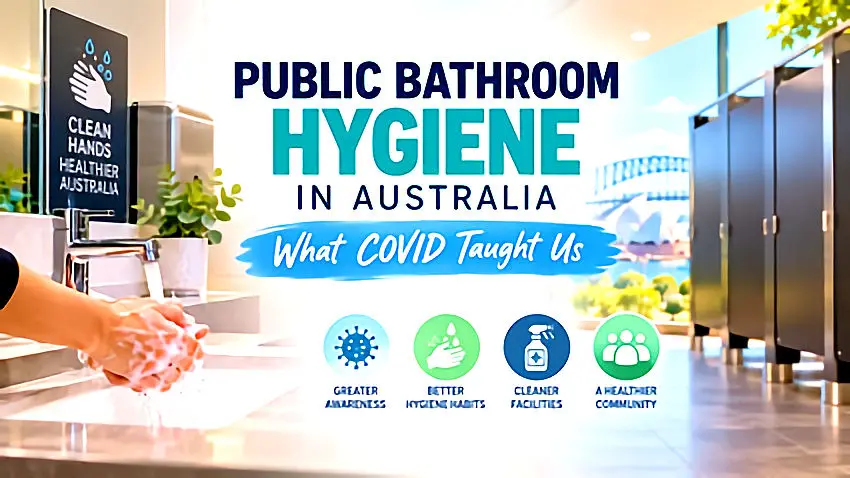
COVID changed the way Australians looked at public bathrooms. Before 2020, most people expected them to be reasonably clean and working properly. Since the pandemic, people are far more conscious of what they touch, how clean a bathroom appears, whether it smells, and whether the fixtures look well-maintained.
That change in expectation has not disappeared.
For businesses, shopping centres, restaurants, schools and public facilities, bathrooms are no longer just a necessary room hidden down the corridor. They have become part of the overall customer experience. A clean, well-maintained bathroom creates confidence. A neglected one can undo a lot of the good work being done elsewhere in the building.
At Whywait Plumbing, we believe that is one of the most important lessons to come from the pandemic.
We became much more aware of what we touch.
Think about a traditional public bathroom. A person may touch a door handle, toilet flush button, tap, soap dispenser, hand dryer and another door on the way out. Before the pandemic, very few people consciously thought about that sequence.
COVID changed that almost overnight.
Touch-free taps, soap dispensers and automatic doors suddenly became much more attractive because people became aware of shared surfaces. The same principle applies to urinals. A properly designed waterless urinal has no flush button, flush valve or electronic sensor for the user to touch. The person simply uses the fixture and walks away.
That simplicity is one of the reasons we have worked with waterless urinals for many years. It removes unnecessary contact and components that can fail or require ongoing servicing.
Sometimes the most hygienic fixture is also the simplest
One of the things the plumbing industry has learned repeatedly is that more technology does not always create a better bathroom. Sensors fail, solenoid valves fail, batteries go flat, and flush valves leak. Automatic systems can also activate unnecessarily, wasting water without improving hygiene.
Good design should remove unnecessary complications wherever possible.
This is particularly relevant with urinals. A ZeroFlush waterless urinal does not require water to be flushed, a flush button, or an automatic flush valve. That means fewer components and fewer things that can go wrong.
Of course, simple does not mean maintenance-free. Every urinal still needs correct cleaning and servicing. The difference is that a well-designed waterless urinal can achieve that without continually using drinking-quality water every time somebody uses it.
The pandemic made us think differently about flushing
Another issue that received much more attention during the pandemic was what actually happens when toilets and urinals are flushed.
Research has shown that flushing toilets can create aerosols containing microscopic particles. That does not mean people should be frightened of using public bathrooms, but it does reinforce something fairly obvious: moving water rapidly around human waste can create droplets and aerosols.
A waterless urinal removes the flushing process entirely.
That gives facility managers another reason to consider waterless technology beyond water savings alone. Whywait Plumbing discusses this in more detail in our article on the ZeroFlush hygiene advantage in public toilets.
Clean does not mean using more chemicals
The pandemic also encouraged an understandable obsession with disinfecting surfaces. Unfortunately, this sometimes created the belief that if a little cleaning chemical was good, then more must be better.
That is not always true, particularly with plumbing fixtures.
Public bathrooms need proper cleaning procedures, but stronger chemicals and excessive use of cleaning products do not automatically yield better results. In some cases, the wrong chemicals can damage fixtures, seals and drainage systems or interfere with the operation of waterless urinals.
Cleaning staff need to understand the fixtures they are maintaining. The plumber, cleaners and facility manager should ideally all be working from the same maintenance procedure.
The cleaner should not have to guess what products to use, and the plumber should not arrive six months later, wondering what has been poured down the fixture. Our urinal maintenance guide explains why correct cleaning and servicing are essential for both flushing and waterless urinals.
Australia cannot afford to forget about water efficiency
COVID dominated the headlines for several years, but another Australian problem never disappeared. Water remains a resource we cannot afford to waste.
Australians understand drought. South East Queensland certainly does. We have experienced severe water restrictions, watched dam levels fall and been repeatedly reminded that our water supply is not unlimited. Then the rain returns and, far too often, water conservation drops down the priority list.
That cycle makes little sense.
Water efficiency should not depend on whether it rained last week. Traditional urinals use drinking-quality water simply to transport urine into a drain. A waterless urinal eliminates the need to flush water.
The saving happens automatically. It does not rely on the customer changing their behaviour or remembering to do anything differently.
This is the important difference between water conservation and water efficiency. Conservation often relies on people changing what they do. Efficiency comes from designing the system to use less water in the first place.
A good public bathroom should be almost uneventful
It may sound strange, but the best public bathrooms are often the ones nobody talks about.
A person walks in, everything works, the room is clean, there is no unpleasant smell, they wash their hands and walk out. Nobody complains. Nobody rings the facility manager, and nobody calls the plumber.
That is success.
Good public bathroom design is not about making the room complicated. It is about making it reliable, easy to clean and easy to maintain. Fixtures should be selected with real-world operation in mind, not simply because they look good in an architectural drawing.
This is something we discuss further in the ZeroFlush article: Public toilet design that reduces callouts and complaints.
Odour is still one of the biggest complaints
People naturally associate bathroom odour with poor hygiene, and understandably so. Nobody wants to walk into a public bathroom that smells unpleasant.
The problem is that covering an odour with fragrance does not solve anything. It simply creates two smells.
Persistent urinary odours require proper investigation. Possible causes include incorrect cleaning, drainage problems, dry floor wastes, poor servicing or fixture problems. Waterless urinals are sometimes blamed automatically, but our experience has often been the opposite.
When correctly installed, cleaned, and maintained, ZeroFlush urinals can create a cleaner, drier urinal environment, and keeping areas dry matters. Constantly wet surfaces around urinals can contribute to staining, cleaning problems and odour.
The goal should never be to disguise a smell. The goal should be to identify and remove the cause.
The bathroom has become part of the customer experience
This is probably the biggest lesson businesses should remember.
Imagine a restaurant with excellent food, friendly staff and beautiful surroundings. Then a customer walks into a filthy bathroom. What do they remember?
Quite often, the bathroom.
The same applies to hotels, clubs, shopping centres, entertainment venues, schools and public facilities. Customers cannot see your maintenance records or inspect your plumbing system. They may have no idea how much effort goes into managing the building.
But they can see the bathroom.
In many ways, the bathroom serves as evidence of how the entire property is managed. A clean, functioning bathroom quietly tells the customer that somebody is paying attention.
A neglected bathroom tells them something else entirely.
What should Australian facility managers be looking at now?
The pandemic is behind us, but the lessons should not disappear with it.
When reviewing a public bathroom, facility managers should look beyond appearance alone. Consider whether unnecessary touchpoints can be removed, whether fixtures are reliable, whether cleaning procedures are clearly documented and whether maintenance staff have been involved in selecting the equipment.
It is also worth asking whether drinking-quality water is being used unnecessarily, whether persistent smells are being properly investigated and whether the bathroom has been designed around whole-of-life maintenance rather than the initial purchase price.
For men’s bathrooms in particular, waterless urinals can be worth considering as part of that assessment.
Where ZeroFlush fits
Whywait Plumbing has been involved with waterless urinals on the Gold Coast since the 1990s. That experience has taught us something important: not all waterless urinals are the same.
We have seen products that performed extremely well and others that created ongoing maintenance problems. We began using ZeroFlush after experiencing issues with earlier cartridge-style systems, and that experience has shaped how we assess these installations today.
Trap systems differ. Cleaning requirements differ. Maintenance procedures differ. The drainage arrangement and the way the bathroom is used also matter.
That is why we do not simply tell every client to install a particular product.
We look at the building first. We consider usage levels, existing drainage, cleaning procedures and maintenance arrangements. Only then should the fixture be selected.
Sometimes ZeroFlush is the right answer. Sometimes the existing system simply needs better servicing. The important thing is understanding the problem before spending money trying to fix it.
The lasting lesson is better bathroom design.
The pandemic forced everyone to look more closely at hygiene, but the real opportunity goes far beyond that.
We can design public bathrooms that are cleaner, simpler, easier to maintain, more reliable, and far more water-efficient. Achieving that does not necessarily mean adding more technology. In many cases, it means removing unnecessary complexity.
One less touchpoint. One less sensor. One less flush valve. And, with a ZeroFlush urinal, potentially thousands of litres of unnecessary flushing water are removed from the building’s water consumption.
For Australian businesses and facility managers, that is the lesson worth keeping.
Frequently Asked Questions
Yes, provided they are correctly installed, cleaned and maintained. A waterless urinal removes the flushing process and has no flush button or sensor for the user to touch. Hygiene still depends on proper cleaning, proper servicing, and a drainage system that works as designed.
They should not smell when they are operating correctly. Persistent odour usually indicates a problem that needs investigation, such as incorrect cleaning, poor maintenance, drainage issues or a failed trap or seal. Simply adding fragrance rarely solves the real cause of the problem.
Yes. ZeroFlush urinals are designed to be simple, but they are not maintenance-free. They still require the correct cleaning products, routine inspection and servicing. The advantage is that there are fewer mechanical components, such as flush valves, solenoids and sensors that can fail.
The amount depends on how often the urinal is used and the type of flushing system it replaces. The important point is that a waterless urinal uses no water for flushing, so every flush that would otherwise have occurred is eliminated. In a busy commercial bathroom, this can add up to a significant reduction in water consumption over time.
Not necessarily. The existing drainage, usage levels, cleaning procedures and maintenance arrangements all need to be considered. Whywait Plumbing prefers to assess the bathroom first rather than assume that one product suits every site.
Touch-free fixtures can reduce the number of shared surfaces people need to touch. However, they still need correct cleaning and maintenance. Sensors, batteries, solenoid valves, and other components can also fail, so touch-free technology should be selected for its ability to improve the bathroom experience, not simply because it adds more technology.
Cleaning alone does not fix every odour problem. Smells can come from drainage faults, dry floor wastes, poorly maintained urinals, damaged seals or incorrect cleaning chemicals. A persistent smell should be investigated rather than continually covered with deodoriser.
It depends on the building. Waterless urinals can reduce water use, eliminate flush valves and remove a user touchpoint. However, the right choice depends on drainage, cleaning, maintenance and how heavily the bathroom is used. A proper site assessment should come before the product decision.
Whywait Plumbing can assess your existing urinals, drainage, cleaning practices and maintenance history before recommending what should happen next.
We will explain the options and the trade-offs honestly. Sometimes the answer will be ZeroFlush. Sometimes it will be improving what you already have.
Either way, you should understand what is causing the problem before spending money trying to solve it.