

Why a quick fix for poor water flow could compromise your plumbing, cost you money and create problems you never expected.
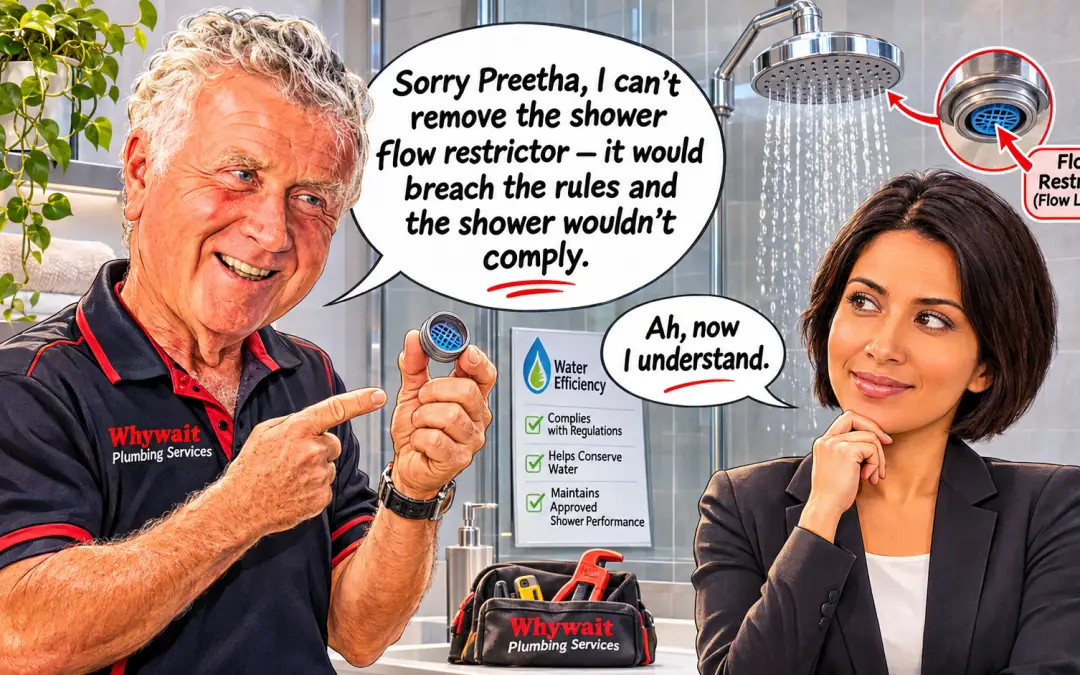
Your shower isn’t delivering enough water, and someone suggests removing the flow restrictor to increase the flow. It’s only a small plastic component inside the shower head, so removing it seems like a simple solution. Unfortunately, that apparently harmless modification can affect the fixture’s performance, reliability, warranty and compliance with Australian plumbing requirements.
At Whywait Plumbing, we’ve been solving plumbing problems on the Gold Coast since 1976, and we’ve learnt that the quickest fix isn’t necessarily the right one. We understand how frustrating a poorly performing shower can be, but removing a flow controller isn’t something we’ll do if it compromises the product’s certification or plumbing compliance.
Our responsibility is to identify why your shower isn’t working properly and recommend a solution that fixes the problem without creating another one.
💧 Flow Restrictors Do More Than Save Water
Most modern taps and shower heads contain a flow restrictor, flow controller or flow regulator designed to control the amount of water passing through the fixture. These components are often mistaken for simple water-saving devices, but they can play a much more important role in the engineering and operation of the product.
Manufacturers design shower heads, hoses, internal waterways and spray mechanisms to operate under particular flow and pressure conditions. In some designs, the flow controller helps maintain consistent water delivery and the intended spray pattern, while also protecting certain downstream components from excessive operating pressure.
Removing or modifying the controller changes the conditions under which the product was designed and tested. Depending on the fixture, that can reduce performance, affect reliability and potentially shorten its service life.
The important point is that the controller isn’t necessarily an unnecessary restriction that can simply be discarded. It may be a critical part of a carefully engineered plumbing product, and altering it can have consequences beyond simply increasing the amount of water that comes out.
⚖️ What Australian Plumbing Legislation Says About Flow Restrictors
Australia operates the national Water Efficiency Labelling and Standards (WELS) scheme, established under the Water Efficiency Labelling and Standards Act 2005. It regulates water-efficiency information and product registration for taps, shower heads, toilets, urinals and other specified products.
The familiar blue WELS labels identify the water efficiency of products tested and registered in particular configurations. If a shower head was registered with a specific flow controller, removing or modifying that component can mean the product no longer performs in accordance with its registered configuration.
The Australian Government’s WELS guidance makes it clear that taps and showers registered with flow controllers must be supplied and installed with those components in place. It also warns that removing them can compromise WaterMark compliance and breach plumbing regulations.
Here in Queensland, plumbing installations must also satisfy the applicable requirements of the Plumbing and Drainage Act 2018, Plumbing and Drainage Regulation 2019 and the Plumbing Code of Australia. Under the Plumbing Code’s standard Deemed-to-Satisfy requirements, ordinary shower, basin, kitchen sink and laundry trough outlets generally require a minimum 3-star WELS rating and must discharge no more than 9 litres per minute, subject to applicable exceptions.
There is a distinction between national product registration requirements and the legislation governing plumbing installations. However, both are important, and licensed plumbers have a responsibility to ensure the products they install and the work they undertake remain compliant.
A customer asking us to remove a flow restrictor doesn’t remove our professional responsibility to do the job correctly.
For more information on the importance of registered plumbing products, read our earlier article, What Are WELS Water Rating Labels on Taps and Toilets?.
🚿 Removing a Flow Restrictor Can Actually Damage Your Shower
One of the less understood consequences of removing a flow controller is the damage it can cause to the shower assembly itself. Manufacturers engineer shower heads, flexible hoses and internal components to operate within particular conditions, and increasing the flow beyond those conditions doesn’t necessarily improve performance.
An article published by Plumbing Connection, titled Go With the Flow: The Callback Risk of Tampering With Plumbing Fixtures, explains why this can become a problem.
PROVE Engineering director Terry Nguyen discusses how some manufacturers position flow controllers at the inlet of shower hoses to reduce the pressure experienced by components further downstream. Removing these controllers can expose components to conditions they were never designed to withstand, increasing the possibility of premature deterioration or failure.
The potential consequences include damaged shower hoses, leaking internal components, altered spray patterns and a shortened service life. In some cases, increasing the water flow can actually make the shower perform worse because its internal design relies on a particular flow rate to produce the intended spray.
This creates another problem for plumbers who remove restrictors merely to satisfy a customer. The customer might initially be pleased with the increased flow, only to experience a failed shower hose or handpiece later, resulting in an avoidable callback and additional expense.
What appeared to be a simple improvement can become an entirely unnecessary plumbing problem.
🔧 Poor Water Flow Doesn't Always Mean Poor Water Pressure
One of the most common misunderstandings surrounding shower performance is the difference between water pressure and water flow. Water pressure is the force available to move water through the plumbing system, while water flow is the actual volume delivered over a particular period.
Although pressure and flow are related, they aren’t interchangeable. A shower can have adequate supply pressure and still deliver disappointing flow because of blocked outlets, accumulated sediment, partially closed valves or restrictions elsewhere in the plumbing system.
Problems can also arise from faulty pressure-limiting valves, hot water equipment, mixer cartridges or shower heads that aren’t suited to the available pressure conditions. Removing the flow controller doesn’t identify which of these problems is responsible and may simply disguise the original fault.
Our article Water Pressure Gold Coast: Low and High Pressure Made Clear explains why pressure and flow vary between properties and how proper testing helps identify the cause of poor plumbing performance.
🔍 How Whywait Plumbing Investigates Poor Shower Performance
When customers complain about poor shower performance, our first priority is to identify the actual cause. Depending on the installation, that may involve measuring the available water pressure and flow, inspecting the shower head and tapware, and investigating restrictions within the hot and cold water supplies.
We also consider whether the problem affects one fixture or several, whether performance changes between hot and cold water, and whether the installed shower head is appropriate for the plumbing system. These details help us determine whether the problem is caused by a faulty component, restricted pipework or a product that’s simply unsuitable for the installation.
Sometimes the solution is straightforward, such as cleaning a blocked outlet, replacing a deteriorated shower head or repairing a faulty valve. In other cases, selecting a different WELS-registered shower head designed to perform effectively at the available pressure may provide a considerably better result.
Modern water-efficient shower heads can provide excellent performance without excessive water consumption. The important thing is choosing a suitable product and making sure the complete installation is operating as intended.
If your taps or shower fittings aren’t performing properly, our Gold Coast tap repair and replacement service explains how we diagnose and rectify these problems.
💰 More Water Doesn't Necessarily Mean a Better Shower
Removing a flow controller can significantly increase water consumption, particularly in households where several people use the shower every day. A shower delivering 9 litres per minute uses approximately 90 litres during a ten-minute shower, while increasing the flow to 15 litres per minute raises consumption to 150 litres over the same period.
That’s an additional 60 litres every shower, or approximately 21,900 extra litres annually for someone taking one ten-minute shower every day. When that additional water must be heated, the household also faces increased energy consumption and potentially higher utility bills.
However, water efficiency isn’t simply about restricting water to the lowest possible flow rate. A shower using less water per minute may not achieve genuine savings if someone needs considerably longer to shower satisfactorily, which is why manufacturers put so much effort into designing products that deliver an effective spray while using less water.
The objective should be a satisfying shower experience without wasting water or compromising the fixture’s performance. A properly selected 4-star or 5-star WELS-registered shower head can often provide an excellent balance of comfort and efficiency.
🛡️ Can Removing a Flow Restrictor Affect Your Warranty or Insurance?
Plumbing fixtures are designed, tested and certified to operate in particular configurations, and manufacturers provide warranties based on the product being installed and used appropriately. Removing or modifying a critical flow controller can affect the manufacturer’s warranty obligations, particularly when a subsequent failure is connected to that alteration.
There may also be insurance implications if a modified fixture fails and causes water damage. This doesn’t mean removing a flow controller automatically invalidates a household insurance policy, because coverage depends on the policy wording and circumstances of the claim. However, an insurer investigating significant water damage may consider whether the fixture was installed, modified or maintained in accordance with the manufacturer’s instructions and applicable requirements.
Our view is that these are unnecessary risks when better solutions are available. Customers should be confident their plumbing fixtures are installed correctly and operating as intended, without worrying that an unnecessary modification has compromised their reliability or certification.
👨🔧 Whywait Plumbing's Position: Fix the Problem, Don't Create Another One
There’s always a temptation in the service industry to give customers exactly what they ask for, even when the requested solution isn’t technically appropriate. In plumbing, that might mean removing a flow controller because someone wants more water from their shower, even though doing so could compromise the fixture.
The immediate result may appear satisfactory, but that doesn’t mean the underlying problem has been identified or corrected. If the shower subsequently fails, the customer is left with another problem, and the plumber may be responsible for returning to repair a failure that could have been avoided.
After fifty years in the plumbing industry, we believe professional responsibility involves more than simply carrying out instructions. Customers engage licensed plumbers because they expect us to understand the products we work with, recognise the applicable regulations, and recommend solutions based on sound technical judgement.
Sometimes that means explaining why a particular request isn’t appropriate and offering a better alternative. We believe that’s part of providing a professional service, rather than being difficult or unnecessarily restrictive.
Where an existing fixture can be repaired, cleaned or adjusted without compromising compliance, we’ll explain the options. If a different approved fixture will provide better performance, we’ll recommend one suitable for the installation, including appropriately registered, manufacturer-approved alternative flow-controller configurations where available.
What we won’t do is knowingly alter a certified fixture outside its approved configuration simply to achieve a temporary increase in water flow.
✅ What Should You Do If Your Shower Has Poor Water Flow?
If your shower isn’t performing satisfactorily, don’t automatically assume that removing the flow restrictor is the answer. Online videos and advice sometimes make these modifications appear harmless, but they rarely explain the product’s engineering, certification requirements or the consequences for components elsewhere in the assembly.
A licensed plumber can investigate the available pressure and flow, identify restrictions or faulty components, and determine whether the existing shower head is suitable for the installation. In many cases, the solution may be relatively straightforward, while in others a better-designed and properly registered replacement can provide the performance you’re looking for.
The important thing is to address the cause rather than modify the fixture and hope for the best.
💙 Fifty Years of Plumbing Has Taught Us Something Important
After fifty years in the plumbing industry, we’ve learnt that customers don’t really want flow restrictors removed. What they actually want is a shower that works properly, delivers a satisfying experience and doesn’t create problems later.
That’s a perfectly reasonable expectation, and it’s our responsibility to help achieve it. We believe customers deserve practical advice, technically sound workmanship and plumbing installations that comply with the applicable Australian requirements.
Doing the right thing sometimes means explaining why a shortcut isn’t the answer, particularly when it could compromise the performance or reliability of a product. That’s why Whywait Plumbing will always favour identifying the actual problem and recommending an appropriate solution rather than making modifications that could create unnecessary risks.
Choose Whywait and consider it done.
🚿 Need Better Shower Performance?
If your taps or shower heads aren’t delivering satisfactory performance, Whywait Plumbing can investigate the cause and recommend a practical, compliant solution. We’ve been looking after Gold Coast plumbing since 1976, and we still believe doing the job properly is the best way to provide lasting value for our customers.
❓ Frequently Asked Questions About Shower Flow Restrictors
Removing a flow controller can cause a shower head to no longer comply with its registered WELS configuration and applicable plumbing requirements. Whether a particular alteration constitutes an offence depends on the circumstances and legislation involved, but licensed plumbers must not knowingly undertake non-compliant plumbing work.
Removing a flow controller may increase the amount of water passing through the shower, but it doesn't increase the available water supply pressure. It may also change the spray pattern or expose internal components to operating conditions beyond those intended by the manufacturer, so a proper diagnosis is generally the better approach.
Yes, depending on the design of the shower assembly. Some manufacturers use flow controllers to protect hoses, handpieces and internal components from excessive pressure, while others rely on controlled flow to produce the intended spray pattern. Removing the controller can reduce performance, shorten the fixture's service life or contribute to premature failure.
The Plumbing Code of Australia's standard Deemed-to-Satisfy provisions generally require ordinary shower outlets to achieve a minimum 3-star WELS rating and discharge no more than 9 litres per minute. Specific exceptions and alternative compliance arrangements may apply, so a licensed plumber should assess the circumstances and determine what products and configurations are permitted.
Poor shower flow can result from blocked shower outlets, accumulated sediment, faulty mixer cartridges, restrictive valves or problems with the hot water supply. The shower's location, pipe sizing and suitability for the available water pressure can also influence performance, which is why testing is preferable to guessing.
Yes, in many cases satisfactory shower performance can be restored without compromising the fixture's design or certification. We can investigate water pressure and flow, check for restrictions, repair faulty components and recommend appropriate WELS-registered replacement fixtures when necessary. Our priority is to provide a shower that works properly while maintaining the applicable plumbing standards.