


24 Hours A Day
Low water pressure is exhausting.
Weak showers. Slow taps. Washing machines and dishwashers taking forever.
We’ll find the cause. Then we’ll fix it properly. No guesswork loops.
📞 Call 24/7: (07) 5580 4311
📩 Email: service@whywait.com.au
📅 Book online: /contact-whywait-plumbing/
If it’s urgent, call. Forms can be slower during emergencies.
Low Water Pressure Gold Coast: When Your Tap’s More Whimper Than Whoosh! Something has changed. Schedule your appointment now.
If one tap is weak, it’s usually a local blockage.
If the entire home is weak, it’s often due to a valve, PRV, leak, or restriction.
If neighbours are also weak, it may be the council supply-side at your meter.
Want the numbers and DIY tests? Read: Gold Coast Water Pressure
Small truth: pressure problems rarely “fix themselves”. They just… wait.
These checks save time. And money. Do what you can, then call us.
🔎 Is it one tap or every tap?
🌡️ Is hot weaker than cold?
🚿 Is the shower weak only when other taps run?
🧼 Clean the shower head and tap aerator (grit blocks them).
👂 Listen for water sounds when everything is “off”. That’s a clue.
If you’re unsure, don’t stress. Most people are guessing. We get it.
This is simple. It’s also genuinely useful.
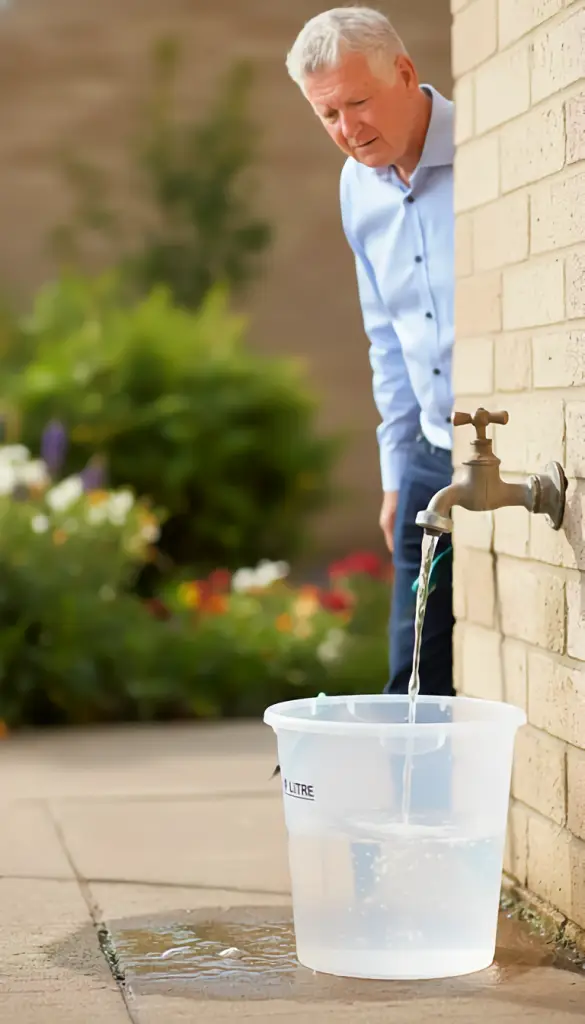
🪣 Use the outdoor tap closest to your meter
⏱️ Turn it on fully
✅ Time to fill a 9-litre bucket
⚠️ If it takes much longer than 30 seconds, something’s off
Use the tap closest to your meter. Turn it on fully. Time a 9L bucket fill.
If it takes much longer than 30 seconds, you may have low flow or low pressure.
Gold Coast pressure can vary a lot.
That’s why homes feel different, even a few streets apart.
📏 Target minimum at connection: 220 kPa
🌊 Network delivery from the council can vary up to: ~900 kPa
🧯 Inside homes should be controlled below: 500 kPa
If your home falls outside that comfort zone, problems accumulate.
Leaks. Burst hoses. Valve failures. And that one tap that never behaves.
Low pressure isn’t one problem. It’s a symptom.
Sometimes it’s a boring fix. Sometimes it’s a quiet warning.
🚿 Blocked shower head or tap aerator (grit is common)
🧼 Blocked strainer under a mixer or flex hose
🔧 Local isolation valve partly shut
🧱 Older fittings with internal restriction
Quick clue: One tap weak usually means a local restriction.
That’s the “good news” scenario.
This is where it gets serious.
🛡️ PRV failing, blocked, or set too low
🚰 Meter stop valve not fully open
🕳️ Concealed leak stealing flow (gardens, walls, slabs)
🌡️ Tempering valve restriction (hot side issues)
🧱 Pipe restriction (older pipe build-up, internal corrosion)
📐 Undersized pipework or poor layout (pressure drops under demand)
Truth: PRVs are a repeat offender in this regard. They’re meant to protect your home. But when they go bad, everything feels weak.
That pattern matters.
🌡️ Tempering valve issue
🔥 Hot water unit restriction
🧼 Hot-side strainers clogged
🛡️ PRV not behaving consistently (yes, it can show up like this)
That usually points to a flow restriction.
📉 PRV choking flow under demand
🚰 Partly closed valves
📐 Pipe sizing/layout issues
🕳️ Leaks reducing available flow
People waste months “trying stuff”. You don’t need that.
If your whole home is weak, or pressure swings feel random, your PRV is often the fastest place to check.
(And yes, we test pressure and flow properly. Not just vibes.)
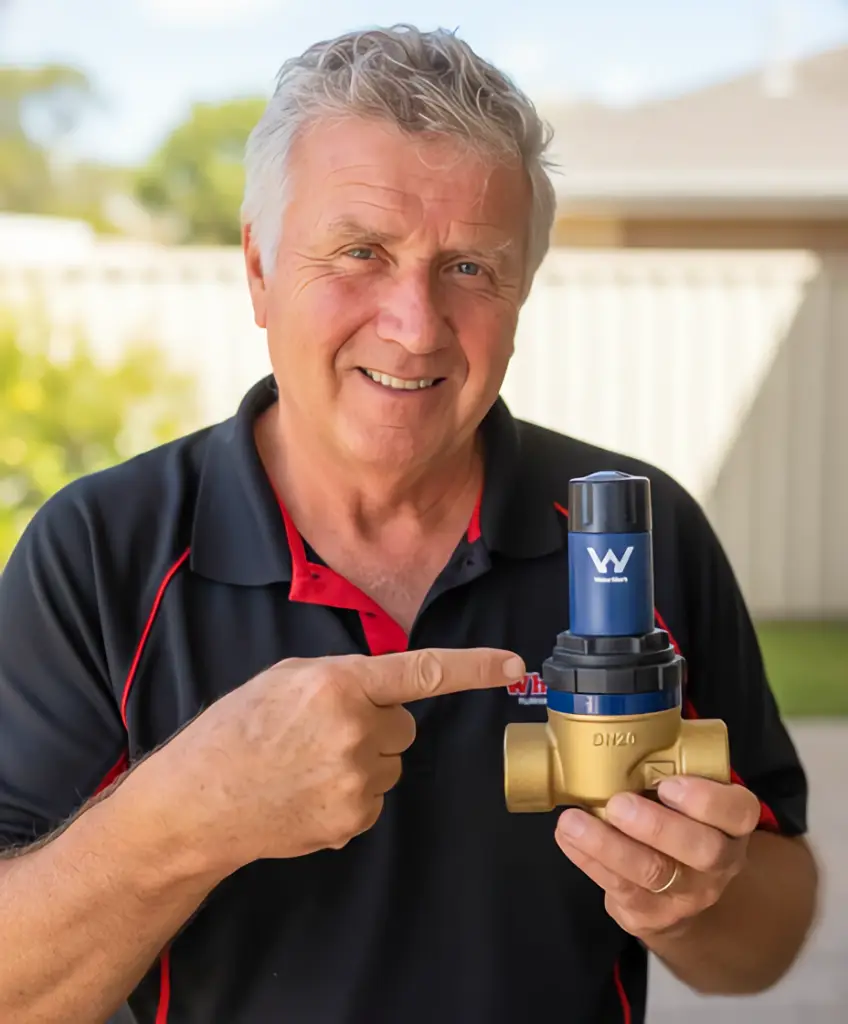
A Pressure Reducing Valve (PRV) controls the water pressure entering your home.
It takes the council supply pressure and makes it safer. And steadier.
Why does that matter?
Because high pressure quietly wrecks plumbing. Then it hits you at the worst time.
Australian Standards require pressure inside buildings to be limited.
In plain terms: static pressure at outlets should not exceed 500 kPa (except for fire services).
That’s why PRVs exist. It’s not a “nice to have”. It’s the law.
Most PRVs are set to a level around that threshold.
Sometimes lower is better for your home. It depends on where the 500 kPa is measured, but the rule of thumb is to measure it at the most distant outside hosetap.
A PRV sits where the mains enters the property. Usually near the council water meter.
Inside the PRV is a spring-loaded mechanism. It opens and closes automatically.
✅ When the incoming pressure is too high
💥 The valve restricts the flow area
💥 Pressure drops before it enters your plumbing
✅ When the incoming pressure is lower
💥 The valve stays more open
💥 It allows enough flow through
So it’s not just “on/off”. It constantly adjusts. Quietly doing its job.
Maintaining steady pressure helps your entire system function properly.
🧱 Prevents damage: Less stress on pipes, joints, hoses, and valves.
🚿 Keeps pressure consistent: Fewer annoying swings when the council supply changes.
🧺 Improves appliance performance: Hot water systems, toilets, dishwashers, and washing machines work better.
💥 Protects against surges: Sudden pressure spikes can damage plumbing fast. PRVs buffer that hit.
A PRV is basically a shock absorber for your plumbing.
Not perfect, but honestly, close.
Yes. And it’s common. A PRV can reduce pressure too much when it’s:
❌ Blocked with grit
❌ Failing internally
❌ Set too low
❌ Simply worn out
It can also “half fail”. Those are the most confusing ones.
Your PRV should be checked and serviced annually.
📉 Whole house feels weak
🔁 Pressure changes during the day
🚿 Shower drops when other taps run
🔥 Hot side is weak and inconsistent
💥 Pipes bang when taps shut
🧻 Toilet valves keep failing
🧯 Flex hoses fail more often than they should
If you’re seeing a few of these, don’t wait. It usually gets worse, not better.
A PRV protects your home from high mains pressure. It also smooths pressure swings. When it fails, it can cause weak showers and inconsistent flow.

It’s time to call us if:
📉 Whole house is weak
🔥 Hot is weak, cold is fine
🚿 Pressure drops when two taps run
🕵️ You suspect a leak
🧯 You’ve had repeated hose or valve failures
🧠 You want a clear answer, not another guess
We test properly — pressure + flow — then pinpoint the restriction. PRV issues, partially closed valves, leaks, blocked strainers, old pipework. We find it.
Stop guessing. The sooner it’s checked, the less damage it can cause.
If it’s urgent (burst hose, flooding, no water), call us now. We’re 24/7.
Usually a blocked aerator, strainer, or shower head. Sometimes a local isolation valve is partly shut.
Often, the tempering valve or hot water system restrictions. That pattern matters.
It can be due to flow restriction, pipe sizing, PRV issues, or valves not being fully open.
Yes. If it’s blocked, failing, or set too low.
Do the 9-litre bucket test.
Then compare “one tap” vs “whole home”.
 CALL NOW
